

Medieval names and surnames: 200+ real male, female and last names from the Middle Ages
215 names · Updated · By The Nomezo Editors · Save to Pinterest
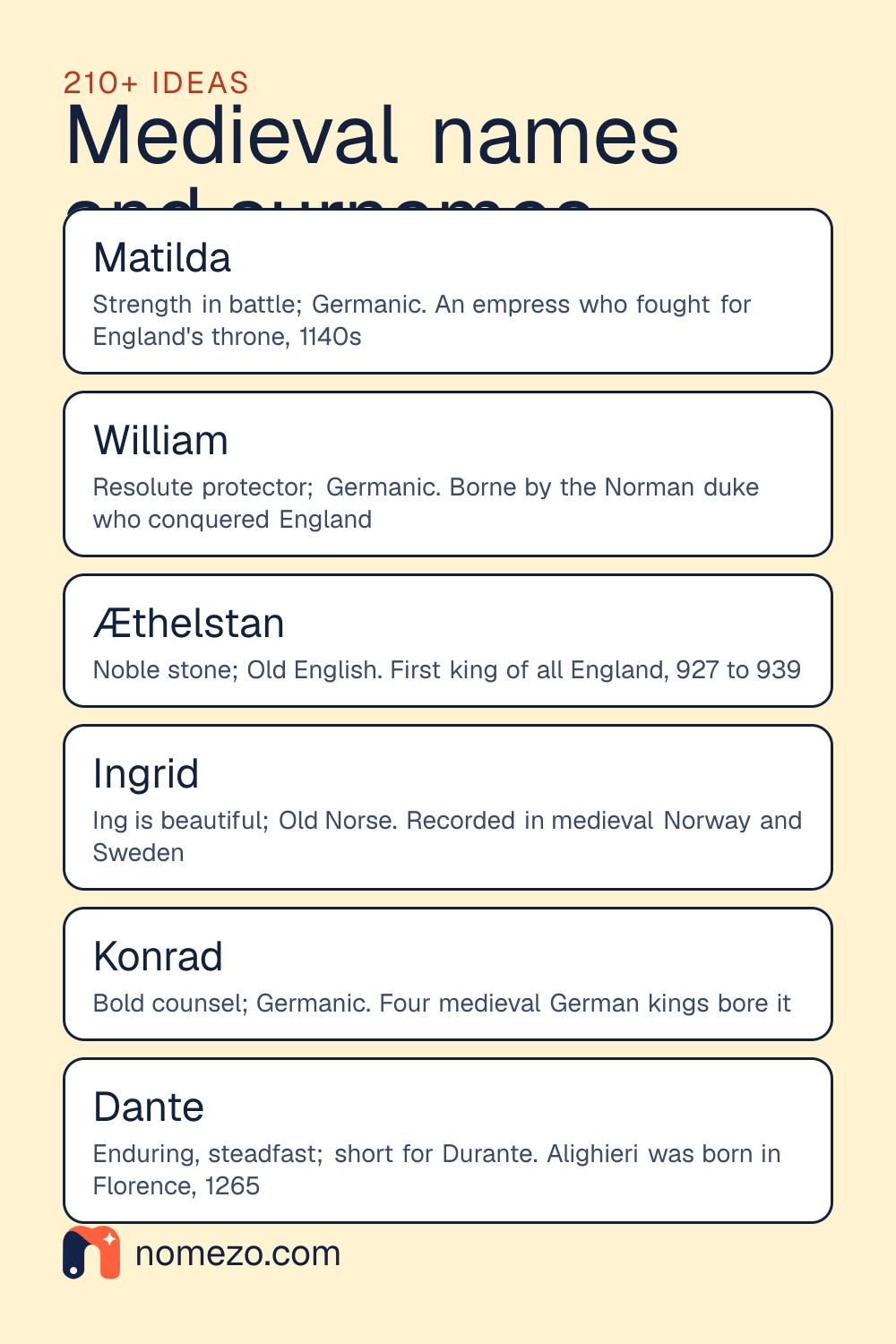
Medieval names are the names people really used in Europe between about 500 and 1500, such as Matilda, William and Æthelstan. Medieval last names grew later from trades, fathers' names, places and nicknames, like Fuller, Hobson and Underhill.
Below are 200+ real medieval names: male and female names recorded in England, France, Scandinavia, Germany, Italy, Spain, Wales, Ireland and Scotland, medieval women's names from across Europe, and medieval surnames from trades, fathers and places. Every given-name note gives the meaning, the language it comes from and a real person or period, so you can place each name in the right century and region; surname notes explain the trade, father, place or nickname behind them.
Can't decide? Shuffle 6 random picks
Berengaria
Bear and spear; Germanic. Navarrese princess who married Richard the Lionheart, 1191
Stoddard
Kept a stud of horses; Old English stod and hierde
Beatrice
Traveler, later read as blessed; Latin. Dante's Beatrice, 13th century
Margery
A pearl; Greek, a form of Margaret. Common in 14th-century England
Hild
Battle; Old English. Abbess of Whitby, host of the synod of 664
Sweyn
Boy, young man; Old Norse. Forkbeard seized England's crown in 1013
Find a medieval name on this page
Narrow 215 names by how common they were for US babies in 2025, by section, length or first letter, or search the meanings.
Medieval female names from England and France
The names Norman and later medieval families gave their daughters, from the 11th to the 15th century.
- Margery 6 in 2025: A pearl; Greek, a form of Margaret. Common in 14th-century England
- Cecily 137 in 2025: Blind; from Latin caecus, via Cecilia. Popular in 15th-century England
- Clemence 9 in 2025: Merciful, gentle; Latin. Used in France and England, 12th to 15th century
- Sybil 152 in 2025: A prophetess; Greek. Common among Norman noble families in the 1100s
- Rosamund 15 in 2025: Horse protection; Germanic. Borne by a celebrated 12th-century English beauty
- Adela 201 in 2025: Noble; Germanic. William the Conqueror's daughter, countess of Blois
- Lettice Under 5 in 2025: Joy, happiness; from Latin Laetitia. Used in later medieval England
- Melisende Under 5 in 2025: Brave and strong; Gothic, via Old French. Crusader queen of Jerusalem, 12th century
- Eleanor US #12: Meaning uncertain; Occitan, via Old French. Eleanor of Aquitaine, queen of France and then of England, 12th century
- Ellen 230 in 2025: A medieval English form of Helen; Greek. Fifth among women in a Yorkshire record of 1379
- Juliana US #256: Feminine of Julian; Latin. Among the 10 commonest women's names in a Yorkshire record of 1379
- Katherine US #186: Meaning debated; Greek. Saint Catherine of Alexandria made it a medieval favorite
Medieval male names from England and France
Norman and Plantagenet favorites, many of them carried to England in 1066.
- Fulk Under 5 in 2025: People; Germanic. A count of Anjou who became king of Jerusalem, 1131
- Bertrand Under 5 in 2025: Bright shield; Germanic, often confused with Bertram. Du Guesclin, a famed French knight of the 1300s
- Theobald Under 5 in 2025: Bold people; Germanic. The counts of Blois and Champagne used it often
- Tancred Under 5 in 2025: Thought and counsel; Germanic. A Norman prince of the First Crusade
- Piers 5 in 2025: Stone, rock; medieval form of Peter. Hero of Langland's 1370s poem
- Everard Under 5 in 2025: Brave boar; Germanic. Recorded in England and Flanders after 1066
- Adam US #101: Man, perhaps earth; Hebrew. Among the 10 commonest men's names in a Yorkshire record of 1379
- Geoffrey 31 in 2025: Peace, with a debated first part; Germanic via Norman French. Borne by Chaucer, 14th century
Anglo-Saxon and Old English names
Names used in England before the Norman Conquest of 1066. Most join two Old English words.
- Æthelstan Under 5 in 2025: Noble stone; Old English. First king of all England, 927 to 939
- Æthelred Under 5 in 2025: Noble counsel; Old English. The king nicknamed Unready, from unræd, poor counsel
- Leofric Under 5 in 2025: Dear ruler; Old English. Earl of Mercia and husband of Lady Godiva
- Godgifu Under 5 in 2025: Gift of God; Old English. The real name of Lady Godiva, 11th century
- Wulfstan Under 5 in 2025: Wolf stone; Old English. Archbishop of York and famed preacher, 1000s
- Godwin 15 in 2025: Friend of God; Old English. Earl of Wessex and father of Harold II
- Byrhtnoth Under 5 in 2025: Bright daring; Old English. Ealdorman who fell at the Battle of Maldon, 991
- Dunstan Under 5 in 2025: Dark stone; Old English. Archbishop of Canterbury and patron saint of smiths
- Æthelflæd Under 5 in 2025: Noble beauty; Old English. Lady of the Mercians, who fought the Danes
- Hild Under 5 in 2025: Battle; Old English. Abbess of Whitby, host of the synod of 664
- Wulfric 5 in 2025: Wolf ruler; Old English. Common in late Anglo-Saxon England
- Frideswide Under 5 in 2025: Strong peace; Old English. Patron saint of Oxford, 8th century
- Æthelthryth Under 5 in 2025: Noble strength; Old English. Founder of Ely Abbey, also called Etheldreda
Medieval Norse and Scandinavian names
Names from Viking-age and medieval Norway, Sweden, Denmark and Iceland.
- Gunnhild Under 5 in 2025: War and battle; Old Norse. The saga queen called Mother of Kings, wife of Erik Bloodaxe
- Olaf 5 in 2025: Ancestor's descendant; Old Norse. Norway's patron saint, killed in 1030
- Haakon Under 5 in 2025: High son; Old Norse. The Good, a 10th-century king of Norway
- Sweyn Under 5 in 2025: Boy, young man; Old Norse. Forkbeard seized England's crown in 1013
- Thorstein Under 5 in 2025: Thor's stone; Old Norse. A frequent name in Iceland's sagas
Medieval German names
Names of emperors, saints and poets in the Holy Roman Empire.
- Friedrich 29 in 2025: Peaceful ruler; Germanic. Barbarossa, Holy Roman emperor, 1155 to 1190
- Gertrud Under 5 in 2025: Spear strength; Germanic. The Great, a mystic nun of Helfta, 1200s
- Kunigunde Under 5 in 2025: Clan and war; Germanic. Empress and saint, wife of Henry II
- Ludwig 12 in 2025: Famous warrior; Germanic. Louis the Pious, Charlemagne's heir, bore its older form
- Gisela 37 in 2025: A pledge; Germanic. An 11th-century empress, wife of Conrad II
- Ulrich 17 in 2025: Heritage and power; Germanic. Bishop of Augsburg, first saint formally canonized, 993
- Siegfried 7 in 2025: Victory and peace; Germanic. Hero of the Nibelungenlied, written around 1200
- Rudolf Under 5 in 2025: Famous wolf; Germanic. First Habsburg king of Germany, elected 1273
Medieval Italian, Spanish and Portuguese names
Names from the city-states of Italy and the Christian kingdoms of Iberia.
- Francesco 145 in 2025: A Frenchman; Latin. Saint of Assisi, founder of the Franciscans, 1200s
- Giovanna US #878: God is gracious; Hebrew. A queen of Naples, 1343 to 1382
- Leonardo US #91: Brave lion; Germanic. Leonardo of Pisa, later called Fibonacci, who spread Hindu-Arabic numerals in Europe
- Cosimo 16 in 2025: Order, world; Greek. De' Medici, banker and ruler of Florence, 1400s
- Ramiro 201 in 2025: Perhaps famous counsel; Visigothic. Kings of Asturias, León and Aragon, 9th to 12th century
- Mafalda Under 5 in 2025: Strength in battle; Portuguese form of Matilda. Queens and princesses, 1100s and 1200s
Medieval Welsh, Irish and Scottish names
Names of the princes, saints and poets of medieval Wales, Ireland and Scotland.
- Angharad Under 5 in 2025: Much loved; Welsh. Recorded in medieval Welsh royal families
- Tangwystl Under 5 in 2025: Peace pledge; Welsh. Recorded in 13th-century Gwynedd
- Rhodri Under 5 in 2025: Wheel king; Welsh. The Great, who united much of Wales, 9th century
- Dafydd Under 5 in 2025: Beloved one; Welsh form of David. Ap Gwilym, a great 14th-century poet
- Hywel Under 5 in 2025: Eminent, conspicuous; Welsh. Dda, the Good, traditionally credited with Welsh law
- Cadwaladr Under 5 in 2025: Battle leader; Welsh. A 7th-century king of Gwynedd
- Áed Under 5 in 2025: Fire; Old Irish. Borne by many early medieval Irish kings
- Conall 19 in 2025: Wolf rule; Old Irish. A common name among early Irish kings
- Órlaith 6 in 2025: Golden princess; Irish. Borne by a sister of Brian Boru, 10th century
- Macbeth Under 5 in 2025: Son of life; Gaelic. A real king of Scots from 1040 to 1057
- Somerled Under 5 in 2025: Summer traveler; Old Norse. Norse-Gaelic king of Argyll and the Isles, died 1164
Saints' names popular in medieval Europe
Church names that spread through every kingdom and stayed common for centuries.
Medieval women's names from across Europe
Queens, abbesses, saints and countesses from Frankish Gaul to Anglo-Saxon England, with a woman who made each name famous.
- Radegund Under 5 in 2025: Counsel and war; Germanic. Frankish queen who founded an abbey at Poitiers
- Balthild Under 5 in 2025: Bold battle; Germanic. Anglo-Saxon-born queen of the Franks, 7th century
- Fredegund Under 5 in 2025: Peace and war; Germanic. A ruthless Frankish queen who died in 597
- Liutgard Under 5 in 2025: People and enclosure; Germanic. The last wife of Charlemagne, died 800
- Ermentrude Under 5 in 2025: Whole strength; Germanic. Queen of the Frankish king Charles the Bald
- Gerberga Under 5 in 2025: Spear protection; Germanic. A 10th-century queen of the West Franks
- Theophanu Under 5 in 2025: Appearance of God; Greek. Byzantine bride of Emperor Otto II, wed 972
- Ermengarde Under 5 in 2025: Whole enclosure; Germanic. Viscountess of Narbonne and patron of troubadours
- Berengaria Under 5 in 2025: Bear and spear; Germanic. Navarrese princess who married Richard the Lionheart, 1191
- Douce Under 5 in 2025: Sweet; Old French. Countess of Provence from 1112 to 1127
- Esclarmonde Under 5 in 2025: Clarity of the world; Occitan. A noblewoman of Foix and Cathar, died 1215
- Basilia Under 5 in 2025: Royal; Greek, a feminine form of Basil. Found in 12th-century English records
- Ealhswith Under 5 in 2025: Temple and strong; Old English. Wife of Alfred the Great, died 902
- Ælfthryth Under 5 in 2025: Elf strength; Old English. Queen of King Edgar and mother of Æthelred
- Eadgifu Under 5 in 2025: Rich gift; Old English. Queen of Edward the Elder and mother of two kings
- Wynflæd Under 5 in 2025: Joy and beauty; Old English. A noblewoman whose will survives from about 950
- Cyneburh Under 5 in 2025: Royal fortress; Old English. Mercian princess and saint, daughter of King Penda
- Eadburh Under 5 in 2025: Rich fortress; Old English. Daughter of King Offa and a queen of Wessex
- Ælfflæd Under 5 in 2025: Elf beauty; Old English. Abbess of Whitby, died 714
- Leofrun Under 5 in 2025: Dear secret; Old English. Abbess of Minster-in-Thanet, seized by Danish raiders in 1011
Medieval occupational surnames
From the 1200s on, English bynames for a person's trade hardened into family names. Each of these began as a medieval job.
- Fuller US surname #293: Cleaned and thickened woven wool by trampling it in water
- Carpenter US surname #247: A woodworker; from Anglo-Norman carpentier
- Wright US surname #37: A maker or craftsman, from Old English wyrhta
- Cartwright US surname #1,663: A maker of carts and wagons; Middle English
- Barker US surname #369: A tanner, who used tree bark, or a shepherd; Middle English
- Skinner US surname #637: Prepared animal hides for leather and fur; Middle English
- Glover US surname #512: Made or sold gloves; Middle English
- Sadler US surname #1,706: Made saddles for riders and packhorses; Middle English
- Webb US surname #158: A weaver of cloth; an Old English job name
- Draper US surname #1,492: A dealer in woolen cloth; from Old French drapier
- Chaloner US surname #155,270: Made blankets, named for the cloth town of Châlons in France
- Kempster US surname #70,918: A woman who combed wool; Middle English
- Pottinger US surname #20,018: Made or sold pottage, the thick stew of medieval meals, or perhaps an apothecary
- Leach US surname #797: A physician, from Old English læce
- Scrivener US surname #30,781: A professional scribe who wrote out legal documents
- Chamberlain US surname #1,243: Ran the private rooms of a lord's household
- Faulkner US surname #998: A falconer, who trained hawks for hunting
- Woodward US surname #978: A forest keeper, from Old English wudu and weard
- Warrender US surname #74,428: Kept a warren, a breeding ground for rabbits
- Coward US surname #6,172: A cowherd, from Middle English cou and herde. Today it reads as the insult
- Stoddard US surname #2,541: Kept a stud of horses; Old English stod and hierde
- Hogarth US surname #25,404: A hog herd; a northern English job name
- Gozzard: A goose herd; Middle English
Medieval last names from fathers' names
Many medieval last names mean son of. Pet forms like Hob, Wilkin and Hodge, the Norman fitz and the Welsh ap all show up here.
- Hobson US surname #2,139: Son of Hob, a medieval pet form of Robert
- Wilkins US surname #586: Son of Wilkin, little Will, from William
- Perkins US surname #235: Son of Perkin, little Peter
- Hodgson US surname #3,514: Son of Hodge, a medieval pet form of Roger
- Atkinson US surname #642: Son of Atkin, little Adam
- Watkins US surname #251: Son of Watkin, little Walter
- Gilbertson US surname #4,183: Son of Gilbert, a Norman favorite after 1066
- Fitzalan: Son of Alan; Norman French. Borne by the medieval earls of Arundel
- Fitzhugh US surname #10,057: Son of Hugh; Norman French fitz, from Latin filius
- Fitzherbert US surname #88,580: Son of Herbert; a Norman French family name
- Fitzwalter: Son of Walter; Robert of this family led the barons in 1215
- Pritchard US surname #1,550: From Welsh ap Richard, son of Richard
- Price US surname #97: From Welsh ap Rhys, son of Rhys
- Prosser US surname #4,508: From Welsh ap Rosser, son of Roger
- Penry US surname #32,948: From Welsh ap Henry, son of Henry
- Upjohn: From Welsh ap John, son of John
Medieval surnames from places and nicknames
Where you lived or what you were like: a house by the water, a head of red hair or a name for courage.
- Attwater: Lived beside a river, lake or pond; Middle English
- Bywater US surname #25,086: Lived beside a river or lake; Middle English
- Noakes US surname #18,622: From atten okes, at the oaks; Middle English
- Townsend US surname #492: Lived at the end of the town or village
- Underhill US surname #5,202: Lived at the foot of a hill; Middle English
- Attfield: Lived by the open field of the village
- Bythesea: Lived beside the sea; a rare English surname
- Westwood US surname #15,363: Lived by the west wood, or came from a place so named
- Bradshaw US surname #828: From Bradshaw in Lancashire or another English place of the name, meaning broad wood or thicket
- Whitehead US surname #800: A nickname for someone with white or fair hair
- Read US surname #2,150: Red-haired or ruddy; an Old English nickname
- Cruikshank US surname #18,972: Crooked leg; a Scottish nickname surname
- Doughty US surname #3,168: Brave, valiant; from Old English dyhtig
- Freeman US surname #159: A free-born man, not a serf bound to the manor
- Wiseman US surname #1,904: A nickname for a wise or learned person
- Goodchild US surname #25,020: A medieval nickname or given name meaning good child
- Strongitharm: Strong in the arm; a rare English nickname surname
How to pick the right name
Match the century
Æthelstan and Hild belong before 1066, while William, Alice and Joan fit the Norman and Plantagenet centuries. Pick a name from the period your story or family history covers.
Match the region
A knight from Wales would be Hywel or Dafydd, not Konrad. Choosing names from one section keeps a cast of characters believable.
Add a byname or an early surname
Most early medieval people had no fixed surname. They were known by a trade, a place or a father, like Walter the Smith, Ingrid of Bergen or Leif Erikson. In later medieval England these bynames hardened into surnames such as Fuller, Hobson and Underhill.
Check the meaning
Germanic names join two words, often wolf, battle, bright or noble. Read the note so the meaning suits the person who carries it.
Save this list for later
Pin it to a naming board, or tap the heart next to any name to keep it in your favorites on this device.
Medieval names: how common they really were, and which ones are back
By The Nomezo Editors · Updated October 25, 2026 · How we research names
Medieval England had remarkably few names. In one Yorkshire record of 1379, about one man in three was called John, and Alice, Agnes and Joan covered half the women. A believable medieval cast is full of Johns and Alices, with the rarer names for the characters you want readers to remember.
Many medieval names never left: Emma, Henry and William are all in the 2025 US top 10. The tag beside each name above shows how many US babies got it in 2025, and for surnames their rank in the 2020 Census.
- Step 1Pick the century and regionÆthelstan is pre-1066; William and Alice are Norman.
- Step 2Weigh common against rareA village of Johns and Alices sounds real; a village of Melisendes does not.
- Step 3Use the everyday formRecords say Johanna; people said Joan.
- Step 4Add a bynameA trade, a place or a father: Walter the Smith, Ingrid of Bergen.
How common was it? A Yorkshire record of 1379
| Men | Number | Women | Number |
|---|---|---|---|
| John | 555 | Alice | 400 |
| William | 339 | Agnes | 265 |
| Thomas | 209 | Joan | 237 |
| Robert | 174 | Emma | 131 |
| Richard | 89 | Ellen | 96 |
| Henry | 44 | Isabel | 95 |
| Adam | 43 | Margaret | 81 |
| Roger | 32 | Matilda | 65 |
Source: Talan Gwynek's counts of about 1,665 men (men) and 1,794 women (women) in a Latin record from Yorkshire, 1379, in the Medieval Names Archive. Counts are for the main spelling of each name.
Written in Latin, spoken in English
Medieval clerks wrote names in Latin, so records say Johanna, Alicia and Willelmus. Of the Latin forms in English poll-tax lists, the Medieval Names Archive warns that "few of these Latin forms would ever have been used in daily speech" (Medieval Names Archive). Use the everyday form: Joan, Alice, William.
| In the record | Said aloud |
|---|---|
| Johannes | John |
| Willelmus | William |
| Johanna | Joan |
| Alicia | Alice |
| Elena | Ellen |
| Matilda | Matilda, or Maud |
Maud was the medieval English and French form of Matilda (Behind the Name).
Medieval names today
- Coming back. From 2015 to 2025, Mabel rose from No. 578 to No. 201, Matilda from No. 537 to No. 365 and Otto from No. 544 to No. 277.
- Still rare. Agnes went to 246 US girls in 2025, Cecily to 137 and Philippa to 61.
- Surnames. Wright is No. 37 in the 2020 US Census and Price No. 97, while Bythesea, Strongitharm, Attwater and Fitzalan are not among the surnames held by 100 or more people (Census Bureau).
| Name | US rank in 2025 |
|---|---|
| Emma | #3 |
| Henry | #5, its highest ever |
| William | #9 |
| Eleanor | #12 |
| John | #23 |
| Lucy | #25 |
| Thomas | #34 |
| Alice | #65 |
Source: US Social Security Administration.
Medieval-sounding, but later
- Cedric was invented by Walter Scott for Ivanhoe in 1819, probably from Cerdic, a semi-legendary founder of Wessex (Behind the Name).
- Famous nicknames came later. Æthelred's "Unready" was first written down by Walter Map in the 1180s, about 170 years after his death, and "Fibonacci" first appears in 1506; in his lifetime Leonardo was "of Pisa" (Medievalists.net).
- Lady Godiva's ride was first recorded by Roger of Wendover in the early 13th century, about 150 years after Godgifu died (Medievalists.net).
Sources
- Talan Gwynek: Yorkshire masculine names from 1379
- Talan Gwynek: Yorkshire feminine names from 1379
- Medieval Names Archive: English names 1300 to 1450
- Medievalists.net: what 20 famous medieval names really mean (2026)
- Behind the Name: Cedric
- Behind the Name: Maud
- US Social Security Administration: baby names
- US Census Bureau: 2020 surnames
Frequently asked questions
What are some real medieval names?
Common real medieval names include William, Robert, John, Henry and Richard for men and Alice, Matilda, Agnes, Joan and Emma for women. Before 1066, English names such as Æthelstan, Edith and Wulfric were typical.
What were common medieval female names?
In a Yorkshire record of 1379, the commonest women's names were Alice, Agnes, Joan, Emma, Ellen, Isabel and Margaret, followed by Matilda, Juliana and Cecily. Elsewhere in Europe, medieval women bore names such as Radegund, Berengaria and Douce.
What were common medieval male names?
John, William, Thomas, Robert and Richard dominated later medieval England: in one Yorkshire record of 1379, about one man in three was named John. In Scandinavia, Olaf, Erik and Magnus were common, and in Germany Konrad, Otto and Friedrich.
Did medieval people have last names?
Usually not at first. Most people had a single given name plus a description such as a trade, a place or a father's name. Hereditary surnames became fixed in England during the 13th to 15th centuries.
What are some medieval surnames?
Medieval surnames came from trades (Fuller, Cartwright, Chaloner), fathers' names (Hobson, Fitzhugh, Pritchard), places (Attwater, Underhill) and nicknames (Read, Doughty). Most became fixed family names between the 13th and 15th centuries.
What was the most common medieval name?
John, by a long way in later medieval England: in a Yorkshire record of 1379, 555 of about 1,665 men were John. For women, Alice led with 400 of 1,794, ahead of Agnes and Joan.
Is Cedric a medieval name?
No. Walter Scott invented it for his novel Ivanhoe in 1819, probably from Cerdic, a semi-legendary founder of Wessex.
Which medieval names are popular today?
Emma (No. 3), Henry (No. 5), William (No. 9), Eleanor (No. 12) and John (No. 23) were all in the US top 25 in 2025. Mabel and Matilda are climbing, while Agnes and Cecily are still rare.
More fantasy & d&d and generators
- Viking names170 names. Real Viking names with Old Norse meanings: female and male names, famous Vikings, Viking surnames, names that honor Thor, Norse gods and bynames.
- Roman names212 names. Roman names with meanings: 200+ male and female names, Roman surnames (nomina and cognomina), emperors, gods and Greek and Roman mythology names.
- Biblical names184 names. Biblical names for boys and girls with meanings, languages and the book where each person appears, from Noah and Abigail to rare female biblical names.
- Gothic names188 names. Gothic names with real meanings: female and male goth names, names that start with E, names from gothic novels, plus invented goth names and titles.
- Vintage girl names159 names. Vintage girl names with meanings and origins: Victorian classics, 1920s and 1950s favorites, flower and gem names, cute nicknames and Puritan virtue names.
- Classic boy names156 names. Classic boy names with meanings: timeless favorites, biblical and royal names, Latin, Celtic and one-syllable classics, and classics from around the world.
- Elf names171 names. Elf names for female and male elves, wood elves, high elves, dark elves and Christmas elves, plus real elves from Norse myth and names that mean elf.
- Fantasy NamesFantasy names and fantasy name generators for D&D, novels and games: elves, dwarves, orcs, dragons, demons, kingdoms and towns.
- Fantasy name generatorCharacter names for 11 fantasy peoples, female or male, with family names and epithets.