

Japanese girl names: 170+ girls' and women's names with kanji and meanings
173 names · Updated · By The Nomezo Editors · Save to Pinterest
Japanese girl names such as Himari (陽葵, sun and hollyhock), Sakura (桜, cherry blossom) and Yui (結衣, tie and robe) take their meaning from the kanji used to write them, so one name can carry several meanings. Japanese women's names work the same way, from classic Michiko and Keiko to Hiromi and Satomi.
Below are 170+ real Japanese girl names, each with a common kanji spelling, Hepburn romaji and meaning. The list opens with the top names of 2025 from Meiji Yasuda Life Insurance's annual baby name survey, then covers modern names, flower and nature names, names about love and hope, classic names ending in -ko, Japanese women's names, short names, elegant traditional names and female Japanese last names to complete a full name. Macrons mark long vowels (Yōko, Kyōko) and are usually dropped in everyday English spelling.
Can't decide? Shuffle 6 random picks
Sakuraba (桜庭)
Cherry blossom garden; a spring-filled surname.
Hoshikawa (星川)
Star river; a sparkling, uncommon surname.
Kotone (琴音)
Sound of the koto, the Japanese zither.
Kiyomi (清美)
Pure beauty; a graceful classic.
Momoko (桃子)
Peach child; sweet and old-fashioned.
Mirai (未来)
Future; a hopeful name, also used for boys.
Popular Japanese girl names in 2025
The top girl names of 2025 in Meiji Yasuda Life Insurance's annual survey, which ranks names by kanji. Many kanji have more than one reading.
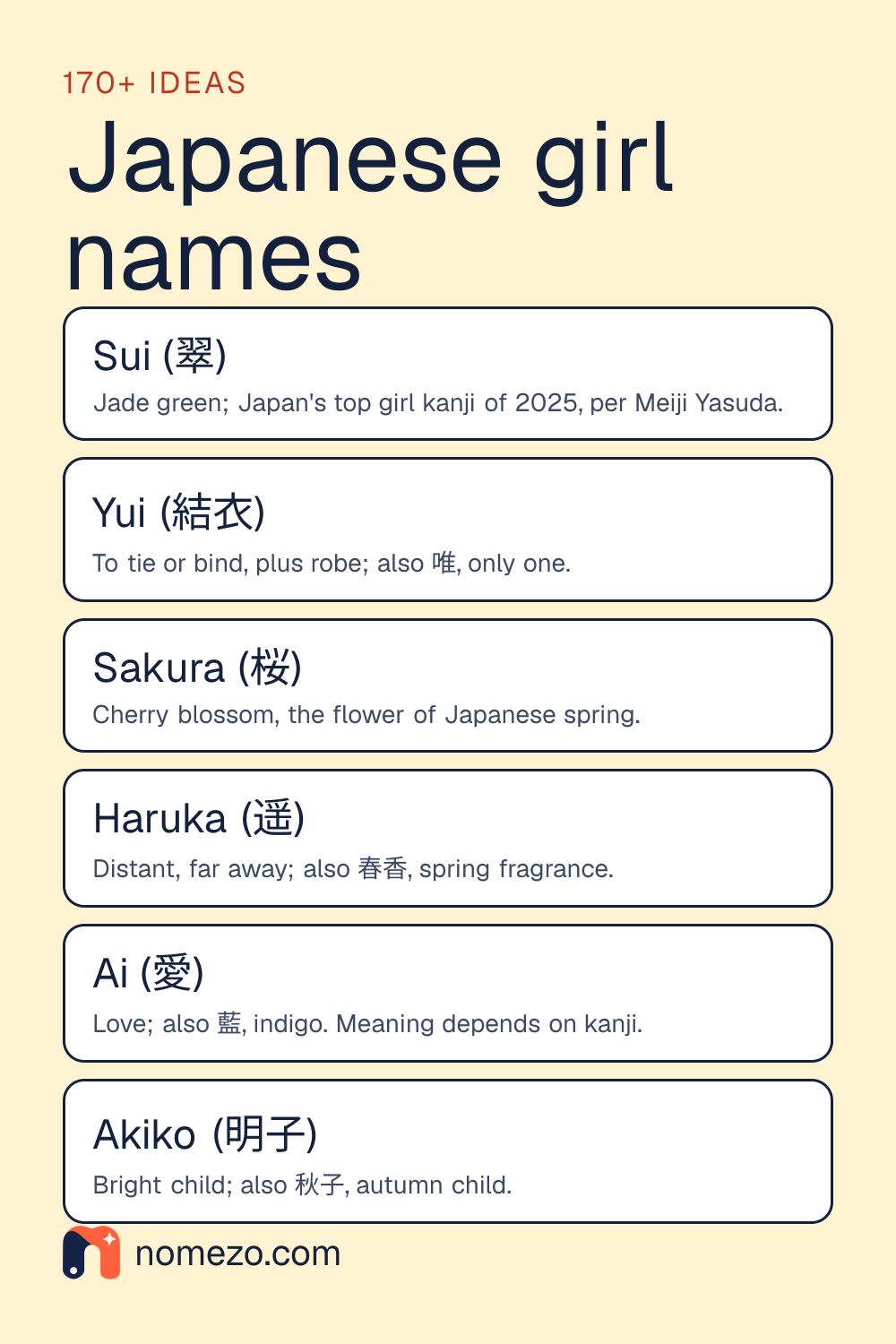
- Sui (翠): Jade green; Japan's top girl kanji of 2025, per Meiji Yasuda.
- Himari (陽葵): Sun and hollyhock, evoking a sunflower; ranked second in 2025.
- Tsumugi (紬): Pongee, a hand-spun silk; the top girl kanji of 2024.
- Mashiro (茉白): Jasmine and white; jumped from 19th to fourth in 2025.
- Rin (凛): Dignified and cool; ranked fifth in 2025. Also 鈴, bell.
- Hina (陽菜): Sun and greens; ranked sixth among girl kanji in 2025.
- Koharu (心陽): Heart and sun; written 小春, it means late autumn's mild days.
- Iroha (彩葉): Colorful leaves; also the classic poem that uses every kana.
- Uta (詩): Poem; also 歌, song. Tied for eighth in 2025.
- Kotoha (琴葉): Koto, the Japanese zither, plus leaf; tied tenth in 2025.
- Yuina (結菜): Tie and greens; the same kanji are also read Yuna.
- Ema (咲茉): Blossom and jasmine; the top girl name by sound in 2025.
Modern Japanese girl names
Fresh, light-sounding names that suit girls born today.
- Yui (結衣): To tie or bind, plus robe; also 唯, only one.
- Mio (澪): A water channel, or the wake left by a boat.
- Akari (灯): Lamplight; also 明里, bright village. Meaning depends on kanji.
- Ichika (一花): One flower; a cheerful, sunny modern choice.
- An (杏): Apricot; one of the shortest Japanese girl names.
- Hiyori (日和): Fine weather, a calm and sunny day.
- Yuzuki (結月): Tie and moon; a dreamy modern name.
- Mitsuki (美月): Beautiful moon; soft, dreamy and bright.
- Riko (莉子): Jasmine child; 莉 is the kanji for jasmine.
- Miu (美羽): Beautiful feather, or beautiful wings.
- Kanon (花音): Flower and sound; a musical modern name.
- Rinka (凛花): Dignified flower; crisp, bright and modern.
Japanese flower names for girls
Flowers are a favorite theme in Japanese girl names, and many use the kanji 花 (flower).
- Sakura (桜): Cherry blossom, the flower of Japanese spring.
- Momo (桃): Peach, the fruit and its pink spring blossom.
- Yuri (百合): Lily; the two kanji mean hundred and join.
- Sumire (菫): Violet, the small purple flower of spring.
- Tsubaki (椿): Camellia, a winter flower prized in Japanese gardens.
- Ayame (菖蒲): Iris, the purple flower of early summer.
- Kaede (楓): Maple, famous for red autumn leaves; also used for boys.
- Ran (蘭): Orchid; a short, elegant flower name.
- Kiku (菊): Chrysanthemum, the flower on Japan's imperial crest.
- Umeko (梅子): Plum child; borne by educator Tsuda, on the 5,000 yen note.
- Sayuri (小百合): Small lily; a gentle, graceful classic.
- Ayaka (彩花): Colorful flower; meaning depends on kanji.
- Hanae (花恵): Flower and blessing; meaning depends on kanji.
- Kaho (花穂): Flower and an ear of grain.
- Shion (紫苑): Aster, a lavender autumn flower; also used for boys.
- Akane (茜): Madder, a plant whose roots give a deep red dye.
- Aoi (葵): Hollyhock; also 碧, blue-green. Used for girls and boys.
- Kurumi (胡桃): Walnut; a sweet, rounded sound.
- Wakana (若菜): Young greens, the fresh herbs of early spring.
Japanese nature names: sky, sea and seasons
Names drawn from the seasons, weather, water and the old calendar months.
- Haruka (遥): Distant, far away; also 春香, spring fragrance.
- Natsuki (夏希): Summer and hope; used for girls and boys.
- Fuyumi (冬美): Winter beauty; a quiet seasonal classic.
- Chiaki (千秋): A thousand autumns; used for girls and boys.
- Miyuki (美雪): Beautiful snow; also 深雪, deep snow.
- Yukiko (雪子): Snow child; a wintry classic.
- Kasumi (霞): Mist or haze, as over spring hills.
- Shizuku (雫): A droplet, like a bead of dew or rain.
- Umi (海): The sea; short, simple and calm.
- Nanami (七海): Seven seas; meaning depends on kanji.
- Minami (美波): Beautiful waves; also 南, south.
- Nagisa (渚): The water's edge, a beach; used for girls and boys.
- Hotaru (蛍): Firefly, the glow of early summer nights.
- Hikari (光): Light, radiance; also used for boys.
- Midori (緑): Green, the color of fresh leaves.
- Mizuki (瑞希): Auspicious and hope; also 美月, beautiful moon.
- Satsuki (皐月): The fifth month of the old calendar; also an azalea.
- Yayoi (弥生): Old name for the third month; also an ancient era.
- Hazuki (葉月): Old name for the eighth month, the leaf month.
Japanese girl names meaning love, hope and kindness
Names built on kanji such as 愛 (love), 希 (hope), 恵 (blessing) and 優 (gentle).
- Ai (愛): Love; also 藍, indigo. Meaning depends on kanji.
- Aiko (愛子): Beloved child; also the name of the emperor's daughter.
- Manami (愛美): Love and beauty; meaning depends on kanji.
- Emi (恵美) US #882: Blessed beauty; also 笑, smile.
- Megumi (恵): Blessing, grace; a warm classic.
- Nozomi (希): Hope, wish; also written 望.
- Yume (夢): Dream; a short, wistful name.
- Kokoro (心): Heart, mind and spirit in one kanji.
- Yuka (優花): Gentle flower; meaning depends on kanji.
- Yūko (優子): Gentle or excellent child; a classic.
- Miyu (美優): Beautiful and gentle; meaning depends on kanji.
- Sachi (幸): Happiness and good fortune.
- Chihiro (千尋): A thousand fathoms; the heroine of Spirited Away.
- Hitomi (瞳): Pupil of the eye; a poetic word for eyes.
- Honoka (穂乃花): Rice ear and flower; the sound also means faint, subtle.
- Mirai (未来): Future; a hopeful name, also used for boys.
- Kiyomi (清美) US #765: Pure beauty; a graceful classic.
- Mai (舞): Dance; also 麻衣. Meaning depends on kanji.
Classic Japanese girl names ending in -ko
Ko (子) means child, and it is the classic ending for Japanese girl names. Many Japanese women born before the 1980s have a -ko name.
- Akiko (明子): Bright child; also 秋子, autumn child.
- Keiko (恵子): Blessed child; meaning depends on kanji.
- Yōko (洋子): Ocean child; also 陽子, sunny child.
- Hanako (花子): Flower child; a classic, storybook name.
- Michiko (美智子): Beautiful wise child; the name of Japan's Empress Emerita.
- Sachiko (幸子): Child of happiness; warm and old-fashioned.
- Naoko (直子): Honest child; meaning depends on kanji.
- Kyōko (京子): Capital child; also 恭子, respectful child.
- Tomoko (智子): Wise child; also 友子, friend child.
- Junko (純子): Pure child; also 順子, obedient child.
- Masako (雅子): Elegant child; the name of Japan's current empress.
- Reiko (玲子): Child of tinkling jade; also 麗子, lovely child.
- Haruko (春子): Spring child; also 晴子, clear-sky child.
- Kazuko (和子): Child of harmony or peace.
- Fumiko (文子): Child of letters and writing.
- Emiko (恵美子): Blessed beautiful child; also 笑子, smiling child.
- Mariko (真理子): Child of truth and reason.
- Kumiko (久美子): A long-lasting, beautiful child.
- Momoko (桃子): Peach child; sweet and old-fashioned.
- Ayako (綾子): Child of patterned silk; meaning depends on kanji.
- Chiyoko (千代子): Child of a thousand generations.
- Etsuko (悦子): Joyful child; meaning depends on kanji.
- Hiroko (裕子): Abundant child; also 博子, learned child.
- Noriko (典子): Child of rules or ceremony; also 紀子. Meaning depends on kanji.
- Yoshiko (良子): Good child; also 佳子, beautiful child.
- Setsuko (節子): Child of moderation; 節 also means season or festival.
- Takako (貴子): Noble, precious child; borne by Doi, Japan's first woman Speaker.
- Nobuko (信子): Faithful child, from 信, trust or belief.
- Atsuko (敦子): Sincere, kind child; meaning depends on kanji.
- Sumiko (澄子): Clear, pure child, like still water.
- Hideko (秀子): Excellent child; borne by film star Takamine.
- Kiyoko (清子): Pure, clean child; a gentle classic.
Japanese women's names
Grown-up classics carried by many Japanese women today. Names ending in -mi often use 美 (beauty), and names ending in -e often use 恵 (blessing) or 江 (inlet).
- Hiromi (裕美): Abundant beauty; also 弘美. Used for boys too.
- Tomomi (智美): Wisdom and beauty; meaning depends on kanji.
- Mami (真美): True beauty; also 麻美, hemp and beauty.
- Asami (朝美): Morning beauty; also 麻美. Meaning depends on kanji.
- Masami (雅美): Elegant beauty; also used for boys as 正美.
- Satomi (里美): Village beauty; also 聡美, wise beauty.
- Kazumi (和美): Harmony and beauty; also used for boys.
- Misato (美里): Beautiful village; soft and old-fashioned.
- Miho (美穂): Beautiful ear of grain, a wish for plenty.
- Mutsumi (睦美): Friendly harmony and beauty; 睦 means close and intimate.
- Rumi (留美): Lasting beauty; 留 means to stay or keep.
- Kazue (和恵): Harmony and blessing; a quiet classic.
- Rie (理恵): Reason and blessing. Say REE-eh.
- Shizue (静江): Quiet inlet, like a calm bay.
- Yoshie (良恵): Good blessing; meaning depends on kanji.
- Michiru (満): To be full or fulfilled; a bright, hopeful name.
Short and cute Japanese girl names
One- and two-syllable names that are easy to say in any language.
- Saki (咲): To bloom; also 早紀. Meaning depends on kanji.
- Moe (萌): Budding, sprouting. Say MO-eh.
- Suzu (鈴): Bell; a bright, chiming sound.
- Nagi (凪): A calm, windless sea; used for girls and boys.
- Mayu (繭): Cocoon; also 真由. Meaning depends on kanji.
- Rei (玲): Tinkling of jade; also used for boys.
- Nao (直): Honest, straightforward; used for girls and boys.
- Kei (恵): Blessing; also 慧, wisdom. Used for both genders.
- Yuzu (柚): The fragrant Japanese citron of winter baths.
- Tamaki (環): Ring or bracelet; used for girls and boys.
- Mika (美香): Beautiful fragrance; meaning depends on kanji.
Elegant and traditional Japanese girl names
Graceful names with ties to Japanese poetry, music and history.
- Chiyo (千代): A thousand generations; a wish for long life.
- Shizuka (静香): Quiet fragrance; the word itself also means quiet.
- Kaori (香織): Fragrance; the kanji mean scent and weave.
- Shiori (栞): Bookmark, or a guide; a literary name.
- Misaki (美咲): Beautiful blossom; also 岬, cape.
- Asuka (飛鳥): Flying bird; also the name of an early historical era.
- Kotone (琴音): Sound of the koto, the Japanese zither.
- Kanade (奏): To play music; used for girls and boys.
- Miyabi (雅): Elegance and courtly refinement; used for both genders.
- Sayaka (清香): Clear fragrance; the sound also means clear and bright.
- Ayane (綾音): Patterned silk and sound; meaning depends on kanji.
- Tomoe (巴): A swirling comma crest; also the name of a famed woman warrior.
- Miyako (都): Capital city; once a poetic word for Kyoto.
- Amane (天音): Sound of heaven; meaning depends on kanji.
- Kozue (梢): Treetop, the very tips of the branches.
Female Japanese last names
Japanese surnames are the same for women and men, so any family name works for a girl. These real surnames have flower, moon, star and water meanings that pair well with the names above.
- Mochizuki (望月): Full moon; a common surname with a poetic meaning.
- Akizuki (秋月): Autumn moon; also the name of a samurai clan.
- Hoshikawa (星川): Star river; a sparkling, uncommon surname.
- Hanamura (花村): Flower village; sweet beside a short given name.
- Sakuraba (桜庭): Cherry blossom garden; a spring-filled surname.
- Fujisaki (藤崎): Wisteria cape; 藤 is the purple wisteria vine.
- Fujikawa (藤川): Wisteria river; graceful and easy to say.
- Yanagisawa (柳沢): Willow marsh; a long, flowing surname.
- Umemura (梅村): Plum village; 梅 is the early-spring plum blossom.
- Amamiya (雨宮): Rain shrine; a soft, misty-sounding surname.
- Mizushima (水島): Water island; clean and calm.
- Momose (百瀬): A hundred rapids, the shallows of a mountain stream.
- Shirakawa (白川): White river; also the name of a medieval emperor.
- Midorikawa (緑川): Green river; fresh and leafy.
- Shiraishi (白石): White stone; a common, elegant surname.
- Hayakawa (早川): Swift river; borne by silent-film star Sessue.
- Saotome (早乙女): A young woman planting rice; a surname with a feminine meaning.
- Natsume (夏目): Summer and eye; the real surname of novelist Sōseki.
How to pick the right name
Choose the kanji, not just the sound
The same name can mean flower or splendor depending on its characters. Decide on the kanji first, then make sure the meaning reads the way you want.
Mind the long vowels
Macrons mark long vowels, so Yōko is said with a long o. English spelling usually drops the macron, which can change how people say the name.
Say it with the family name
Japanese order puts the family name first. Try the full name in both orders and listen for a smooth rhythm.
Ask a native speaker
Some kanji combinations read oddly or carry a second meaning. A quick check with a native speaker avoids surprises.
Save this list for later
Pin it to a naming board, or tap the heart next to any name to keep it in your favorites on this device.
Frequently asked questions
What is the most popular Japanese girl name?
In Meiji Yasuda Life Insurance's 2025 survey, the top girl name by kanji was 翠 (Sui or Midori), followed by 陽葵 (Himari) and 紬 (Tsumugi). By sound, Ema ranked first.
What is a cute Japanese girl name?
Short names with soft sounds feel cute in Japanese, such as Momo (peach), Suzu (bell), Mio (water channel), Miu (beautiful feather) and Hina (sun and greens).
What does -ko mean in Japanese girl names?
Ko (子) means child, so Hanako is flower child and Akiko is bright child. It is the classic ending for Japanese girl names.
What are common Japanese women's names?
Keiko, Yōko, Kazuko, Sachiko and Kumiko were among the most popular names for girls born in the mid-1900s, so many Japanese women carry them today, along with names like Hiromi and Satomi.
Do Japanese women have different last names?
No. Japanese surnames are the same for women and men, so any family name, such as Mochizuki (full moon), works as a female Japanese last name. By law a married couple shares one surname, and most wives take the husband's.
More by origin and generators
- Japanese boy names173 names. Japanese boy names and male names with kanji and meanings: 2025 favorites like Minato, unique picks, common Japanese men's names and samurai names.
- Japanese last names181 names. Japanese last names with kanji and meanings, from Satō and Suzuki to river and rice field names, rare riddle surnames and last names with dark meanings.
- Anime girl names141 names. Anime girl names that are real Japanese given names, from Sakura to Tsumugi, with the kanji, the meaning and pronunciation tips. 140+ cute and cool picks.
- Korean girl names121 names. Korean girl names in Hangul with hanja meanings: cute Korean girl names like Bom and Dami, 2025 favorites, and native Korean names like Haneul and Byeol.
- Flower names for girls125 names. Flower names for girls: 120+ girl and female flower names like Lily, Daisy, Sakura and Rózsa, plus boy and unisex picks and names that mean rose or lotus.
- Unique girl names136 names. Unique girl names with real meanings: 130+ rare baby girl names and unique nicknames for girls, from Irish, Greek, Hebrew, Norse, Persian and more.
- Japanese names that mean shadow100 names. Japanese names and words that mean shadow, darkness and night, like kage (影) and yami (闇), with kanji, romaji and meaning, plus invented character names.
- Names by OriginNames by origin and culture: Japanese, French, Irish, Italian, Spanish, Norse, Greek, Arabic and more, with meanings and pronunciation.
- Random name generatorReal full names from 24 cultures, each with its meaning and origin.