

Japanese last names: 180+ surnames and meanings, with kanji
181 names · Updated · By The Nomezo Editors · Save to Pinterest
The most common Japanese last names are Satō (佐藤), Suzuki (鈴木) and Takahashi (高橋), and most Japanese surnames describe a place, like Yamamoto, base of the mountain. Every name below comes with its meaning and its kanji, the way the last name is written in Japanese.
Below are 180+ real Japanese surnames and their meanings, each with kanji and Hepburn romaji. They are grouped into the most common names, wisteria names tied to the Fujiwara clan, mountain, rice field, water, tree and village names, famous samurai clan surnames, last names with dark meanings, rare names with riddle-like readings and Okinawan surnames. Macrons mark long vowels (Satō, Itō); everyday English spelling usually drops them (Sato, Ito).
Can't decide? Shuffle 6 random picks
Tsuyuri (栗花落)
Chestnut blossoms fall, the start of the rainy season; a Kobe family.
Hagiwara (萩原)
Plain of bush clover.
Hasegawa (長谷川)
River of the long valley.
Ōno (大野)
A big, open field; spelled Ono in English, like 小野.
Kawaguchi (川口)
Mouth of the river.
Higashi (東)
East; a short direction surname.
Find a Japanese surname on this page
Narrow 181 surnames by how common they are in the 2020 US Census, by section, length or first letter, or search the meanings.
Most common Japanese last names
Satō, Suzuki, Takahashi and Tanaka lead every survey; Itō and Watanabe swap fifth place depending on the source. The rest are also among Japan's most common surnames.
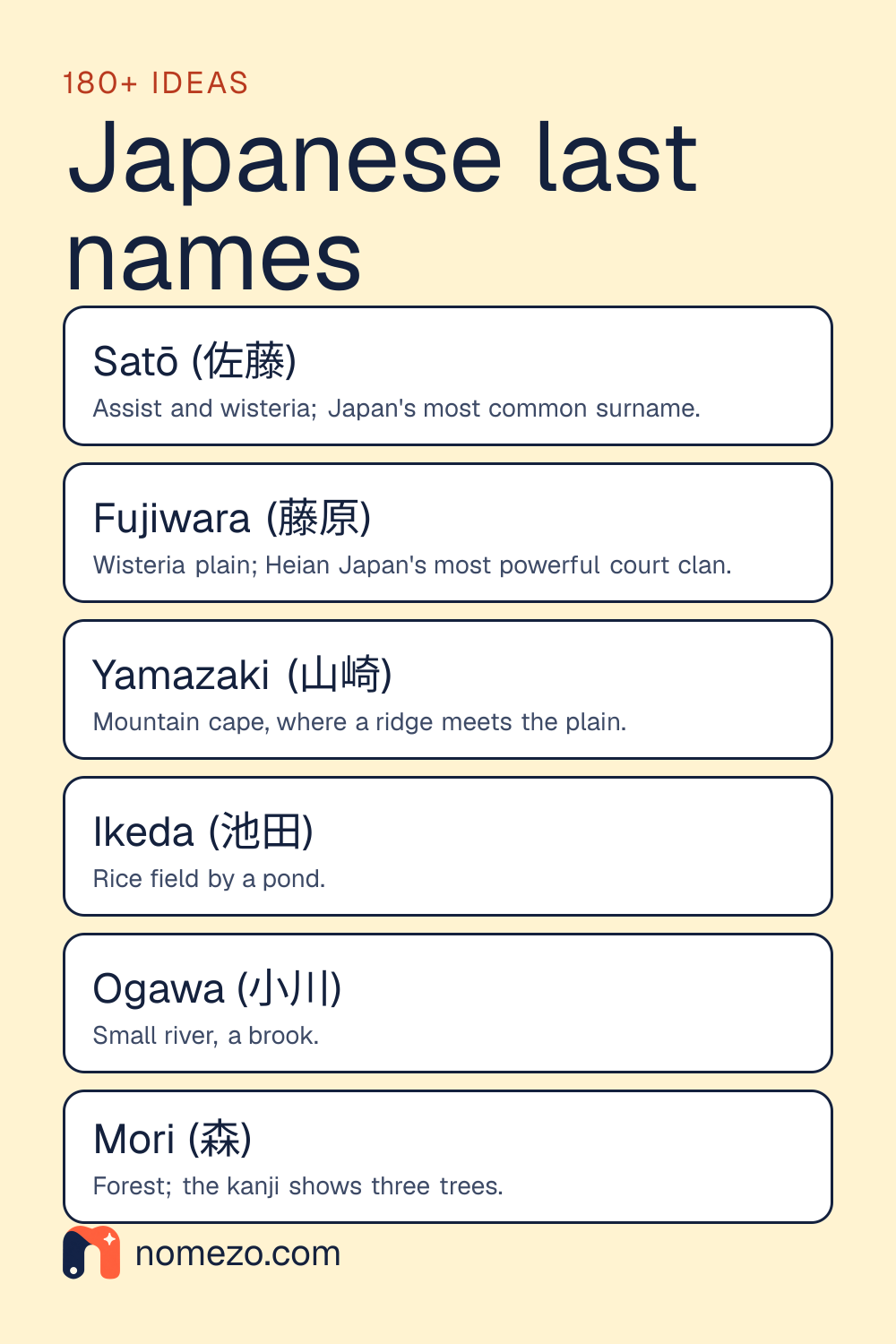
- Satō (佐藤) 6,266 in the US: Assist and wisteria; Japan's most common surname.
- Suzuki (鈴木) 5,253 in the US: Bell and tree; the second most common surname.
- Takahashi (高橋) 4,818 in the US: High bridge; the third most common in Japan.
- Tanaka (田中) 7,304 in the US: Middle of the rice field; fourth most common.
- Itō (伊藤) 4,282 in the US: Ise and wisteria; by tradition, Fujiwara of Ise province; fifth or sixth most common.
- Watanabe (渡辺) 5,949 in the US: Area by the ferry crossing; from a port in old Osaka.
- Yamamoto (山本) 6,961 in the US: Base or foot of the mountain.
- Nakamura (中村) 7,414 in the US: Middle village; one of the ten most common.
- Kobayashi (小林) 3,789 in the US: Small forest or grove.
- Katō (加藤) 4,515 in the US: Add and wisteria; Fujiwara who served in Kaga province.
- Yoshida (吉田) 4,048 in the US: Good fortune and rice field.
- Yamada (山田) 4,393 in the US: Mountain rice field; used in Japan's sample name.
- Sasaki (佐々木) 2,857 in the US: Assist, repeated, and tree; tied to an estate in old Ōmi.
- Yamaguchi (山口) 2,776 in the US: Mountain mouth, the entrance to a mountain.
- Matsumoto (松本) 4,259 in the US: At the base of the pine tree.
- Inoue (井上) 1,447 in the US: Above the well, near a spring.
- Kimura (木村) 3,599 in the US: Village among the trees.
- Hayashi (林) 2,857 in the US: Forest or grove; the kanji shows two trees.
- Saitō (斎藤) 3,569 in the US: Purification and wisteria; Fujiwara who served the Saigū office.
- Shimizu (清水) 2,490 in the US: Clear water, a pure spring.
Wisteria surnames and the Fujiwara clan
藤 means wisteria and is read tō, dō or fuji. Many -tō and -dō names are traditionally traced to the Fujiwara clan, pairing 藤 with an office or place, though many families have no proven link.
- Fujiwara (藤原) 1,007 in the US: Wisteria plain; Heian Japan's most powerful court clan.
- Kondō (近藤) 1,380 in the US: Near and wisteria; Fujiwara officials of Ōmi province.
- Endō (遠藤) 1,581 in the US: Far and wisteria; Fujiwara governors of Tōtōmi province.
- Kudō (工藤) 475 in the US: Craft and wisteria; Fujiwara of the court carpentry bureau.
- Mutō (武藤) 1,244 in the US: Martial and wisteria; Fujiwara of the palace warrior office.
- Naitō (内藤) 736 in the US: Inner and wisteria; Fujiwara who were palace attendants.
- Andō (安藤) 1,203 in the US: Peace and wisteria; traced to the Abe clan or Aki province.
- Gotō (後藤) 1,715 in the US: After and wisteria; by tradition, Fujiwara who governed Higo province.
- Fujita (藤田) 1,613 in the US: Rice field of wisteria.
- Fujii (藤井) 2,035 in the US: Well beside the wisteria.
- Fujimoto (藤本) 2,462 in the US: At the base of the wisteria.
- Fujisawa (藤沢) 152 in the US: Wisteria marsh; also a city near Tokyo.
- Fujimura (藤村) 333 in the US: Village of the wisteria.
- Fujioka (藤岡) 718 in the US: Hill of wisteria blossoms.
- Shindō (進藤) 228 in the US: Advance and wisteria; a classic -tō name.
Mountain, hill and slope surnames
山 (yama, mountain), 岡 (oka, hill) and 坂 (saka, slope) appear in many surnames that once described where a family lived.
- Yamazaki (山崎) 710 in the US: Mountain cape, where a ridge meets the plain.
- Yamashita (山下) 2,325 in the US: Below the mountain, at its foot.
- Nakayama (中山) 1,378 in the US: Middle mountain, or among the mountains.
- Koyama (小山) 809 in the US: Small mountain, a hill.
- Maruyama (丸山) 804 in the US: Round, gently sloping mountain.
- Akiyama (秋山) 900 in the US: Autumn mountain; a seasonal, scenic name.
- Aoyama (青山) 383 in the US: Green mountain; also a stylish Tokyo district.
- Sugiyama (杉山) 807 in the US: Mountain of Japanese cedar.
- Katayama (片山) 689 in the US: One side of a mountain, a hillside.
- Uchiyama (内山) 375 in the US: Inner mountain, deep in the hills.
- Yokoyama (横山) 1,226 in the US: Beside the mountain, along its flank.
- Nishiyama (西山) 515 in the US: The mountain to the west.
- Takayama (高山) 636 in the US: Tall mountain; also a historic town in Gifu.
- Matsuyama (松山) 390 in the US: Pine mountain; also a city in Ehime.
- Okamoto (岡本) 2,237 in the US: At the base of the hill.
- Okada (岡田) 1,855 in the US: Rice field on a hill.
- Okazaki (岡崎) 924 in the US: Hill cape; also a city in Aichi.
- Sakamoto (坂本) 2,571 in the US: At the foot of the slope.
Rice field surnames
田 (ta or da) means rice field. These names often described where a family's fields lay.
- Ikeda (池田) 2,453 in the US: Rice field by a pond.
- Maeda (前田) 2,148 in the US: The rice field in front.
- Ishida (石田) 1,286 in the US: Rice field among the stones.
- Harada (原田) 1,881 in the US: Rice field on the plain.
- Shibata (柴田) 1,191 in the US: Rice field by the brushwood.
- Ueda (上田) 977 in the US: Upper rice field, on higher ground.
- Murata (村田) 1,244 in the US: Rice field by the village.
- Kubota (久保田) 1,204 in the US: Rice field in a hollow.
- Takada (高田) 348 in the US: Rice field on high ground.
- Nishida (西田) 1,079 in the US: The rice field to the west.
- Ōta (太田) 1,738 in the US: Big, broad rice field.
- Morita (森田) 1,705 in the US: Rice field by the forest.
- Uchida (内田) 1,122 in the US: Inner rice field; a common family name.
- Honda (本田) 1,844 in the US: Main or original rice field.
- Toyoda (豊田) 204 in the US: Bountiful rice field; the family behind Toyota.
- Matsuda (松田) 1,871 in the US: Rice field by the pines.
- Hamada (浜田) 1,684 in the US: Rice field by the beach.
- Shimada (島田) 963 in the US: Rice field on an island.
- Sawada (沢田) 423 in the US: Rice field by a marsh or stream.
- Iwata (岩田) 813 in the US: Rice field among the rocks.
River, island and water surnames
Rivers (川, kawa), wells (井, i), islands (島, shima) and bays (浦, ura) gave many families their names.
- Ogawa (小川) 1,792 in the US: Small river, a brook.
- Ishikawa (石川) 1,691 in the US: Stony river; also a prefecture.
- Hasegawa (長谷川) 1,565 in the US: River of the long valley.
- Nakagawa (中川) 2,270 in the US: The river in the middle.
- Kitagawa (北川) 693 in the US: The river to the north.
- Hosokawa (細川) 200 in the US: Narrow river; a famous samurai clan.
- Kawaguchi (川口) 970 in the US: Mouth of the river.
- Kawasaki (川崎) 1,214 in the US: River cape; also a city near Tokyo.
- Kawamura (川村) 1,330 in the US: Village by the river.
- Kawakami (川上) 1,161 in the US: Upstream, the upper river.
- Ishii (石井) 1,784 in the US: Stone well; a common family name.
- Sakurai (桜井) 595 in the US: Well by the cherry tree.
- Miura (三浦) 1,298 in the US: Three bays; a powerful clan of the Kamakura era.
- Matsuura (松浦) 893 in the US: Bay lined with pines.
- Ōshima (大島) 624 in the US: Big island; also the name of many islands.
- Nakajima (中島) 774 in the US: Middle island; also read Nakashima.
- Kojima (小島) 969 in the US: Small island or islet.
- Mizuno (水野) 727 in the US: Field near the water.
- Hirose (広瀬) 490 in the US: Wide rapids or shallows.
- Mizutani (水谷) 344 in the US: Valley with water running through.
- Nagai (永井) 832 in the US: Eternal well; also 長井, long well.
Tree, flower and forest surnames
Pine (松, matsu), cedar (杉, sugi), cherry (桜, sakura) and bamboo (竹, take) are favorite surname kanji.
- Mori (森) 3,968 in the US: Forest; the kanji shows three trees.
- Matsui (松井) 1,037 in the US: Well beside the pines.
- Sugimoto (杉本) 901 in the US: At the base of the cedar.
- Kikuchi (菊池) 930 in the US: Chrysanthemum pond; also written 菊地.
- Aoki (青木) 1,802 in the US: A green, evergreen tree.
- Takeuchi (竹内) 1,370 in the US: Inside the bamboo grove.
- Kinoshita (木下) 1,166 in the US: Under the tree; Hideyoshi's early surname.
- Umeda (梅田) 390 in the US: Plum rice field; also a busy Osaka district.
- Sakuragi (桜木) Under 100 in the US: Cherry tree; a springtime surname.
- Kuwahara (桑原) 425 in the US: Plain of mulberry trees.
- Hagiwara (萩原) 245 in the US: Plain of bush clover.
- Kashiwagi (柏木) 168 in the US: Oak tree; 柏 is the kashiwa oak.
- Yanagi (柳) 284 in the US: Willow tree, graceful by the water.
- Matsushita (松下) 501 in the US: Under the pine; Panasonic's founder bore it.
- Kusunoki (楠) 150 in the US: Camphor tree; samurai Masashige's clan usually wrote it 楠木.
- Takagi (高木) 667 in the US: Tall tree; a sturdy surname.
- Momoi (桃井) Under 100 in the US: Well by the peach trees.
- Hanada (花田) 187 in the US: Rice field of flowers.
Village, field and direction surnames
村 (mura, village), 野 (no, field) and the directions 東, 西, 南 and 北 place a family in the old landscape.
- Nishimura (西村) 2,331 in the US: The village to the west.
- Kitamura (北村) 563 in the US: The village to the north.
- Tamura (田村) 1,705 in the US: Village of rice fields.
- Nomura (野村) 1,419 in the US: Village in the fields.
- Murakami (村上) 2,633 in the US: Upper village; novelist Haruki's surname.
- Noguchi (野口) 737 in the US: Field entrance; scientist Hideyo once graced the 1,000 yen note.
- Ueno (上野) 611 in the US: Upper field; also a famous Tokyo park district.
- Ono (小野) 2,005 in the US: Small field; the clan of the classical poet Komachi.
- Ōno (大野) 2,005 in the US: A big, open field; spelled Ono in English, like 小野.
- Hirano (平野) 993 in the US: Flat field, a plain.
- Nakano (中野) 1,892 in the US: Middle field; also a Tokyo district.
- Miyamoto (宮本) 2,096 in the US: Base of the shrine; swordsman Musashi's surname.
- Miyazaki (宮崎) 661 in the US: Shrine cape; also a prefecture in Kyushu.
- Hashimoto (橋本) 2,522 in the US: At the foot of the bridge.
- Arai (新井) 867 in the US: New well; also 荒井, wild well.
- Higashi (東) 1,078 in the US: East; a short direction surname.
- Nishi (西) 736 in the US: West; one kanji, one direction.
- Kishi (岸) 391 in the US: Shore or riverbank; short and simple.
- Uehara (上原) 1,020 in the US: Plain on higher ground.
- Shōji (東海林) 370 in the US: East sea forest, read Shōji; hard to read rather than rare, and also read Tōkairin.
Famous samurai clan surnames
Surnames carried by the great clans of Japanese history. Many ordinary families share them today.
- Minamoto (源) Under 100 in the US: Source, origin; the clan of Yoritomo, the first Kamakura shogun.
- Taira (平) 680 in the US: Flat, peaceful; the great rivals of the Minamoto.
- Tachibana (橘) 359 in the US: Mandarin orange tree; one of four great ancient clans.
- Tokugawa (徳川) Under 100 in the US: Virtue river; shoguns of Japan from 1603 to 1867.
- Matsudaira (松平) Under 100 in the US: Pine and flat; the Tokugawa family's original name.
- Oda (織田) 1,735 in the US: Weaving rice field; warlord Nobunaga's clan.
- Toyotomi (豊臣) Under 100 in the US: Bountiful retainer; granted to Hideyoshi by the emperor.
- Takeda (武田) 1,153 in the US: Martial rice field; clan of warlord Shingen.
- Uesugi (上杉) 133 in the US: Upper cedar; clan of warlord Kenshin.
- Date (伊達) 686 in the US: Named for a district in old Mutsu; lord Masamune's clan. Say DAH-teh.
- Hōjō (北条) Under 100 in the US: North strip; regents who ran the Kamakura shogunate.
- Ashikaga (足利) Under 100 in the US: Named for a town in Shimotsuke; the Muromachi shoguns.
- Sanada (真田) 164 in the US: True rice field; clan of the warrior Yukimura.
- Shimazu (島津) 235 in the US: Island harbor; lords of Satsuma in southern Kyushu.
- Hattori (服部) 642 in the US: From an ancient guild of cloth weavers.
Japanese last names with dark meanings
Real surnames whose kanji mention demons, decay, storms, crows, poison or blackness. Families carry them today without a second thought.
- Onizuka (鬼塚) 149 in the US: Demon and mound; borne by NASA astronaut Ellison of Hawaii.
- Onitsuka (鬼束) Under 100 in the US: Demon and bundle; the surname of singer Chihiro.
- Kitō (鬼頭) 138 in the US: Demon head; voice actress Akari bears it. Say kee-TOH.
- Oniki (鬼木) Under 100 in the US: Demon tree; borne by soccer coach Tōru.
- Nakiri (百鬼) Under 100 in the US: Hundred demons; one of several readings of a very rare surname.
- Busujima (毒島) Under 100 in the US: Poison island; also read Dokushima. Busu alone is a Japanese insult, ugly.
- Kutsuki (朽木) Under 100 in the US: Rotting tree; a samurai clan of old Ōmi, now Shiga.
- Igarashi (五十嵐) 426 in the US: Fifty storms; a common name, probably from Niigata.
- Karasuma (烏丸) Under 100 in the US: Crow and circle; a Kyoto street; the court family read it Karasumaru.
- Kurozumi (黒住) Under 100 in the US: Black dwelling; borne by Munetada, an Edo-era Shinto founder.
- Kuroshima (黒島) Under 100 in the US: Black island; actress Yuina bears it.
- Kurobe (黒部) Under 100 in the US: Black and part; also a deep gorge and huge dam in Toyama.
Rare Japanese last names
Rare and riddle-like surnames whose readings barely match the usual sound of their kanji.
- Ninomae (一) Under 100 in the US: One, read ni no mae, before two.
- Tsunashi (十) Under 100 in the US: Ten; counting words end in tsu up to nine, but ten lacks it.
- Hitoshio (一入) Under 100 in the US: One dip, from dyeing cloth; a very rare reading of a rare name.
- Matsushime (松七五三) Under 100 in the US: Pine plus 7-5-3, read shime as in sacred shimenawa rope.
- Watanuki (四月一日) Under 100 in the US: Fourth month, first day: when padding came out of winter clothes.
- Yamanashi (月見里) Under 100 in the US: Moon-viewing village, read no mountains, since none hide the moon.
- Tsuyuri (栗花落) Under 100 in the US: Chestnut blossoms fall, the start of the rainy season; a Kobe family.
- Minai (薬袋) Under 100 in the US: Medicine bag, with an unexpected reading; a family name from Yamanashi.
- Kadenokōji (勘解由小路) Under 100 in the US: Five kanji ending in the word for lane; a Kyoto court family.
- Kusakabe (日下部) Under 100 in the US: Below the sun, read the old way; an ancient clan name.
- Ichijiku (九) Under 100 in the US: Nine, but read like the Japanese word for fig.
Okinawan surnames
Okinawa's surnames often use 城 (castle, gusuku in Okinawan) and are common in Hawaii and the rest of the US: Higa, Oshiro and Kaneshiro are each held by more than 2,000 people in the 2020 US Census.
- Higa (比嘉) 3,553 in the US: Compare and praise; held by 3,553 people in the 2020 US Census.
- Ōshiro (大城) 2,865 in the US: Big castle; usually spelled Oshiro in the US.
- Kaneshiro (金城) 2,198 in the US: Gold castle; also read Kinjō, and in Okinawan Kanagusuku.
- Miyagi (宮城) 345 in the US: Shrine and castle; also read Miyagusuku in Okinawa.
- Arakaki (新垣) 1,543 in the US: New fence or hedge; also read Aragaki and Shingaki.
- Shimabukuro (島袋) 1,344 in the US: Island and bag; an Okinawan name held by 1,344 people in the US.
- Tamashiro (玉城) 1,080 in the US: Jewel castle; also read Tamaki and Tamagusuku.
- Nakasone (仲宗根) 1,103 in the US: Middle, origin and root; an Okinawan place name.
- Chinen (知念) 670 in the US: Wisdom and thought; also an old village in southern Okinawa.
- Yamashiro (山城) 904 in the US: Mountain castle; also the old province around Kyoto.
How to pick the right name
Match the mood of your story
Clan names like Tokugawa or Minamoto feel grand and historic, while Tanaka or Suzuki feel everyday and modern. Pick the one that fits your character's world.
Let the meaning paint a picture
Most surnames describe a place. A river, pine or mountain in the name can quietly hint at where a character comes from.
Pair it with a given name
Combine a surname with a name from our Japanese girl or boy lists, and use Japanese order, family name first, for an authentic feel.
Avoid famous combinations
Oda with Nobunaga or Tokugawa with Ieyasu points straight to a historical figure. Mix and match to keep your character original.
Save this list for later
Pin it to a naming board, or tap the heart next to any name to keep it in your favorites on this device.
Japanese last names in Japan and the US: the most common, one spelling with many readings, and how surnames began
By The Nomezo Editors · Updated October 25, 2026 · How we research names
Satō is Japan's most common surname, carried by about 2 million people, ahead of Suzuki, Takahashi and Tanaka (Nippon.com, 2023). In the US the order changes: Nakamura, Tanaka and Yamamoto lead the Japanese surnames in the 2020 Census, and Okinawan names like Higa and Oshiro are common too.
Ordinary Japanese people have only had surnames since the 1870s, and many names can be read several ways. The finder above narrows the surnames on this page by section, length and how common each is in the 2020 US Census.
Japan's top 10 surnames, and the same names in the US
| Rank in Japan | Surname | People in Japan | People in the US |
|---|---|---|---|
| 1 | Satō (佐藤) | About 2.0 million | 6,266 |
| 2 | Suzuki (鈴木) | About 1.75 million | 5,253 |
| 3 | Takahashi (高橋) | About 1.45 million | 4,818 |
| 4 | Tanaka (田中) | About 1.35 million | 7,304 |
| 5 | Watanabe (渡辺) | About 1.15 million | 5,949 |
| 6 | Itō (伊藤) | About 1.10 million | 4,282 |
| 7 | Yamamoto (山本) | About 1.09 million | 6,961 |
| 8 | Nakamura (中村) | About 1.07 million | 7,414 |
| 9 | Kobayashi (小林) | About 1.04 million | 3,789 |
| 10 | Katō (加藤) | About 870,000 | 4,515 |
Sources: Nippon.com, March 20, 2023 (estimates; other surveys swap Watanabe and Itō); US Census Bureau, where macrons are dropped. Older US spellings survive: Nakashima (1,541) outnumbers Nakajima (774), and Uyeda (1,213) outnumbers Ueda (977).
One spelling, many readings
| Kanji | Readings |
|---|---|
| 中島 | Nakajima, Nakashima |
| 毒島 | Busujima, Dokushima |
| 東海林 | Shōji, Tōkairin |
| 烏丸 | Karasuma, Karasumaru |
| 金城 | Kaneshiro, Kinjō, Kanagusuku |
| 玉城 | Tamashiro, Tamaki, Tamagusuku |
Source: the EDRDG JMnedict name dictionary (CC BY-SA), which lists every reading above as a surname. Ask the family how they read their name.
How Japanese surnames began
- Surnames for everyone. Commoners were allowed surnames from October 13, 1870, and required to have one from February 13, 1875, under Dajōkan Proclamation No. 22 (Wikipedia, in Japanese). Japan now has more than 300,000 surnames by some estimates (Wikipedia).
- One surname per couple. Japanese law does not recognize a married couple with different surnames (Civil Code art. 750), and in 2019 data 95.5% of women took their husband's surname (Wikipedia).
- Family name first. In September 2019 Japan's education ministry announced it would use Japanese order, family name first, in official English documents (Wikipedia).
- Okinawan names. From 1625 the Satsuma domain banned Japanese-looking surnames in the Ryukyu Kingdom. After Japan annexed Okinawa in 1879, many families kept their kanji but changed the reading, so 宮城 Naagusuku became Miyagi (Wikipedia).
Sources
Frequently asked questions
What is the most common Japanese last name?
Satō (佐藤) is the most common Japanese surname, with about 2 million people, followed by Suzuki, Takahashi and Tanaka. Itō and Watanabe swap fifth place depending on the survey.
What do Japanese last names mean?
Most describe a place in the landscape, such as Yamamoto (base of the mountain), Tanaka (middle of the rice field) or Matsushita (under the pine). Others come from old clans and court offices, and a few rare ones, like Ninomae (一, before two), are read like riddles.
Why do so many Japanese surnames end in -tō?
The tō is 藤, wisteria, the first kanji of the powerful Fujiwara clan. Names like Satō, Katō and Kondō are traditionally traced to Fujiwara branches, though many families have no proven link.
What Japanese last names have dark meanings?
Onizuka (demon mound), Kitō (demon head), Busujima (poison island) and Kutsuki (rotting tree) are real surnames with dark meanings. Names with 黒 (kuro, black), like Kurosawa and Kuroda, are also common.
Do Japanese people say the last name first?
Yes. In Japanese the family name comes first, so Tanaka Yuki is Yuki of the Tanaka family. In 2019 Japan's government said it would use this order in official English documents too.
When did ordinary Japanese people get surnames?
In the Meiji era. Commoners were allowed surnames in 1870 and required to have one from 1875; before that, officially using one was mostly a privilege of samurai and nobles. Many families chose names from the landscape around them.
Do married couples in Japan share a surname?
Yes. Japanese law does not recognize a married couple with different surnames, and in 2019 data 95.5% of women took their husband's surname. The rule has been challenged in court several times.
More last names and generators
- Japanese girl names173 names. Japanese girl names and women's names with kanji, romaji and meanings, from 2025 favorites Sui and Himari to classic -ko names and female Japanese last names.
- Japanese boy names173 names. Japanese boy names and male names with kanji and meanings: 2025 favorites like Minato, unique picks, common Japanese men's names and samurai names.
- Chinese last names155 names. Chinese last names with pinyin, characters and meanings, from Wang (king) and Li (plum tree) to Cantonese and Hokkien spellings like Wong, Chan and Tan.
- Last NamesLast names and surnames with meanings and origins: cool, pretty, rare and unique last names, plus a surname generator.
- Cool last names182 names. Cool last names with real origins: classic, job, nature, animal, global, fancy and strong surnames, plus 30+ invented last names for characters.
- Unique last names123 names. Unique last names with real meanings: rare English, Scottish, Irish, Welsh, French, German, Spanish and Japanese surnames, with pronunciation tips.
- Japanese names that mean shadow100 names. Japanese names and words that mean shadow, darkness and night, like kage (影) and yami (闇), with kanji, romaji and meaning, plus invented character names.
- Pretty last names135 names. Pretty last names with real meanings: soft English, nature, elegant French, cute, Italian, Spanish, Irish and Scandinavian surnames, with origins noted.
- Russian last names148 names. Russian last names with meanings and Cyrillic: common, patronymic, occupational, animal, church and noble surnames, with -ov/-ova and -sky/-skaya explained.