

Spanish last names: 170+ popular Spanish surnames and their meanings
170 names · Updated · By The Nomezo Editors · Save to Pinterest
The most common Spanish last names are García, Rodríguez and González, and most Spanish surnames began as a father's first name, a place, a trade or a nickname. A last name in Spanish is called an apellido, and Spaniards traditionally carry two: the father's first surname followed by the mother's first surname, so the son of Juan García López and María Pérez Ruiz is García Pérez.
This page lists 170+ real Spanish surnames with the meaning and origin of each: the most common names in Spain, more popular Spanish last names, -ez patronymics, place names, trades, nicknames, and the regional surnames of the Basque Country, Catalonia and Galicia. Many of them are also among the most common Hispanic and Latino last names in the Americas. Pronunciation tips are included where English speakers often stumble.
Can't decide? Shuffle 6 random picks
Etxeberria
New house, from etxe and berri; say eh-cheh-BEH-rree-ah
Tapia
Mud wall, for a home beside a rammed-earth wall
Tejedor
Weaver, from tejer, to weave
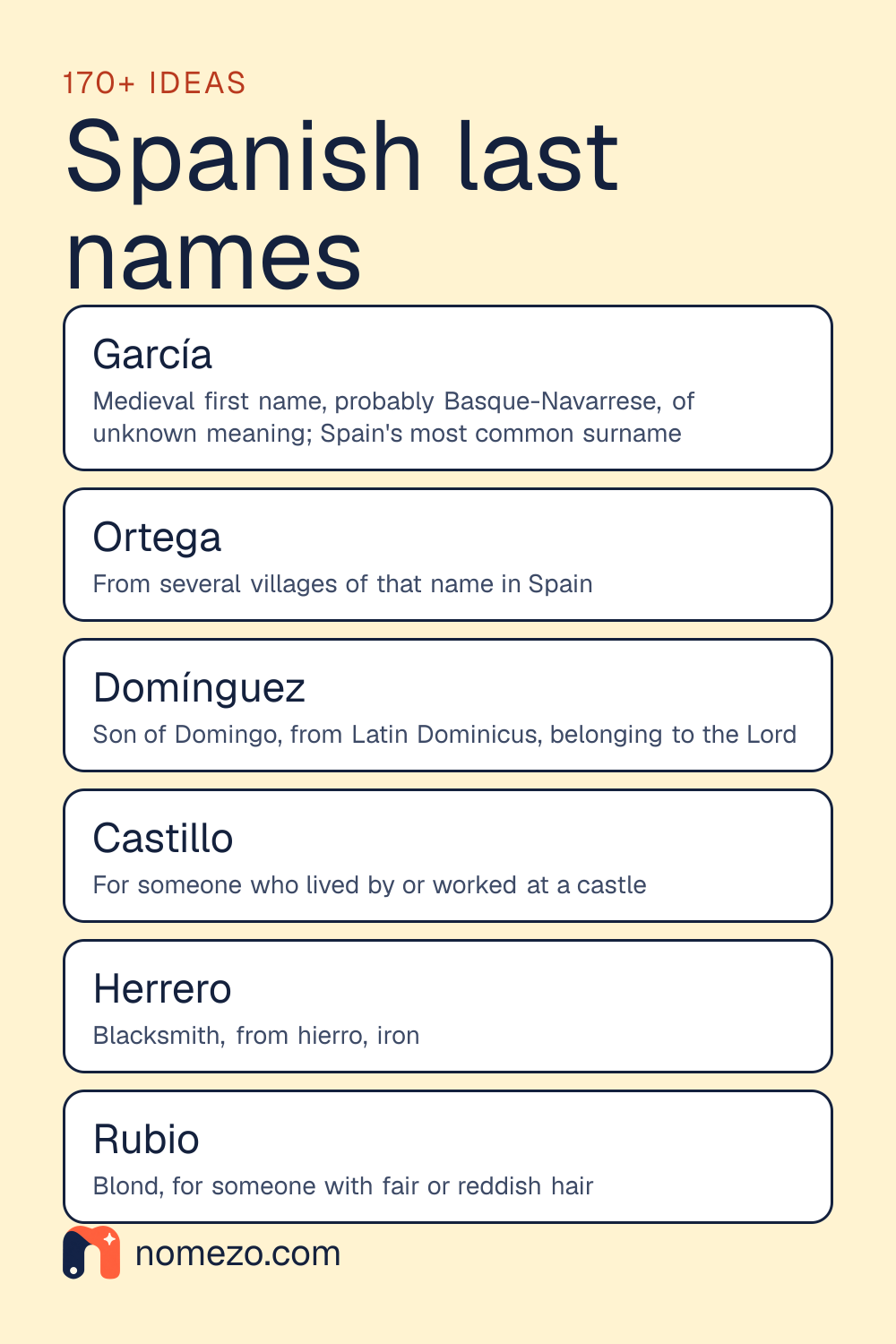
Ortega
From several villages of that name in Spain
Vega
Fertile river meadow, for someone living on one
Bosch
Wood or forest; say BOSK
Spanish surname lookup
Type any Spanish surname to see its accented spelling and how to say it, its rank in Spain and the US, what its ending or Basque parts mean, and the spellings to search in old records.
Try:
Most common Spanish last names
The top surnames in Spain's population register, led by García. Most are patronymics that began as 'son of' a medieval first name.
- García Spain #1 US #6: Medieval first name, probably Basque-Navarrese, of unknown meaning; Spain's most common surname
- Rodríguez Spain #2 US #8: Son of Rodrigo, a Germanic name meaning famous ruler
- González Spain #3 US #13: Son of Gonzalo, a Visigothic name built on gund, battle
- Fernández Spain #4 US #134: Son of Fernando, from Germanic words for journey and daring
- López Spain #5 US #12: Son of Lope, from Latin lupus, wolf
- Martínez Spain #6 US #10: Son of Martín, a name honoring Mars, the Roman war god
- Sánchez Spain #7 US #25: Son of Sancho, from Latin sanctus, holy
- Gómez Spain #9 US #49: Son of Gome, a Visigothic name meaning man
- Jiménez Spain #11 US #98: Son of Jimeno, a medieval Navarrese first name; say hee-MEH-nes
- Hernández Spain #12 US #11: Son of Hernando, an older form of Fernando
- Ruiz Spain #13 US #92: Son of Ruy, a short form of Rodrigo; say roo-EES
- Díaz Spain #14 US #52: Son of Diego, from the medieval Latin name Didacus
- Moreno Spain #15 US #124: Nickname for someone with dark hair or a dark complexion
- Muñoz Spain #16 US #164: Son of Muño, a medieval Castilian first name; say moo-NYOHS
- Álvarez Spain #17 US #95: Son of Álvaro, a medieval Visigothic first name
- Romero Spain #18 US #113: Pilgrim, first for someone who had traveled to Rome
- Gutiérrez Spain #19 US #70: Son of Gutierre, a medieval Castilian name of Germanic origin
- Alonso Spain #20 US #1,169: From a short form of Alfonso, a royal Spanish first name
- Navarro Spain #22 US #321: For someone from Navarre, the old kingdom in the north
More popular Spanish last names
Widespread surnames you will meet all over Spain and Latin America; most of them rank in Spain's top 100.
- Ortega Spain #35 US #243: From several villages of that name in Spain
- Marín Spain #37 US #768: From the first name Marino, of the sea; say mah-REEN
- Sanz Spain #43: From the medieval first name Sancho, meaning holy
- Garrido Spain #46 US #3,975: Elegant or showy, a nickname for a well-dressed man
- Gallego Spain #60: Galician, for someone from Galicia in the northwest
- Calvo Spain #63: Bald, from Latin calvus
- Nieto Spain #70 US #1,377: Grandson, first given as a family nickname
- Durán Spain #81 US #345: From the medieval first name Durand, meaning enduring
- Carmona Spain #87 US #1,310: For someone from the ancient Andalusian town near Seville
- Velasco Spain #96 US #1,056: From a medieval first name; a great noble house of Castile
- Gallardo US #1,123: Gallant or elegant, a nickname for a dashing man
- Lara US #374: From a village in Burgos, seat of a powerful medieval family
- Trujillo US #461: For someone from the Extremadura town where Francisco Pizarro was born
- Quesada US #4,528: From a town in Jaén in southern Spain; say keh-SAH-dah
- Beltrán US #677: From the Spanish form of Bertrand, bright raven
- Roldán US #2,574: From the Spanish form of Roland, famous land
Spanish patronymic surnames ending in -ez
The -ez ending means 'son of', added to a medieval first name. These are some of the oldest and most widespread Spanish surnames.
- Domínguez Spain #23 US #260: Son of Domingo, from Latin Dominicus, belonging to the Lord
- Vázquez Spain #26 US #191: Son of Vasco, a medieval first name; say VAHS-kes
- Ramírez Spain #24 US #27: Son of Ramiro, a Visigothic name joining counsel and fame
- Suárez Spain #31 US #473: Son of Suero, a medieval Asturian and Leonese first name
- Núñez Spain #40 US #228: Son of Nuño, a medieval Castilian first name; say NOO-nyes
- Benítez Spain #75 US #631: Son of Benito, the Spanish form of Benedict, blessed
- Méndez Spain #53 US #155: Son of Mendo, a medieval Galician and Portuguese first name
- Velázquez US #501: Son of Velasco; also the surname of Spain's great Baroque painter
- Márquez Spain #58 US #291: Son of Marcos, the Spanish form of Mark
- Enríquez US #844: Son of Enrique, the Spanish form of Henry
- Ibáñez Spain #85 US #3,980: Son of Ibán, an old form of Juan; say ee-BAH-nyes
- Ordóñez US #1,774: Son of Ordoño, a name borne by kings of Asturias and León
- Bermúdez US #1,258: Son of Bermudo, a name of medieval kings of León
- Peláez: Son of Pelayo, the first king of Asturias
- Estévez US #2,910: Son of Esteban, the Spanish form of Stephen, crown
- Antúnez: Son of Antón, a medieval form of Antonio
- Íñiguez US #4,083: Son of Íñigo, from the Basque name Eneko; say EE-nyee-ges
- Téllez US #1,624: Son of Tello, a medieval Castilian first name
Spanish surnames from places
Toponymic surnames record where a family came from or lived: a kingdom, a city, a castle, a spring or a riverbank.
- Castillo Spain #41 US #94: For someone who lived by or worked at a castle
- Torres Spain #21 US #38: For a family living by a tower or towers
- Medina Spain #39 US #132: From towns whose Arabic name means city
- Toledo US #1,786: For someone from the old royal city of central Spain
- Guzmán US #150: From a village in Burgos; the line of a great noble house
- Aragón US #1,395: For someone from the kingdom in northeast Spain
- Zamora US #540: For someone from the walled city on the Duero River
- Córdoba: For someone from the Andalusian city, once a caliphate's capital
- Villanueva US #532: New town, for a family from a newly founded settlement
- Villalobos US #923: Town of the wolves, from a village in Zamora
- Iglesias Spain #44 US #3,344: Churches, for someone living by a church
- De la Fuente US #4,908: Of the spring, for a family living by one
- Del Río US #3,548: Of the river, for a family living on its banks
- Peña Spain #54 US #209: Rock or crag, for someone living near one; say PEH-nyah
- Serrano Spain #28 US #419: Highlander, someone from the sierra, the mountains
- Carrasco Spain #68 US #1,173: Holm oak, from carrasca, for a family living by the evergreen oaks
- Parra Spain #93 US #951: Grapevine or trellis, for a family living by one
- Robledo US #2,420: Oak wood, from roble, oak
- Escobar US #476: From escoba, broom plant, for a home by a patch of broom
- Tapia US #659: Mud wall, for a home beside a rammed-earth wall
- Paredes US #1,260: Walls, for someone living near a prominent wall
- Salcedo US #1,910: Willow grove, from Latin salix, willow
- Solís US #392: From a village in Asturias, from sol, sun; say soh-LEES
Occupational Spanish surnames
Medieval jobs that turned into family names, from the village forge to the royal hunt.
- Herrero Spain #83: Blacksmith, from hierro, iron
- Herrera Spain #51 US #131: Smithy or ironworks, for a family that worked at one
- Zapatero: Shoemaker, from zapato, shoe
- Molinero: Miller, the person who ran the village mill
- Pastor Spain #97 US #4,541: Shepherd, someone who tended sheep
- Vaquero: Cowherd; the same word gave English the cowboy term buckaroo
- Cabrero: Goatherd, from cabra, goat
- Escudero: Squire or shield-bearer, from escudo, shield
- Caballero Spain #69 US #1,193: Knight or horseman, from caballo, horse
- Guerrero Spain #47 US #240: Warrior or soldier, for a fighting man
- Montero Spain #78 US #2,000: Huntsman, especially a beater on a royal hunt
- Tejedor: Weaver, from tejer, to weave
- Cantero: Stonemason or quarryman who cut building stone
- Barbero: Barber, a medieval trade that included minor surgery
- Calderón US #415: Large cauldron, for a maker or seller of kettles
- Alcalde: Mayor or magistrate, from Arabic al-qadi, the judge
- Ballesteros US #3,469: Crossbowmen, for a crossbow maker or soldier
- Sastre: Tailor, someone who cut and sewed clothes
- Carretero: Cart maker or carter who hauled goods
- Correa US #902: Leather strap or belt, for a maker or seller of them
Spanish surnames from nicknames and traits
Descriptive surnames first given for hair color, character or a memorable trait.
- Rubio Spain #38 US #663: Blond, for someone with fair or reddish hair
- Blanco Spain #33 US #847: White, for someone with very fair hair or skin
- Delgado Spain #34 US #227: Thin or slender, a nickname for a slim person
- Bravo Spain #98 US #803: Fierce or brave, a nickname for a bold person
- Leal US #955: Loyal, for a faithful person
- Cortés Spain #42 US #668: Courteous or well-mannered, from corte, the royal court
- Crespo Spain #94 US #1,931: Curly-haired, from Latin crispus
- Lozano Spain #48 US #576: Proud, lively or handsome
- Franco US #458: Free, for a free man rather than a serf
- Rico US #1,350: Rich or powerful, a nickname for a wealthy man
- Bueno US #2,029: Good, a nickname for a kind person
- Pardo US #3,240: Brownish gray, for hair or clothing color
- Cano Spain #52 US #920: Gray-haired, from Latin canus, white
- Prieto Spain #56 US #1,791: Dark, for someone with very dark hair
- Lobo: Wolf, a nickname for a fierce or cunning man
- Cordero US #1,109: Lamb, for a gentle person or a shepherd
- Valiente: Brave, for a courageous person
- Cabello: Hair, a nickname for someone with a thick head of it
Basque surnames
Basque surnames usually describe the family home: its position, its trees or the water beside it. Many families now use Basque spelling, with tx and k. In Basque, z sounds like s.
- Etxeberria: New house, from etxe and berri; say eh-cheh-BEH-rree-ah
- Goikoetxea: The upper house; say goy-koh-EH-cheh-ah
- Bengoetxea: The lower house; say ben-goh-EH-cheh-ah
- Etxegarai: The high house; say eh-cheh-gah-RYE
- Zubizarreta: Place of the old bridge; say soo-bee-sah-RREH-tah
- Iturriaga: Place of springs, from iturri, spring
- Mendizabal: Broad mountain, from mendi, mountain, and zabal, wide
- Arizmendi: Oak mountain, from haritz, oak, and mendi, mountain
- Gorostiza: Holly grove, from gorosti, holly
- Larrañaga: Place of threshing floors, from larrain
- Elizalde: Beside the church, from eliza, church
- Arrieta: Stony place, from harri, stone
- Urkiza: Birch grove, from urki, birch
- Ugalde: By the water, from ur, water, and alde, side
- Olaetxea: The forge house, from ola, ironworks
- Agirre: An open or exposed place, such as a clearing
- Ezquerra: Left-handed, from Basque ezker, left
Catalan surnames
From Catalonia, Valencia and the Balearic Islands. Many name a feature of the land around the family farm.
- Puig: Hill or peak; say POOTCH
- Pujol: Little hill, a pet form of puig; say poo-ZHOL
- Vidal Spain #62 US #1,877: From a medieval first name, Latin vitalis, full of life
- Ferrer Spain #86 US #1,972: Blacksmith, from ferro, iron
- Serra: Mountain ridge or saw-toothed range
- Roca: Rock, for someone living by a crag
- Font: Spring or fountain, for someone living by one
- Riera: Seasonal stream, for a family living beside one
- Bosch US #4,758: Wood or forest; say BOSK
- Prat: Meadow, for someone living by one
- Vila: Village or farming estate
- Mas: Farmhouse, the traditional Catalan country home
- Coll: Mountain pass, for a family living near one
- Pons: From the Latin first name Pontius
- Sabater: Shoemaker, from Catalan sabata, shoe
- Moliner: Miller, the one who ran the mill
- Casals: Farmsteads or country houses
- Planas: Plains, for a family from flat country
- Rius: Rivers, for a family living near running water
Galician surnames
From Galicia in the green northwest, where surnames often name trees, hills, hill forts and farm buildings.
- Castro Spain #32 US #130: Old hill fort, from Latin castrum; Galicia has hundreds
- Otero US #1,617: Small hill or rise with a view
- Souto: Grove, often of chestnut trees
- Seoane: Saint John, from Galician San Xoán; say seh-oh-AH-neh
- Carballo: Oak tree, a common Galician place name
- Ferreiro: Blacksmith, the Galician form of herrero
- Freire: Friar or monk, from Latin frater, brother
- Rivas Spain #99 US #401: Riverbanks, for a family living on one
- Pazos: Manor houses, from pazo, a Galician country estate
- Fraga: Galician for a thick native woodland
- Barreiro: Clay pit or muddy ground, from barro, clay
- Outeiro: Hill or high ground, the Galician form of otero
- Loureiro: Laurel tree, for a family living by one
- Vilar: Hamlet or small farming settlement
- Lago: Lake or pool, for a family living beside one
- Figueroa US #310: Place of fig trees, from Galician figueira, fig tree
How to pick the right name
Use two surnames for realism
A Spanish character usually has two surnames, like Lucía Navarro Etxeberria. Pair a common surname with a regional one to hint at the family's roots.
Match the region
Basque names point to the north coast, Catalan names to the northeast and the Mediterranean, and Galician names to the green northwest. The -ez patronymics fit anywhere in Spain or Latin America.
Keep the accent marks
Accents are part of the correct spelling and show where the stress falls, as in Martínez and Peláez. Many families in the US dropped them, which is also authentic for an American character.
Read the meaning
A surname like Herrero (blacksmith) or Romero (pilgrim) quietly says something about a character's ancestors. Use the notes to pick one that fits the story.
Save this list for later
Pin it to a naming board, or tap the heart next to any name to keep it in your favorites on this device.
Where Spanish surnames come from
By The Nomezo Editors · Updated October 22, 2026 · How we research names
Spanish surnames settled into fixed family names in the Middle Ages, and nearly all come from four sources: a father's first name, a place, a trade or a nickname. Spain also has three regional surname traditions with their own languages: Basque, Catalan and Galician. Spanish-speaking countries in the Americas share most of these names, alongside Indigenous surnames such as Quispe in Peru. A surname tells you where a name began, not where a family lives today.
| Kind | Where it comes from | On this page |
|---|---|---|
| Patronymics | From a father's first name: Rodríguez, son of Rodrigo. The largest group in Spain's top 20. | 18 |
| Places | From a town, kingdom or a feature of the land: Navarro, Toledo, Del Río. | 25 |
| Trades | From a medieval job: Herrero (blacksmith), Pastor (shepherd). | 20 |
| Nicknames | From looks or character: Rubio (blond), Delgado (thin), Bravo (fierce). | 18 |
| Basque | In Euskara, usually naming the family house and its setting: Etxeberria, new house. | 17 |
| Catalan | From Catalonia, Valencia and the Balearics, often a feature of the farm's land: Puig, hill. | 19 |
| Galician | From the northwest, naming trees, hills and hill forts: Castro, Carballo. | 16 |
Spain's 100 most common surnames (INE, 2025)
On 1 January 2025, 1,446,937 of Spain's 49,128,297 residents had García as their first surname, about one in 34. The top eight, all patronymics apart from García, each belong to more than three-quarters of a million people. Because every Spaniard has two surnames, INE counts each name as a first surname, a second surname, and both.
| Rank | Surname | First surname | Second surname | Both |
|---|---|---|---|---|
| 1 | García | 1,446,937 | 1,468,824 | 74,765 |
| 2 | Rodríguez | 939,214 | 950,067 | 41,281 |
| 3 | González | 930,137 | 939,512 | 39,476 |
| 4 | Fernández | 896,725 | 908,388 | 48,147 |
| 5 | López | 871,380 | 880,428 | 32,802 |
| 6 | Martínez | 832,396 | 840,399 | 36,676 |
| 7 | Sánchez | 818,287 | 828,609 | 32,605 |
| 8 | Pérez | 779,313 | 794,277 | 25,085 |
| 9 | Gómez | 496,272 | 500,028 | 13,122 |
| 10 | Martín | 475,139 | 473,220 | 19,346 |
| 11 | Jiménez | 399,394 | 400,335 | 21,940 |
| 12 | Hernández | 380,919 | 385,264 | 15,194 |
| 13 | Ruiz | 366,644 | 371,017 | 8,102 |
| 14 | Díaz | 350,246 | 351,061 | 8,174 |
| 15 | Moreno | 324,435 | 326,774 | 9,987 |
| 16 | Muñoz | 284,951 | 285,616 | 6,449 |
| 17 | Álvarez | 281,150 | 280,623 | 8,850 |
| 18 | Romero | 227,391 | 227,881 | 4,454 |
| 19 | Gutiérrez | 199,928 | 201,875 | 3,682 |
| 20 | Alonso | 189,942 | 188,027 | 4,239 |
- 21Torres 180,723
- 22Navarro 176,842
- 23Domínguez 156,940
- 24Ramírez 156,686
- 25Ramos 149,677
- 26Vázquez 144,451
- 27Gil 139,109
- 28Serrano 129,941
- 29Morales 127,848
- 30Molina 125,316
- 31Suárez 124,242
- 32Castro 123,156
- 33Blanco 121,880
- 34Delgado 119,872
- 35Ortega 118,777
- 36Ortiz 114,447
- 37Marín 108,047
- 38Rubio 102,390
- 39Medina 95,823
- 40Núñez 94,702
- 41Castillo 94,139
- 42Cortés 89,974
- 43Sanz 88,939
- 44Iglesias 86,084
- 45Santos 85,287
- 46Garrido 84,187
- 47Guerrero 82,949
- 48Lozano 80,558
- 49Flores 79,715
- 50Cruz 78,630
- 51Herrera 77,374
- 52Cano 77,356
- 53Méndez 77,195
- 54Peña 74,072
- 55León 73,175
- 56Prieto 72,655
- 57Cabrera 72,206
- 58Márquez 72,097
- 59Reyes 71,297
- 60Gallego 68,987
- 61Campos 67,952
- 62Vidal 67,572
- 63Calvo 67,348
- 64Vega 66,681
- 65Fuentes 65,327
- 66Aguilar 64,089
- 67Vargas 63,921
- 68Carrasco 63,091
- 69Caballero 61,369
- 70Nieto 60,185
- 71Díez 59,840
- 72Rojas 59,298
- 73Santana 58,815
- 74Giménez 57,495
- 75Benítez 56,956
- 76Arias 56,875
- 77Hidalgo 56,836
- 78Montero 56,711
- 79Santiago 55,826
- 80Pascual 55,673
- 81Durán 55,665
- 82Mora 55,638
- 83Herrero 55,454
- 84Lorenzo 55,302
- 85Ibáñez 53,676
- 86Ferrer 53,051
- 87Carmona 52,749
- 88Soto 51,530
- 89Vicente 50,880
- 90Rivera 49,483
- 91Silva 48,968
- 92Román 48,922
- 93Parra 48,813
- 94Crespo 48,466
- 95Mendoza 47,342
- 96Velasco 47,036
- 97Pastor 46,323
- 98Bravo 46,300
- 99Rivas 45,776
- 100Moya 45,483
Source: INE, most frequent surnames of residents, 1 January 2025. INE prints surnames without accents and counts compound ones such as De la Fuente as their own entry. Search any surname, by province too, with the INE surname search. Same surname twice is common: García García (74,765), Fernández Fernández (48,147), Rodríguez Rodríguez (41,281), González González (39,476), Martínez Martínez (36,676).
The most common surname in each province
García leads 35 of Spain's 52 provinces. The exceptions trace old regional patterns: Fernández in Asturias, León and Cantabria, Rodríguez in Galicia's Pontevedra and Ourense and in Las Palmas, Martínez in Murcia and La Rioja, and Mohamed in the North African cities of Ceuta and Melilla.
| Surname | Most common first surname in |
|---|---|
| Fernández | Asturias, León, Cantabria |
| Martínez | Murcia, La Rioja, Cuenca |
| Rodríguez | Las Palmas, Pontevedra, Ourense, Huelva |
| González | Santa Cruz de Tenerife |
| López | Lugo |
| Sánchez | Salamanca, Cáceres |
| Martín | Ávila |
| Mohamed | Ceuta, Melilla |
INE, residents on 1 January 2025, by province of residence.
How the two-surname system works
Each parent passes on their first surname, so a child of Juan García López and María Pérez Ruiz is García Pérez. The second surnames, López and Ruiz, drop off in the next generation. Try it with your own family below.
Two-surname builder
- Traditional order
- García Pérez
- Each parent passes on their first surname, the father's first.
- Mother's surname first
- Pérez García
- Possible in Spain since 2000, and simply the parents' choice since 2017. Siblings share one order.
- The mother after marriage
- Still Pérez Ruiz: in Spain marriage does not change anyone's surnames.
Parents choose the order
Since 30 June 2017, parents agree on the order of their first surnames when they register a birth. If they disagree or leave it blank, the registrar gives them three days and then decides in the child's best interest. The order chosen for the first child applies to every later child of the same parents.
Ley 20/2011 del Registro Civil, art. 49.2 (BOE)The mother's surname first, since 2000
Ley 40/1999, in force from 6 February 2000, first let parents agree to put the mother's surname first. Without that agreement the father's surname came first, which is why most adults today carry his first.
Ley 40/1999 (BOE)Adults can swap their surnames
Once they come of age, anyone can ask the Civil Registry to reverse the order of their two surnames. The same article lets people join their surnames with y, or i in Catalan, as in Ramón y Cajal.
Código Civil, art. 109, and Ley 20/2011, art. 53 (BOE)Regional spellings are official
A surname can be registered in the spelling of any official language that matches the family's origin or home, so a family registered as Echeverría can become Etxeberria. This is one reason the same family can appear under two spellings.
Ley 20/2011, art. 53.4 (BOE)Marriage changes nobody's surname
Spanish law has no surname change on marriage: the marriage record uses each spouse's surnames from their birth certificate. A woman named María Pérez Ruiz stays María Pérez Ruiz. Señora de García is a social form with no legal effect.
Spanish Foreign Ministry, consular note on surnamesElsewhere in the Spanish-speaking world
Most of Latin America uses the same father-then-mother pattern. In Argentina one surname, the father's, is the legal norm, though many people use both. Some married women add de and their husband's surname, as in Eva Duarte de Perón; Peru's Civil Code makes this a right, not a duty.
Peru, Código Civil art. 24
Surname endings and what they tell you
| Ending or part | Meaning | Examples |
|---|---|---|
| -ez, -az, -iz, -oz | Probably son of: a Castilian patronymic from a father's first name. Linguists still debate where the ending itself comes from, and not every -ez is a patronymic: Chávez comes from Chaves, a town in Portugal. | Rodríguez (Rodrigo), Fernández (Fernando), Díaz (Diego), Ruiz (Ruy), Muñoz (Muño) |
| -es | The Portuguese and Galician match for -ez. | Fernandes, Lopes, Nunes |
| A first name, unchanged | A father's first name used as the surname with no ending at all. | Martín, Alonso, Lorenzo, Vicente, Pascual, Román |
| -ero, -era | A trade: the person who made or worked with something. | Herrero (blacksmith), Zapatero (shoemaker), Molinero (miller), Carretero (carter) |
| -eiro, -eira | Galician, from Latin -arius: a trade, or a place full of one kind of tree. | Ferreiro (blacksmith), Pereira (pear tree), Loureiro (laurel) |
| de, del, de la | Of or from: the place or landmark the family lived by. | De la Fuente (the spring), Del Río (the river), De la Cruz (the cross) |
| etxe-, -etxea | Basque for house: many Basque surnames name the family farmhouse. | Etxeberria (new house), Goikoetxea (upper house), Olaetxea (forge house) |
| -aga, -eta | Basque endings meaning place of, or a place with plenty of something. | Iturriaga (place of the spring), Arrieta (stony place), Larrañaga |
| mendi, zubi, iturri, zabal | Basque landscape words: mountain, bridge, spring, wide. | Mendizabal, Zubizarreta, Iturriaga |
| puig, mas, font, vila, coll, prat | Catalan land words: hill, farmhouse, spring, town, mountain pass, meadow. | Puig, Mas, Font, Vila, Coll, Prat |
| -ol, -et, -ell | Catalan endings meaning little. | Pujol (little hill, from puig) |
| A plain describing word | A nickname for looks or character that became the family name. | Rubio (blond), Delgado (thin), Calvo (bald), Moreno (dark-haired) |
The most common surnames across the Americas
The same patronymics lead almost everywhere Spanish is spoken, but the order changes: Hernández tops Mexico, González leads Argentina and Chile, and Quispe, a Quechua surname, leads Peru. In the US, six Spanish surnames are in the top 13.
| Country | Most common surnames | Year and source |
|---|---|---|
| Mexico | Hernández, García, Martínez, López, González | INE Mexico voter roll, 2021, as reported by Publimetro |
| Argentina | González, Rodríguez, Gómez | RENAPER, people with a national ID, December 2021 |
| Colombia | Rodríguez, Martínez, González | Registraduría, 2019, as reported by Noticias Caracol |
| Chile | González, Muñoz, Rojas | Registro Civil, registrations 2014 to 2023, as reported by Pauta |
| Peru | Quispe, Flores, Sánchez | RENIEC, 2023, as reported by Líbero (Quispe is Quechua) |
| United States | Garcia (#6), Rodriguez (#8), Martinez (#10), Hernandez (#11), Lopez (#12), Gonzalez (#13) | US Census Bureau, 2020 Census surnames (2026) |
Accents, spellings and family research
García and Garcia are the same surname: Spanish writes the accent, and many records, keyboards and US forms drop it. Older records also spell sounds differently, and Basque surnames have a modern Basque spelling and an older Spanish one. Search every form.
| Surname | Also written, or the same name in another language |
|---|---|
| García | Garcia, the usual form in US and many older records |
| Jiménez | Giménez, Ximénez, Jimenes. INE counts Jiménez (#11) and Giménez (#74) as separate surnames |
| Vázquez | Vásquez, the usual form in much of Latin America; Vasquez, Vazquez |
| Núñez | Nunez, Nuñez; Nunes in Portuguese and Galician |
| Ibáñez | Ybáñez, Ibañez, Ybanez |
| Etxeberria | Echeverría, Echevarría, Echeberria; Etcheverry in the French Basque Country |
| Agirre | Aguirre, the Spanish spelling of the same Basque name |
| Goikoetxea | Goicoechea, Goicoetxea |
| Herrero | Ferrer in Catalan, Ferreiro in Galician, Ferreira in Portuguese: the same trade, blacksmith |
| Bosch | Bosc, the modern Catalan spelling of the word for wood; Bosque in Castilian |
- Start from the full name with both surnames. The second surname is the mother's family, so each record points to two lines, not one.
- Spain's Civil Registry has recorded births, marriages and deaths since 1 January 1871. Ask the Registro Civil of the town where the event happened.
- Before 1871, use Catholic parish books of baptisms, marriages and burials. The Council of Trent made them compulsory in 1563; most are now in diocesan archives, and many are searchable on FamilySearch.
- Search every spelling: with and without accents, b and v, j, g and x, y and i, z and s, and the Basque, Catalan or Galician form beside the Castilian one.
- Look for married women under their own birth surnames in Spanish records. In some Latin American records a woman may also appear as de plus her husband's surname.
- A shared surname does not prove a shared family, or Sephardic Jewish ancestry: most surnames arose many times in many places, and conversos took ordinary Christian surnames.
Sources and how we checked
Counts come from official registers, with the date beside each one. Meanings come from published surname dictionaries; where a surname's origin is debated, as with García, the note says so rather than pick one story.
- INE: most frequent surnames, residents on 1 January 2025: Spain's top 100, the top 20 as first, second and both surnames, the same surname twice, and the leader in each province
- INE: surname search: the count for any surname, nationally and by province
- BOE: Ley 20/2011 del Registro Civil (consolidated): choosing the order of surnames (art. 49.2), reversing it, adding y or i, and regional spellings (art. 53)
- BOE: Ley 40/1999 on the order of surnames: the first law letting the mother's surname go first
- BOE: Código Civil, art. 109: adults changing the order of their surnames
- Spanish Foreign Ministry: note on surnames and marriage: marriage does not change surnames in Spain
- Gaceta de Madrid, 14 December 1870: the Civil Registry starting on 1 January 1871
- Council of Trent, Session XXIV (1563): parish books of marriages and baptisms
- Gabriel M. Verd, on the Spanish -ez ending (ASJU, 1982): why the origin of -ez is still debated
- Coromines, Onomasticon Cataloniae (IEC): Pujol, from Latin podiolum, little hill
- Auñamendi Encyclopedia: -aga: the Basque place ending
- Behind the Name: surnames: meanings of individual surnames, checked one by one
- US Census Bureau: 2020 Census names data: the most common US surnames
- US Census Bureau: 2020 last names files: US ranks in the lookup
- US Census Bureau: 2010 surnames: 2010 ranks in the lookup
Frequently asked questions
What are the most popular Spanish last names?
García is the most common surname in Spain, carried as a first surname by more than 1.4 million residents. Rodríguez, González, Fernández and López follow, and Ortega, Marín, Sanz and Garrido are all in Spain's top 50, according to the INE.
Why do Spanish people have two last names?
Spanish custom gives each child two surnames: the father's first surname, then the mother's first surname. Since 2000 parents in Spain have been able to put the mother's surname first, and women keep their own surnames after marriage.
What does -ez mean in Spanish last names?
The -ez ending means son of. Rodríguez is son of Rodrigo, Martínez is son of Martín and Fernández is son of Fernando.
How do you say last name in Spanish?
Last name in Spanish is apellido. Most people have two: the primer apellido, usually the father's, and the segundo apellido, usually the mother's.
How do you pronounce the z in Spanish surnames?
In Latin America z sounds like s, so Pérez is PEH-res. In most of Spain, z and a c before e or i sound like the th in think, so Pérez is PEH-reth.
What is the most common surname in Spain?
García. On 1 January 2025, 1,446,937 residents of Spain had it as their first surname and 1,468,824 as their second, according to the INE. It leads in 35 of Spain's 52 provinces.
Can the mother's surname go first in Spain?
Yes. Since 2000 parents could agree to it, and since 30 June 2017 the order is simply their choice when they register the birth. If they cannot agree, the registrar decides. All children of the same parents share the order chosen for the first.
Do Spanish women change their surname when they marry?
No. Spanish law has no surname change on marriage, so a woman keeps both of her surnames for life. Children take one surname from each parent.
Is García Spanish or Basque?
García began as a medieval first name in northern Spain, probably among Basque speakers in Navarre, and is now the most common Spanish surname. Its meaning is unknown: one theory links it to the Basque word hartz, bear, but none is proven.
Are Etxeberria and Echeverría the same surname?
Yes. Etxeberria is the Basque spelling and Echeverría the older Spanish spelling of the same name, meaning new house. Spanish law lets a family register the Basque spelling, so search both.
Does a Spanish surname mean Jewish ancestry?
Not on its own. Jews who converted in medieval Spain took the same Christian surnames as everyone else, so no surname proves Sephardic ancestry. Spain's own nationality rules treat a surname as one piece of evidence at most.
More last names and generators
- Mexican last names127 names. Mexican last names with meanings: the most common surnames in Mexico, -ez names, Basque, Nahuatl and Maya surnames, and how Mexico's two surnames work.
- Last NamesLast names and surnames with meanings and origins: cool, pretty, rare and unique last names, plus a surname generator.
- Spanish boy names153 names. Spanish boy names and male Spanish names with meanings and pronunciation: Spain's top names for 2024, men's compound names, Basque, Catalan and Latino picks.
- Spanish girl names124 names. Spanish girl names and female Spanish names with meanings and pronunciation: Spain's top 2024 names, classics, Marian names, Basque, Catalan and Latina picks.
- Spanish name generatorReal Spanish and Latin American names, each with its meaning.
- Italian last names152 names. Italian last names with meanings and origins: the most common surnames, northern -i and southern -o names, Venetian, Sicilian and Sardinian families and more.
- Cool last names182 names. Cool last names with real origins: classic, job, nature, animal, global, fancy and strong surnames, plus 30+ invented last names for characters.
- Names by OriginNames by origin and culture: Japanese, French, Irish, Italian, Spanish, Norse, Greek, Arabic and more, with meanings and pronunciation.
- Russian last names148 names. Russian last names with meanings and Cyrillic: common, patronymic, occupational, animal, church and noble surnames, with -ov/-ova and -sky/-skaya explained.