

Mexican last names: 120+ common surnames and meanings
127 names · Updated · By The Nomezo Editors · Save to Pinterest
The most common Mexican last names are Hernández, García and Martínez, followed by López and González, according to Mexico's birth and voter records. Mexicans usually carry two surnames, the father's first surname and then the mother's, so Ana Hernández Cruz has Hernández from her father and Cruz from her mother.
Below are 120+ real Mexican surnames with the meaning and origin of each: the top twenty, -ez patronymics, other popular names, surnames from the land, Basque names brought to New Spain, Nahuatl and Maya surnames, devotional names and surnames from Mexican history. Most came from Spain, but some are older than the Spanish conquest. Pronunciation tips appear where English speakers may stumble.
Can't decide? Shuffle 6 random picks
Palma
Palm tree, or one of the places named for palms
Nogales
Walnut trees, from nogal, walnut
Ríos
Rivers, for someone living near running water
Luna
Moon, or from Spanish towns of that name
Montes
Mountains or wooded hills
Sandoval
From a village in Burgos, home of a noble Castilian family
Find a Mexican surname on this page
Narrow 127 surnames by how common they are in the 2020 US Census, by section, length or first letter, or search the meanings.
Most common Mexican last names
The surnames that top Mexico's birth records, led by Hernández. Most are Spanish patronymics meaning 'son of'.
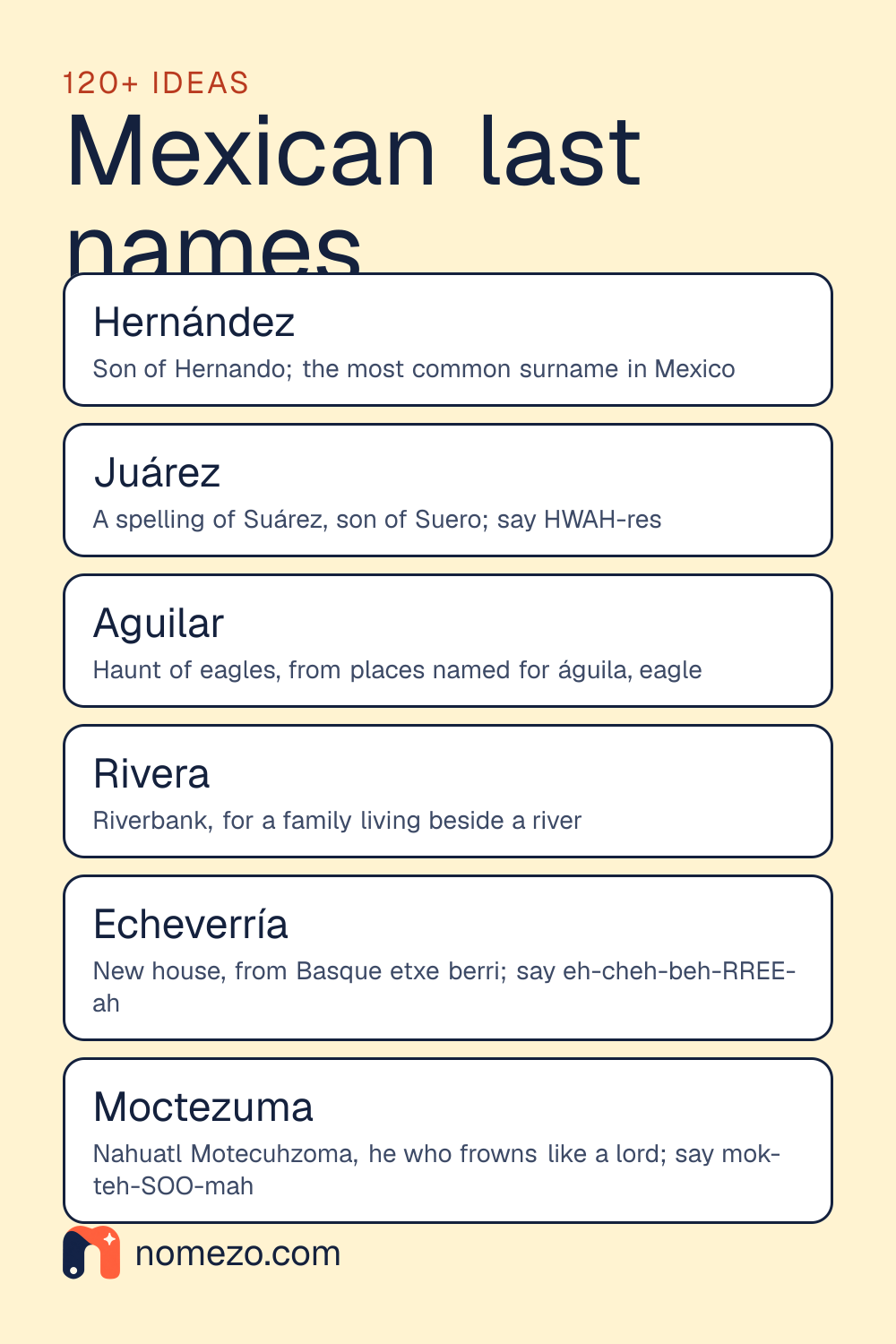
- Hernández US #11: Son of Hernando; the most common surname in Mexico
- García US #6: Medieval Basque-Navarrese first name; second most common in Mexico
- Martínez US #10: Son of Martín, a name honoring Mars, the Roman war god
- López US #12: Son of Lope, from Latin lupus, wolf
- González US #13: Son of Gonzalo, a Visigothic name built on gund, battle
- Rodríguez US #8: Son of Rodrigo, a Germanic name meaning famous ruler
- Sánchez US #25: Son of Sancho, from Latin sanctus, holy
- Ramírez US #27: Son of Ramiro, a Visigothic name joining counsel and fame
- Flores US #39: Flowers, or son of a man named Floro
- Gómez US #49: Son of Gome, a Visigothic name meaning man
- Morales US #62: Mulberry trees, for a family living near them
- Vázquez US #191: Son of Vasco, a medieval first name; say BAHS-kes
- Reyes US #56: The kings, honoring the Three Kings of Epiphany
- Jiménez US #98: Son of Jimeno, a medieval Navarrese first name; say hee-MEH-nes
- Torres US #38: Towers, for a family living by one
- Díaz US #52: Son of Diego, from the medieval Latin name Didacus
- Gutiérrez US #70: Son of Gutierre, a medieval Castilian name of Germanic origin
- Ruiz US #92: Son of Ruy, a short form of Rodrigo; say RWEES
Mexican surnames ending in -ez
The -ez ending (and the rarer -iz and -oz) means 'son of'. After the top twenty, these patronymics fill page after page of any Mexican phone book.
- Juárez US #315: A spelling of Suárez, son of Suero; say HWAH-res
- Méndez US #155: Son of Mendo, a medieval Galician and Portuguese first name
- Domínguez US #260: Son of Domingo, from Latin Dominicus, belonging to the Lord
- Velázquez US #501: Son of Velasco; also the surname of Spain's great Baroque painter
- Álvarez US #95: Son of Álvaro, a medieval Visigothic first name
- Núñez US #228: Son of Nuño, a medieval Castilian first name; say NOO-nyes
- Benítez US #631: Son of Benito, the Spanish form of Benedict, blessed
- Márquez US #291: Son of Marcos, the Spanish form of Mark
- Muñoz US #164: Son of Muño, a medieval Castilian first name; say moo-NYOHS
- Fernández US #134: Son of Fernando, from Germanic words for journey and daring
- Enríquez US #844: Son of Enrique, the Spanish form of Henry
- Téllez US #1,624: Son of Tello, a medieval Castilian first name
- Ortiz US #68: Son of Orti, a short form of Fortunio, fortunate
Popular Mexican surnames
More names you will hear in every Mexican city, most taken from Spanish towns, trades or traits.
- Aguilar US #138: Haunt of eagles, from places named for águila, eagle
- Chávez US #84: From Chaves, a town in northern Portugal near Galicia
- Ramos US #74: Branches, often linked to Palm Sunday processions
- Vargas US #144: Slopes or wet meadows, from the old Spanish word varga
- Rojas US #282: Red, a nickname for red hair, or from Rojas in Burgos province
- Contreras US #239: From a village of that name in Burgos province
- Ávila US #326: From the walled city in Castile, home of Saint Teresa
- Sandoval US #244: From a village in Burgos, home of a noble Castilian family
- Molina US #316: Mill, or one of many Spanish towns named for one
- Castillo US #94: Castle, for someone who lived by or worked at one
- Moreno US #124: Nickname for someone with dark hair or a dark complexion
- Romero US #113: Pilgrim, first for someone who had traveled to Rome
- Medina US #132: From towns whose Arabic name means city
- Herrera US #131: Smithy or ironworks, for a family that worked at one
- Castro US #130: Old hill fort, from Latin castrum
- Guzmán US #150: From a village in Burgos; the line of a great noble house
Mexican last names from nature and the land
Rivers, springs, orchards and hills: many surnames simply describe where a family lived.
- Rivera US #46: Riverbank, for a family living beside a river
- Ríos US #233: Rivers, for someone living near running water
- Fuentes US #377: Springs or fountains, for a family living near water
- Arroyo US #666: Stream or creek, for a family living beside one
- Robles US #385: Oak trees, for someone living by an oak grove
- Rosas US #786: Roses, for someone living where roses grew
- Olivares US #1,504: Olive groves, for a family living among them
- Nogales US #27,108: Walnut trees, from nogal, walnut
- Palma US #1,696: Palm tree, or one of the places named for palms
- Huerta US #747: Orchard or kitchen garden
- Campos US #328: Fields, for a family of the open countryside
- Prado US #1,489: Meadow or pasture, for a family living by one
- Montes US #705: Mountains or wooded hills
- Soto US #188: Grove or thicket near a river
- Salinas US #390: Salt works, for someone who lived or worked at one
- Espinoza US #285: Thorny place, from espino, a thornbush or hawthorn
- Cabrera US #357: Goat pasture, from places named for cabra, goat
- Del Valle US #2,946: Of the valley, for a family living in one
- Estrada US #241: Paved road, from Latin strata
- Silva US #157: Woodland, from the Latin word for forest; very common in Portugal
Basque surnames in Mexico
Basque settlers, miners and officials were prominent in colonial New Spain, and their names stayed. Most describe a house, a tree or the shape of the land.
- Echeverría US #3,607: New house, from Basque etxe berri; say eh-cheh-beh-RREE-ah
- Aguirre US #414: An open or exposed place, such as a clearing
- Ibarra US #521: River meadow or valley, from Basque ibar
- Ochoa US #408: Wolf, from the Basque first name Otxoa
- Zavala US #654: Wide place, from Basque zabal, wide
- Elizondo US #2,296: Beside the church, from eliza, church, and ondo, next to
- Iturbide US #52,071: Road to the spring, from iturri, spring, and bide, way
- Arriaga US #1,966: Stony place, from harri, stone
- Urrutia US #4,646: The far-off place, from urruti, far
- Larrea US #18,331: The pasture or meadow, from Basque larre
- Uribe US #1,435: Lower town, from uri, town, and behe, below
- Mendoza US #88: Cold mountain, from mendi, mountain, and hotz, cold
- Garay US #2,491: High place, from Basque garai, high
- Irigoyen US #20,674: Upper town, from iri, town, and goien, highest
- Lizárraga US #5,331: Place of ash trees, from lizar, ash
- Arteaga US #1,858: Place of holm oaks, from arte, holm oak
- Ugarte US #9,948: Between waters, from ur, water, and arte, between
Nahuatl and Maya surnames
A smaller group of Mexican surnames comes from Indigenous languages. Nahuatl names survive in central Mexico, and Maya names are very common in Yucatán. Maya meanings follow the Cordemex Maya dictionary.
- Moctezuma US #8,883: Nahuatl Motecuhzoma, he who frowns like a lord; say mok-teh-SOO-mah
- Popoca US #15,929: Nahuatl for it smokes, the same root as the smoking volcano
- Xicoténcatl US #99,304: Nahuatl name of Tlaxcalan lords, tied to the bumblebee; say shee-koh-TEN-kahtl
- Chan US #384: Yucatec Maya for small; the most common Maya surname in Yucatán, and also a common Chinese surname
- Pech US #13,977: Yucatec Maya for tick, the small creature
- Canul US #33,419: Yucatec Maya for guardian or protector; say kah-NOOL
- May US #304: Yucatec Maya for a young deer; say MY. Also an English surname
- Balam US #45,763: Yucatec Maya for jaguar; say bah-LAHM
- Dzul US #68,391: Yucatec Maya for foreigner or gentleman; say TSOOL
- Ek US #15,221: Yucatec Maya for star; also the logwood dye tree
- Couoh: Yucatec Maya for tarantula
- Ceh US #103,857: Yucatec Maya for a large deer; say KEH
- Moo US #6,241: Yucatec Maya for macaw; say MOH
- Dzib US #105,671: Yucatec Maya for writing or painting; say TSEEB
- Cocom US #98,894: Maya for one who listens closely; a ruling family of Mayapán
- Canché US #41,034: Yucatec Maya for a raised wooden frame or rustic altar
Religious and devotional Mexican surnames
Surnames drawn from saints, feasts and church devotions form a large group in Mexico.
- De la Cruz US #417: Of the cross, a devotional surname
- Santos US #190: The saints, a devotional name sometimes given to a child born on All Saints' Day
- De Jesús US #726: Devotional surname honoring the name of Christ
- Natividad US #7,782: Nativity, honoring the birth of Christ
- Pascual US #2,827: From a first name meaning of Easter, Latin paschalis
- Sacramento US #31,303: Sacrament, honoring the Eucharist
- San Juan US #7,400: Saint John, for a family devoted to him
Surnames from Mexican history
Last names carried by Mexico's independence heroes, revolutionaries, presidents and artists, with the meaning behind each.
- Hidalgo US #1,459: Nobleman, from hijo de algo; Miguel began the independence war
- Zapata US #1,055: From an old Spanish word for a boot; Emiliano bore it
- Guerrero US #240: Warrior; Vicente became Mexico's second president
- Madero US #14,454: Timber or beam; Francisco launched the 1910 revolution
- Cárdenas US #421: From a town in La Rioja; Lázaro nationalized Mexico's oil
- Orozco US #500: From Orozko in Biscay; muralist José Clemente bore it
- Villa US #653: Town or estate; revolutionary Pancho adopted it as his name
- Carranza US #1,244: From Karrantza, a Basque valley; Venustiano oversaw the 1917 constitution
- Infante US #3,087: Royal prince or child; film idol Pedro bore it
How to pick the right name
Give a character two surnames
Mexican names usually end with the father's surname and then the mother's, as in Sofía Ramírez Ochoa. In everyday speech people often use only the first surname.
Let the surname hint at a region
Maya surnames like Pech and Canul point to the Yucatán Peninsula, and Nahuatl surnames to central Mexico. The common -ez names fit anywhere in the country.
Keep or drop the accents on purpose
Hernández and Juárez take written accents in Spanish. Many Mexican American families dropped them, so either spelling can be authentic depending on the character.
Use the meaning
Balam means jaguar, Hidalgo means nobleman and Aguilar means haunt of eagles. A surname with a fitting meaning adds a quiet layer to a story.
Save this list for later
Pin it to a naming board, or tap the heart next to any name to keep it in your favorites on this device.
Mexican last names: the counts in Mexico and the US, what happens to two surnames on US paperwork, and who chooses the order
By The Nomezo Editors · Updated October 25, 2026 · How we research names
Hernández was the surname on 671,972 Mexican birth records from 2017 to 2020, more than any other. In the US the order changes: García is the country's sixth most common surname, with 1,149,510 people in the 2020 Census, and 26 surnames on this page are in the US top 100.
Two surnames do not always survive US forms intact. The finder above narrows the names by section, length or first letter, and the tags show each surname's US rank.
The most common surnames, in Mexico and the US
- The Maya surnames of Yucatán. Chan is the most common Maya surname in Yucatán, with 73,314 people on the 2016 voter roll, followed by Pech, Canul and May (Posta, citing INE).
| Surname | Mexican births, 2017–2020 | US rank, 2020 |
|---|---|---|
| Hernández | 671,972 | #11 |
| García | 458,788 | #6 |
| Martínez | 447,073 | #10 |
| López | 412,247 | #12 |
| González | 352,650 | #13 |
| Pérez | 332,048 | #21 |
| Rodríguez | 293,473 | #8 |
| Sánchez | 288,543 | #25 |
| Ramírez | 258,411 | #27 |
| Cruz | 204,640 | #55 |
Sources: INEGI figures as reported by El CEO (December 23, 2021), not a published INEGI table; US Census Bureau, 2020. US counts include families from other Spanish-speaking countries.
Two surnames on US paperwork
- Accents are dropped. US passports and Social Security cards do not show accents. In 2023 NBC News reported that California had barred accent marks on birth certificates since 1986, while Texas, Illinois and several other states allowed them (NBC News).
- Surnames get run together. The 2020 Census strips spaces and hyphens, so 3,631 people were counted under GARCIAHERNANDEZ and 3,470 under HERNANDEZGARCIA (US Census Bureau).
- The order is a choice in some states. In 2016 Mexico's Supreme Court ruled that Mexico City could not force the father's surname to come first; Baja California now lets parents agree on the order, but civil registration is state law, so rules still differ (El Imparcial).
Sources
Frequently asked questions
What is the most common last name in Mexico?
Hernández is the most common surname in Mexico, followed by García, Martínez, López and González, both in 2017–2020 birth records (INEGI, Mexico's statistics institute) and in the voter roll (INE).
How do Mexican last names work?
Mexicans usually carry two surnames: the father's first surname followed by the mother's first surname. In 2016 the Supreme Court ruled that Mexico City could not force the father's surname to come first, and some states, such as Baja California, now let parents agree on the order, but the rules still vary by state.
Are there Mexican last names from Indigenous languages?
Yes. Nahuatl surnames such as Moctezuma and Popoca survive in central Mexico, and Maya surnames such as Chan, Pech and Canul are very common in Yucatán.
Why do so many Mexican surnames end in -ez?
The -ez ending is a Spanish patronymic meaning son of, so Hernández is son of Hernando and Ramírez is son of Ramiro. Spanish settlers brought these names to Mexico from the 1500s on.
Why are Basque surnames common in Mexico?
Basque settlers, miners and officials were prominent in colonial New Spain. That is why Echeverría, Aguirre, Ibarra and Ochoa are familiar Mexican surnames today.
Can the mother's surname go first in Mexico?
In some states, yes. After a 2016 Supreme Court ruling against Mexico City's father-first rule, states such as Baja California let parents agree on the order, but each state sets its own registry rules, so check locally.
Why do Mexican American families hyphenate or drop a surname?
US forms usually have one last-name box, so the second surname can be mistaken for the last name or dropped. Hyphenating, as in García-Hernández, keeps both together; other families keep only the father's surname.
More last names and generators
- Spanish last names170 names. Spanish last names with meanings: the most popular surnames in Spain, -ez patronymics, Basque, Catalan and Galician names, and how a last name in Spanish works.
- Mexican boy names132 names. Mexican boy names with meanings and pronunciation: Mexico's top names, compound names, Nahuatl names like Cuauhtémoc, heroes' names and classic nicknames.
- Mexican girl names124 names. Mexican girl names with meanings and pronunciation: Mexico's top names for girls, compound names, Guadalupe and Marian names, and Nahuatl names like Xóchitl.
- Last NamesLast names and surnames with meanings and origins: cool, pretty, rare and unique last names, plus a surname generator.
- Spanish name generatorReal Spanish and Latin American names, each with its meaning.
- Cool last names182 names. Cool last names with real origins: classic, job, nature, animal, global, fancy and strong surnames, plus 30+ invented last names for characters.
- Names by OriginNames by origin and culture: Japanese, French, Irish, Italian, Spanish, Norse, Greek, Arabic and more, with meanings and pronunciation.
- Russian last names148 names. Russian last names with meanings and Cyrillic: common, patronymic, occupational, animal, church and noble surnames, with -ov/-ova and -sky/-skaya explained.
- Last name generatorReal surnames from 24 cultures, each with its meaning, origin and kind.