

Italian last names: 150+ surnames and their meanings
152 names · Updated · By The Nomezo Editors · Save to Pinterest
The most common Italian last names are Rossi, Russo and Ferrari, and most began as nicknames, fathers' names, trades or places. The ending often hints at the region: -i is typical of the north and -o of the south, though Lombardy's Colombo and Piedmont's Ferrero end in -o too, -n and -on of the Veneto, -utti and -otti of Friuli, and -u, -as or -is of Sardinia.
This page lists 150+ real Italian surnames with the meaning and origin of each: the most common names, northern and southern families, pet-form endings, Venetian, Sicilian and Sardinian names, trades, names built with De and Di, surnames from places, and the names given to foundlings. Regional endings are tendencies, not rules, since families have moved around Italy for centuries.
Can't decide? Shuffle 6 random picks
Porcu
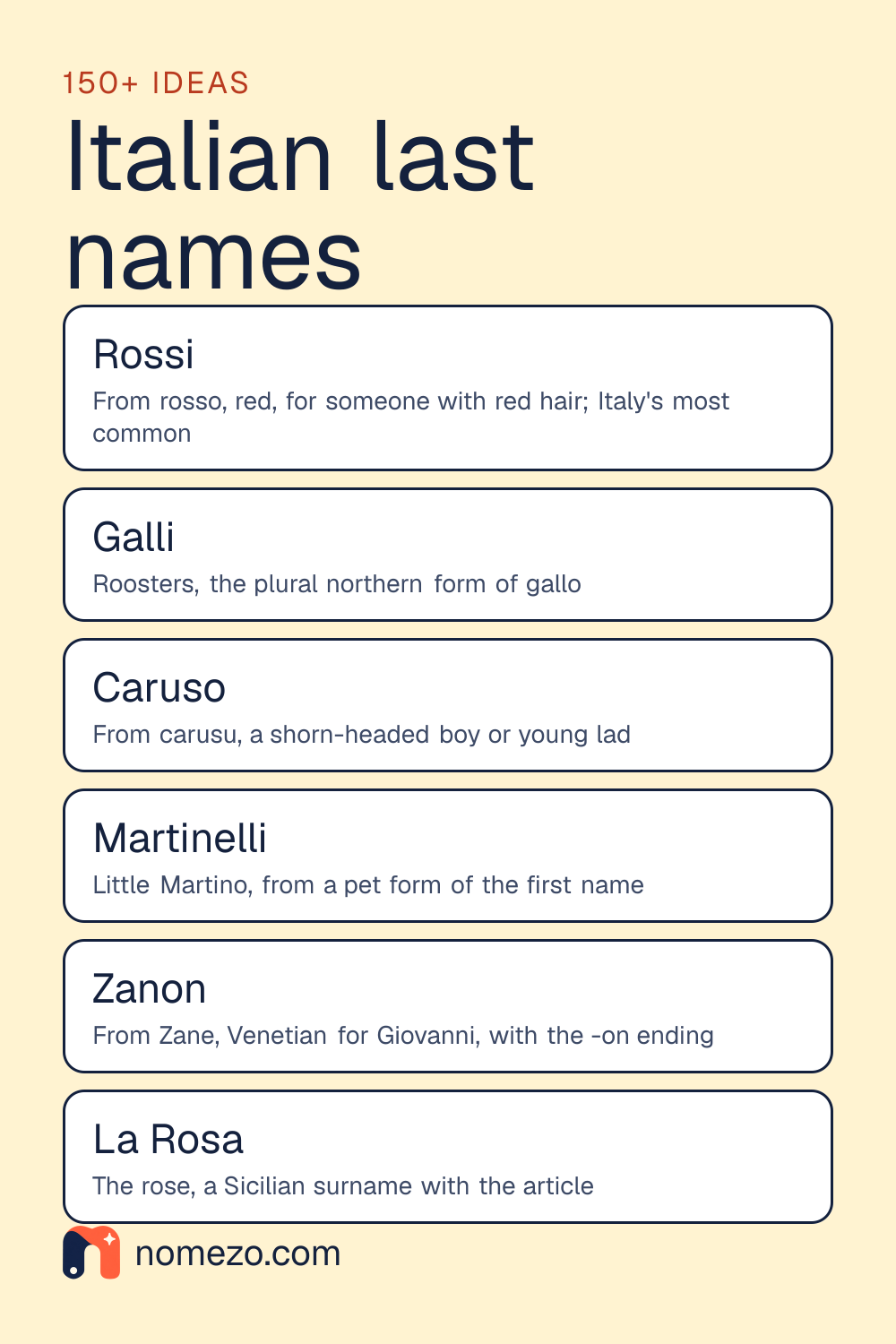
Sardinian for pig, an old farming nickname
La Rosa
The rose, a Sicilian surname with the article
Visentin
For someone from Vicenza
Mantovani
For someone from Mantua
Brambilla
From the town of Brembilla, near Bergamo; typical of Lombardy
Calzolari
Shoemakers, from calzolaio, a maker of shoes
Italian name tools
Read what a surname's ending says about where a family came from, see every surname a child can take from two parents under the 2022 ruling, and check first names against the rules of Italy's civil registry.
Read a surname
- Esposito: exposed: a name given to abandoned children, especially in Naples.
- -o is the singular form, the usual ending in the south.
Endings are tendencies, not rules: families moved, and names travelled with them.
A child's surname from both parents
- Rossi RussoBoth surnames, in the order the parents agree
- Russo RossiBoth surnames, the other order
- RossiOnly the first parent's surname, if both agree
- RussoOnly the second parent's surname, if both agree
If the parents disagree, a judge decides. A parent with two surnames passes on one.
Would the registry accept it?
- Andrea is a boy's name in Italy. The name must match the child's sex; courts have disagreed about Andrea for a girl.
This checks the main rules of DPR 396/2000 and is not legal advice.
Most common Italian last names
The surnames you meet most often across Italy, led by Rossi. Many describe hair color or a trade.
- Rossi US #1,387: From rosso, red, for someone with red hair; Italy's most common
- Russo US #740: Southern form of rosso, red, for a red-haired ancestor
- Ferrari US #4,311: A smith, from ferro, iron; the northern plural form
- Bianchi US #4,196: White, for white hair or a very pale face
- Romano US #1,247: From Rome, or from the first name Romano
- Colombo US #6,835: Dove; Lombardy's top surname, often given to Milan's foundlings
- Ricci US #3,161: From the Italian word for curly, for curly hair
- Greco US #2,165: Greek, for someone of Greek origin; common in the south
- Bruno US #1,160: Brown, for someone with brown hair or skin
- Gallo US #1,610: Rooster, a nickname for a proud or showy man
- Conti US #3,590: From conte, count, for someone in a count's service
- De Luca US #2,308: Son of Luca, the Italian form of Luke
- Mancini US #3,369: From mancino, meaning left-handed
- Costa US #890: Slope or coast, for someone living on a hillside
- Giordano US #2,273: From a first name honoring the River Jordan
- Rizzo US #2,001: Curly-haired, a southern form of riccio
- Lombardi US #2,614: For someone from Lombardy, land of the Lombards
Northern Italian surnames
Most end in -i, from medieval Latin records (Petrus filius Martini, Peter son of Martino) or a family plural, the Bianchi or the Martini.
- Galli US #10,795: Roosters, the plural northern form of gallo
- Neri US #4,462: Black, for someone with very dark hair
- Biondi US #14,026: Blond, for someone with fair hair
- Mori US #8,009: Moorish or dark, for a dark-haired person
- Martini US #4,643: Son of Martino, the family of Martin
- Bernardi US #10,501: Son of Bernardo, from Germanic words for bear and hardy
- Cavalli US #29,143: Horses, for a horse dealer or horseman
- Rinaldi US #4,818: Son of Rinaldo, a Germanic name meaning counsel and rule
- Ferri US #11,045: Iron, for an ironworker
- Brambilla US #80,054: From the town of Brembilla, near Bergamo; typical of Lombardy
- Villa US #653: Town or village, from Latin villa; very common in Lombardy
- Riva US #19,483: Bank or shore, for a family by a river or lake
- Sala US #9,687: Hall or manor house; typical of Lombardy
- Cattaneo US #33,184: Captain or minor lord, from Latin capitaneus
- Medici US #29,248: Doctors, from medico; Florence's ruling family
Southern Italian surnames
Most keep a singular ending in -o or -e. Many are nicknames, saints' names or Norman and Greek first names.
- Caruso US #1,807: From carusu, a shorn-headed boy or young lad
- Longo US #2,943: Tall, from Latin longus, long
- Basile US #4,825: From the first name Basilio, Greek for royal
- Pagano US #4,365: Villager or countryman, from Latin paganus
- Santoro US #4,203: From Latin sanctorum, for a child born on All Saints' Day
- Coppola US #4,258: Cap, for a maker or wearer of caps
- Cirillo US #9,457: From the Greek first name Kyrillos, lordly
- Vitale US #2,810: From a first name meaning full of life
- Palumbo US #3,386: Wood pigeon, a southern nickname
- Aiello US #4,026: From places named Aiello, from Latin agellus, little field
- Barone US #3,013: Baron, for someone in a baron's household
- Gentile US #2,535: Kind or noble, from Latin gentilis
- Ruggiero US #3,927: From Roger, a first name brought south by the Normans
- Bianco US #4,454: White, the southern singular form, for white hair or a very pale face
Italian surnames with pet-form endings
Endings like -ini, -etti, -elli, -ucci and -otti mean little. Tuscany and the Marche favor -ucci, Tuscany -ai and Friuli -utti.
- Martinelli US #6,964: Little Martino, from a pet form of the first name
- Bellini US #22,253: From Bellino, a pet form of bello, handsome
- Puccini US #41,948: From Puccio, a Tuscan pet form of Iacopo, James
- Vannucci US #44,823: From Vanni, a Tuscan short form of Giovanni
- Paolucci US #16,390: Little Paolo, with the -ucci ending of Tuscany and the Marche
- Niccolai US #90,184: From Niccolò, Nicholas, with the Tuscan -ai ending
- Marchetti US #8,140: Little Marco, a pet form of Mark
- Rossetti US #9,404: Little red one, a pet form of rosso
- Morelli US #5,499: From a pet form of Mauro, Latin Maurus, a Moor
- Bianchini US #17,347: Little white one, a pet form of bianco
- Zanetti US #26,847: Little Zane, the Venetian form of Gianni
- Bortolotti US #97,730: From Bortolo, Bartholomew; common in Trentino
- Antonelli US #7,779: Little Antonio, the family of Anthony
- Giannini US #9,744: Little Gianni, a pet form of Giovanni
- Cappelletti US #30,865: Little hats, for a hatmaker
Venetian surnames
The Veneto often drops the final vowel, giving endings in -n and -on, and uses Da and Dal, from and from the.
- Zanon US #55,400: From Zane, Venetian for Giovanni, with the -on ending
- Meneghin US #150,935: From Menego, the Venetian form of Domenico
- Perin US #27,169: From Piero, a Venetian pet form of Pietro
- Bortolin: From Bortolo, the Venetian form of Bartolomeo
- Marcon US #44,416: Big Marco, with the Venetian -on ending
- Benetton: From Benetto, Venetian for Benedetto, with -on
- Visentin US #113,565: For someone from Vicenza
- Trevisan US #52,580: For someone from Treviso
- Padovan US #108,965: For someone from Padua
- Furlan US #32,948: For someone from Friuli, in the regional language
- Schiavon: Slav, or from the village of Schiavon near Vicenza
- Favaro US #56,329: Smith, the Venetian form of fabbro
- Boscolo: A classic Chioggia surname, from bosco, wood
- Dal Molin US #90,848: From the mill, with the Venetian preposition dal
Sicilian and Sardinian surnames
Sicilian names show Greek, Norman and Spanish roots and often keep an article, La or Lo. Sardinian names come from the Sardinian language.
- La Rosa US #5,229: The rose, a Sicilian surname with the article
- Lo Bianco US #29,114: The white one, for fair hair, with Sicilian lo
- La Torre US #7,855: The tower, for a family living by one
- Lo Monaco US #19,770: The monk, a nickname or a monastery worker
- Lo Iacono US #17,058: The deacon, from Greek diakonos
- Cavallaro US #9,657: Horseman or horse keeper, with the Sicilian -aro ending
- Saitta US #27,817: Sicilian for arrow, from Latin sagitta
- Catalano US #3,909: For someone from Catalonia, a legacy of Aragonese rule
- Puglisi US #12,170: For someone from Puglia, with the Sicilian -isi ending
- Messina US #2,886: For someone from the port city on the Strait
- Sanna US #32,900: Sardinian for fang; the island's most common surname
- Pinna US #76,236: Sardinian pinna, feather, or possibly a nickname for the nostril
- Porcu: Sardinian for pig, an old farming nickname
- Floris US #46,623: Sardinian word meaning flowers
- Nieddu: Sardinian for black, for dark hair
- Cadeddu: Sardinian for puppy, an affectionate nickname
- Frau: Sardinian word for a blacksmith
- Cossu US #107,521: Corsican, for a family from the neighboring island
- Manca US #69,752: Sardinian for left, for a left-handed person
- Marras US #156,449: Sardinian for hoes, the farming tool
Occupational Italian surnames
Medieval trades that became family names. The north tends to use the plural -i, the south the singular -o.
- Ferraro US #2,986: Smith or ironworker, the southern singular form
- Fabbri US #23,186: Smiths, from fabbro, blacksmith
- Sartori US #14,640: Tailors, from Latin sartor
- Molinari US #10,598: Millers, the people who ran the mill
- Barbieri US #7,704: Barbers, who also performed minor surgery
- Pastore US #8,438: Shepherd, someone who kept sheep
- Pescatore US #32,985: Fisherman, from pescare, to fish
- Notaro US #18,191: Notary, the keeper of legal records
- Giudice US #24,125: Judge, for a magistrate or his family
- Speziale US #37,907: Apothecary or spice dealer
- Fornari US #69,752: Bakers, from forno, oven
- Calzolari: Shoemakers, from calzolaio, a maker of shoes
- Vaccaro US #5,426: Cowherd, from vacca, cow
- Tessitore US #35,388: Weaver, from tessere, to weave
- Bottai: Coopers, makers of barrels; a Tuscan -ai name
- Massaro US #7,433: Farm manager, from massa, a farming estate
Italian surnames with De, Di and D'
De and Di mean of, so Di Stefano is the son or family of Stefano. These forms are most common in central and southern Italy.
- Di Stefano US #5,713: Son of Stefano, from Greek stephanos, crown
- De Angelis US #4,640: Of the angels, a Latin genitive form
- D'Amico US #2,856: Son of Amico, friend
- Di Pietro US #6,207: Son of Pietro, from Greek petros, rock
- Di Giovanni US #7,955: Son of Giovanni, the Italian John
- D'Alessandro US #6,095: Son of Alessandro, defender of men
- De Santis US #3,744: Of the saints, a Latin form common in Abruzzo
- Di Marco US #8,043: Son of Marco, the Italian Mark
- De Martino US #11,656: Son of Martino, the Italian Martin
- Di Benedetto US #8,122: Son of Benedetto, blessed
- Di Lorenzo US #9,817: Son of Lorenzo, Laurence, from the Roman town Laurentum
- D'Agostino US #4,166: Son of Agostino, Augustine, venerable
- Del Vecchio US #7,342: Of the old man, for the elder's family
- De Laurentiis US #154,182: Of Laurentius, a Latin -iis form from Abruzzo
- D'Angelo US #3,118: Son of Angelo, messenger
Italian surnames from places
Names given to newcomers, recording the city, region or country a family came from.
- Calabrese US #4,209: For someone from Calabria
- Napolitano US #5,127: For someone from Naples
- Genovese US #7,028: For someone from Genoa
- Pisano US #7,559: For someone from Pisa
- Veneziano US #25,558: For someone from Venice
- Siciliano US #9,213: For someone from Sicily
- Toscano US #3,885: For someone from Tuscany
- Fiorentino US #11,570: For someone from Florence
- Milanese US #40,000: For someone from Milan
- Mantovani US #55,082: For someone from Mantua
- Albanese US #5,594: Albanian, often for the Arbëreshë of southern Italy
- Tedesco US #5,829: German, for a family from north of the Alps
Italian foundling surnames
Abandoned children were given surnames by the institutions that raised them. Some of these, like Esposito and Colombo, are now among Italy's most common names.
- Esposito US #1,631: Latin expositus, placed outside; given to foundlings, especially in Naples
- Innocenti US #41,249: Innocent ones, a name given at Florence's foundling hospital
- Proietti US #50,074: Cast away, a name given to abandoned children
- Degli Esposti: Of the foundlings; typical of Bologna
- Diotallevi: May God raise you
- Trovato US #17,094: Found, for a child found and taken in
- Sperandio US #74,428: Hope in God, given to children in charity's care
- Di Dio US #24,443: Of God, given to children entrusted to charity
- Degl'Innocenti: Of the Innocents, after the foundling hospital in Florence
- Allevi: Short form of a foundling name meaning may God raise you
How to pick the right name
Let the ending set the region
A surname ending in -i reads northern, one in -o usually reads southern, and Zanon or Furlan reads Venetian. These are tendencies: Lombardy's most common surname, Colombo, ends in -o.
Mind spaces and apostrophes
In Italy, De Luca, D'Angelo and Lo Bianco keep their spaces and apostrophes. In the US many became DeLuca or Deluca, which is also authentic for an Italian American character.
Read the meaning first
Many surnames are nicknames: Mancini means left-handed and Ricci means curly-haired. Others, like Esposito, record a family's history. The notes help you choose with care.
Save this list for later
Pin it to a naming board, or tap the heart next to any name to keep it in your favorites on this device.
Italian last names, checked: why the rankings are estimates, why Russo beats Rossi in America, and where foundling names come from
By The Nomezo Editors · Updated October 26, 2026 · How we research names
Rossi tops every list of Italy's most common surnames, but Italy publishes no official count, so every ranking is an estimate. In the US the picture flips: Russo, the southern form, is carried by 45,790 Americans, almost twice as many as Rossi, because most Italian immigrants came from the south and Sicily.
Many common Italian surnames began as names given to abandoned children, from Esposito in Naples to Colombo in Milan. The kit above reads what a surname's ending suggests and builds a child's surname from both parents, and the tags show each name's rank among US surnames.
Italian surnames in the US: the southern forms win
- Spellings merge in America. Delorenzo (3,501 people) now outnumbers Di Lorenzo (3,149), and Deangelo has 4,562 bearers beside D'Angelo's 11,263 (US Census Bureau).
- No official ranking in Italy. Italy's statistics office and national registry do not publish surname counts, for privacy reasons; the usual lists go back to the linguist Emidio De Felice's 1970s count of phone subscribers, which missed people without phones (Geopop).
| Northern form | People | Southern form | People |
|---|---|---|---|
| Rossi | 25,108 | Russo | 45,790 |
| Galli | 2,823 | Gallo | 21,711 |
| Ricci | 11,142 | Rizzo | 17,631 |
| Ferrari | 7,969 | Ferraro | 11,797 |
| Lombardi | 13,474 | Lombardo | 14,506 |
Source: US Census Bureau, 2020. About 4 million Italians reached the US between 1880 and 1914, mostly from southern Italy and Sicily (Wikipedia).
Where the foundling names come from
- Each city had its own. Esposito is mainly from Naples and Campania, Proietti from Lazio and Umbria, Innocenti from Florence and Tuscany, Degli Esposti from Bologna, and Trovato and Di Dio from Sicily (Treccani).
- Colombo was a dove on a badge. Many Colombos in Milan and Lombardy descend from children of the foundling hospital of Santa Caterina della Ruota, whose emblem was a dove (Treccani). Colombo is now Lombardy's most common surname.
- Naples stopped naming every foundling Esposito in 1811, after a decree of Joachim Murat's Kingdom of Naples (Wikipedia)).
- Check the meaning. Aiello comes from places named Aiello, from Latin agellus, little field (Behind the Name), and Morelli from a pet form of the first name Mauro (Behind the Name), not from moro, dark.
Sources
Frequently asked questions
What is the most common Italian last name?
Rossi, by every estimate, followed by names such as Russo, Ferrari, Esposito and Bianchi. Italy publishes no official surname count, so rankings come from estimates such as phone directories. Rossi and Russo both mean red, for a red-haired ancestor.
Why do so many Italian last names end in -i?
Medieval Latin records often named a man as son of his father, as in Petrus filius Martini, which gave Pietro Martini. A family could also be named in the plural, so one man of the Bianco family was a Bianchi. Either way, the -i stuck, especially in the north and center.
Can you tell where an Italian surname is from by its ending?
Often, yes. Endings in -i are typical of the north, -o of the south, -n and -on of the Veneto, -otti and -utti of Friuli, and -u, -as or -is of Sardinia. These are tendencies rather than rules.
What does Esposito mean?
Esposito comes from Latin expositus, placed outside, and was given to abandoned children, especially in Naples. It is now one of the most common surnames in Italy.
What do De and Di mean in Italian surnames?
Both mean of. Di Stefano is the son or family of Stefano, and De Santis means of the saints. These forms are most common in central and southern Italy.
What is the most common Italian last name in the US?
Russo. The 2020 US Census counts 45,790 Americans named Russo, far more than the 25,108 named Rossi, even though Rossi leads in Italy. Most Italian immigrants came from the south, where the -o forms are usual.
Do Italian children get both parents' surnames?
They can. Since a 2022 Constitutional Court ruling, a child takes both parents' surnames unless the parents agree on one. In 2025, 7.3% of babies born in Italy got both, up from 6.7% in 2024, according to ISTAT.
More last names and generators
- Italian boy names163 names. Italian boy names and men's names with meanings and pronunciation: popular picks like Leonardo, classics, Gian- blends, nicknames for guys and saints' names.
- Italian girl names146 names. Italian girl names and Italian women's names with meanings and easy pronunciation: Sofia and Aurora, timeless classics, saints' names and vintage names.
- Spanish last names170 names. Spanish last names with meanings: the most popular surnames in Spain, -ez patronymics, Basque, Catalan and Galician names, and how a last name in Spanish works.
- Last NamesLast names and surnames with meanings and origins: cool, pretty, rare and unique last names, plus a surname generator.
- Italian name generatorReal Italian first names and surnames, each with its meaning.
- Italian city names139 names. Italian city names by region, from Rome and Florence to hill towns like Orvieto and Matera. 130+ real places, each with a checked origin or fact.
- Cool last names182 names. Cool last names with real origins: classic, job, nature, animal, global, fancy and strong surnames, plus 30+ invented last names for characters.
- Names by OriginNames by origin and culture: Japanese, French, Irish, Italian, Spanish, Norse, Greek, Arabic and more, with meanings and pronunciation.
- Russian last names148 names. Russian last names with meanings and Cyrillic: common, patronymic, occupational, animal, church and noble surnames, with -ov/-ova and -sky/-skaya explained.