

Russian last names: 140+ surnames and their meanings
148 names · Updated · By The Nomezo Editors · Save to Pinterest
The most common Russian last names are Ivanov, Smirnov and Kuznetsov. Most end in -ov, -ev or -in, possessive endings that make Ivanov literally Ivan's, or son of Ivan. A woman adds -a: Ivanova, Smirnova, Kuznetsova.
Surnames ending in -sky (feminine -skaya) work the same way but come from places, estates and church feasts, so Uspensky means of the Dormition. Below are 140+ real Russian surnames grouped by origin: common names, first names, trades, animals, nature and nicknames, -sky names, places and noble families. Each note gives the meaning, with the stressed syllable in capitals where it helps. The tag beside each name gives its Cyrillic spelling for a man and a woman.
Can't decide? Shuffle 6 random picks
Makarov
Son of Makar, from Greek makarios, blessed. Say mah-KAH-roff
Maksimov
Son of Maksim, Latin for greatest
Ovchinnikov
From ovchinnik, a maker of sheepskins
Kotov
From kot, a tomcat
Ilyin
Son of Ilya, the Russian Elijah
Shuisky
Princely family from the town of Shuya
Russian surname decoder
Type a surname in English or Cyrillic to see its forms for a man, a woman and a family, what its ending tells you, and how it is spelled in passports, maps, library catalogs and German records.
Try:
Common Russian last names
The surnames you meet most often in Russia. In the pronunciations, the stressed syllable is in capitals.
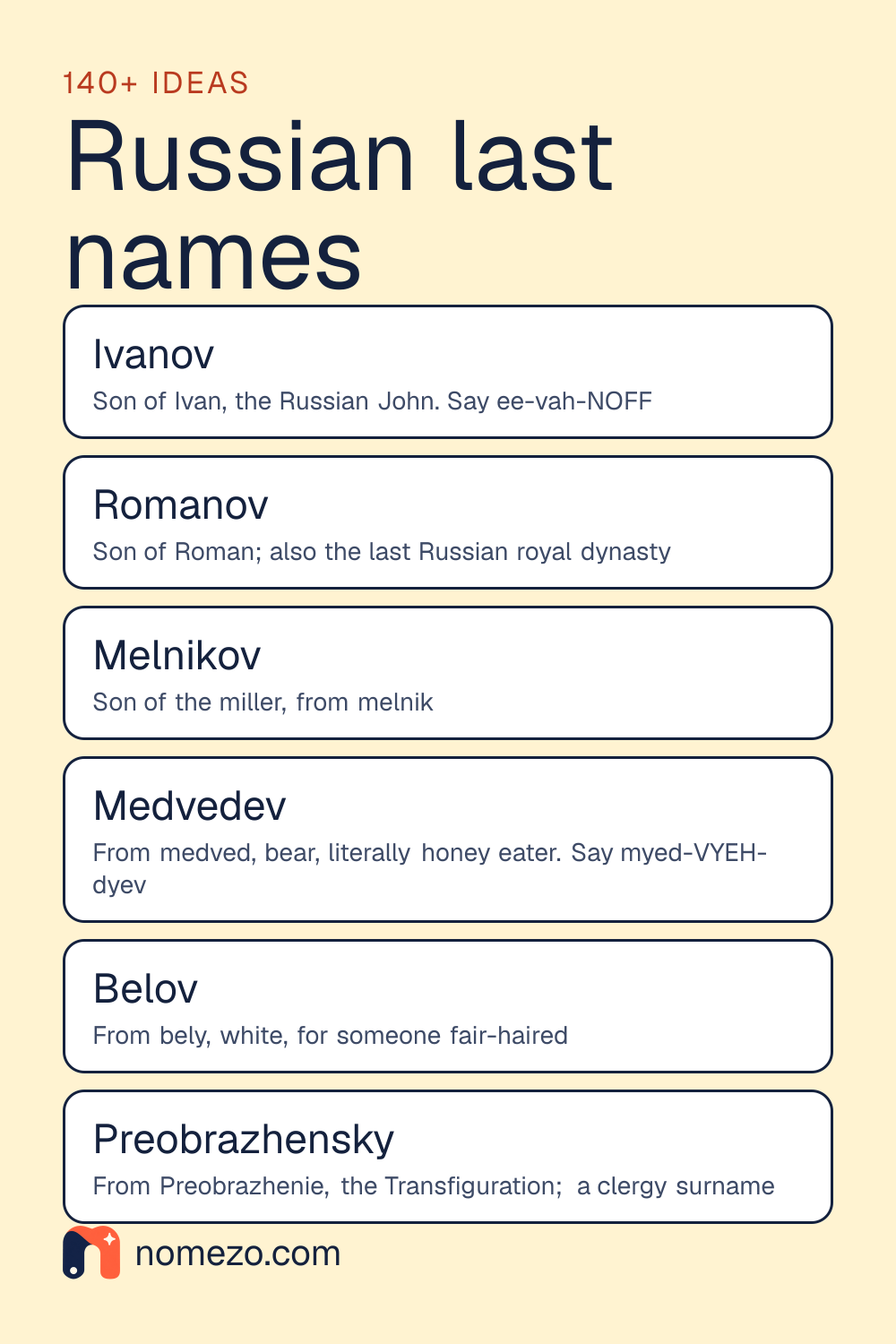
- Ivanov Иванов Иванова: Son of Ivan, the Russian John. Say ee-vah-NOFF
- Smirnov Смирнов Смирнова: From smirny, quiet or meek. Say smeer-NOFF
- Kuznetsov Кузнецов Кузнецова: From kuznets, blacksmith. Say kooz-nyeh-TSOFF
- Popov Попов Попова: Son of the priest, from pop. Say pah-POFF
- Vasiliev Васильев Васильева: Son of Vasily, from Greek Basil, royal. Say vah-SEEL-yev
- Petrov Петров Петрова: Son of Pyotr, Peter, meaning stone. Say pyeh-TROFF
- Sokolov Соколов Соколова: From sokol, falcon. Say sah-kah-LOFF
- Mikhailov Михайлов Михайлова: Son of Mikhail, the Russian Michael. Say mee-KHY-loff
- Novikov Новиков Новикова: From novik, a newcomer or young recruit. Say NO-vee-koff
- Fyodorov Фёдоров Фёдорова: Son of Fyodor, Theodore, gift of God. Say FYO-dah-roff
- Morozov Морозов Морозова: From moroz, frost. Say mah-RO-zoff
- Volkov Волков Волкова: From volk, wolf; one of the most familiar animal surnames
- Alekseev Алексеев Алексеева: Son of Aleksei, from Greek for defender. Say ah-lek-SAY-ev
- Lebedev Лебедев Лебедева: From lebed, swan. Say LYEH-byeh-dyev
- Semenov Семёнов Семёнова: Son of Semyon, the Russian Simeon. Say seh-MYO-noff
- Yegorov Егоров Егорова: Son of Yegor, a Russian form of George. Say yeh-GO-roff
- Pavlov Павлов Павлова: Son of Pavel, Paul, from Latin for small. Say PAHV-loff
- Kozlov Козлов Козлова: From kozyol, billy goat. Say kahz-LOFF
- Stepanov Степанов Степанова: Son of Stepan, Stephen, Greek for crown. Say styeh-PAH-noff
- Nikolaev Николаев Николаева: Son of Nikolai, Nicholas, victory of the people
- Orlov Орлов Орлова: From oryol, eagle. Say ar-LOFF
- Makarov Макаров Макарова: Son of Makar, from Greek makarios, blessed. Say mah-KAH-roff
- Nikitin Никитин Никитина: Son of Nikita, from Greek for victor. Say nee-KEE-tin
- Zakharov Захаров Захарова: Son of Zakhar, Zachary, God has remembered. Say zah-KHAH-roff
Russian surnames from first names
Many surnames grew from a father's or grandfather's first name. The -ov, -ev or -in ending means belonging to him.
- Romanov Романов Романова: Son of Roman; also the last Russian royal dynasty
- Borisov Борисов Борисова: Son of Boris, a name of early Russian princes
- Antonov Антонов Антонова: Son of Anton, the Russian Anthony
- Gavrilov Гаврилов Гаврилова: Son of Gavriil, the Russian Gabriel
- Grigoriev Григорьев Григорьева: Son of Grigory, Gregory, Greek for watchful
- Davydov Давыдов Давыдова: Son of Davyd, David, Hebrew for beloved
- Tarasov Тарасов Тарасова: Son of Taras, an old Greek saint's name
- Filippov Филиппов Филиппова: Son of Filipp, Greek for lover of horses
- Maksimov Максимов Максимова: Son of Maksim, Latin for greatest
- Yakovlev Яковлев Яковлева: Son of Yakov, the Russian Jacob
- Danilov Данилов Данилова: Son of Danila, Daniel, Hebrew for God is my judge
- Matveev Матвеев Матвеева: Son of Matvei, Matthew, gift of God
- Sergeev Сергеев Сергеева: Son of Sergei, from the Roman family name Sergius
- Kirillov Кириллов Кириллова: Son of Kirill, Cyril, from Greek for lord
- Fomin Фомин Фомина: Son of Foma, the Russian Thomas
- Ilyin Ильин Ильина: Son of Ilya, the Russian Elijah
- Kuzmin Кузьмин Кузьмина: Son of Kuzma, from the Greek saint Kosmas
- Sidorov Сидоров Сидорова: Son of Sidor, a folk form of Isidore
- Karpov Карпов Карпова: Son of Karp, from Greek karpos, fruit
- Denisov Денисов Денисова: Son of Denis, from Greek Dionysios
- Timofeev Тимофеев Тимофеева: Son of Timofei, Timothy, Greek for honoring God
- Afanasiev Афанасьев Афанасьева: Son of Afanasy, from Greek for immortal
- Osipov Осипов Осипова: Son of Osip, a folk form of Joseph
- Lukin Лукин Лукина: Son of Luka, the Russian Luke
Occupational Russian surnames
Trades and church jobs that became family names. Kuznetsov, the smith, is the best known; here are the rest.
- Melnikov Мельников Мельникова: Son of the miller, from melnik
- Goncharov Гончаров Гончарова: From gonchar, a potter
- Kozhevnikov Кожевников Кожевникова: From kozhevnik, a leather tanner
- Rybakov Рыбаков Рыбакова: From rybak, a fisherman
- Plotnikov Плотников Плотникова: From plotnik, a carpenter
- Pastukhov Пастухов Пастухова: From pastukh, a shepherd or herdsman
- Bondarev Бондарев Бондарева: From bondar, a barrel maker or cooper
- Kalashnikov Калашников Калашникова: Son of a kalach maker; kalach is a ring-shaped bread
- Ovchinnikov Овчинников Овчинникова: From ovchinnik, a maker of sheepskins
- Krasilnikov Красильников Красильникова: From krasilnik, a cloth dyer
- Tkachev Ткачёв Ткачёва: From tkach, a weaver. Say tkah-CHOFF
- Shvetsov Швецов Швецова: From shvets, a tailor or shoemaker
- Dyakov Дьяков Дьякова: From dyak, a church clerk or government scribe
- Ponomarev Пономарёв Пономарёва: From ponomar, a church sexton
- Konovalov Коновалов Коновалова: From konoval, a horse healer
- Sapozhnikov Сапожников Сапожникова: From sapozhnik, a boot maker
- Kolesnikov Колесников Колесникова: From kolesnik, a wheelwright
- Myasnikov Мясников Мясникова: From myasnik, a butcher
- Pushkarev Пушкарёв Пушкарёва: From pushkar, a cannon gunner
Russian last names from animals and birds
Animal nicknames are everywhere in Russian surnames. Volkov (wolf), Orlov (eagle) and Sokolov (falcon) are in the common list above.
- Medvedev Медведев Медведева: From medved, bear, literally honey eater. Say myed-VYEH-dyev
- Zaitsev Зайцев Зайцева: From zayats, hare. Say ZY-tsev
- Golubev Голубев Голубева: From golub, a dove or pigeon
- Vorobyov Воробьёв Воробьёва: From vorobei, sparrow. Say vah-rah-BYOFF
- Gusev Гусев Гусева: From gus, a goose
- Solovyov Соловьёв Соловьёва: From solovei, nightingale. Say sah-lah-VYOFF
- Komarov Комаров Комарова: From komar, a mosquito
- Voronin Воронин Воронина: From voron, a raven
- Lisitsyn Лисицын Лисицына: From lisitsa, a fox
- Belkin Белкин Белкина: From belka, a squirrel
- Zhuravlev Журавлёв Журавлёва: From zhuravl, crane. Say zhoo-rahv-LYOFF
- Sorokin Сорокин Сорокина: From soroka, magpie. Say sah-RO-kin
- Kotov Котов Котова: From kot, a tomcat
- Baranov Баранов Баранова: From baran, a ram
- Bykov Быков Быкова: From byk, a bull
- Petukhov Петухов Петухова: From petukh, a rooster
- Sinitsyn Синицын Синицына: From sinitsa, a titmouse
- Shchukin Щукин Щукина: From shchuka, a pike fish. Say SHCHOO-kin
- Ershov Ершов Ершова: From yorsh, a small spiny ruffe fish
- Utkin Уткин Уткина: From utka, a duck
- Galkin Галкин Галкина: From galka, a jackdaw
- Skvortsov Скворцов Скворцова: From skvorets, a starling
- Kukushkin Кукушкин Кукушкина: From kukushka, a cuckoo
- Karasev Карасёв Карасёва: From karas, the crucian carp
Russian surnames from nature and nicknames
Colors, weather, plants and personality: a fair-haired man became Belov, a quiet one Molchanov.
- Belov Белов Белова: From bely, white, for someone fair-haired
- Chernov Чернов Чернова: From cherny, black, for someone dark-haired
- Krasnov Краснов Краснова: From krasny, red, which once also meant beautiful
- Sedov Седов Седова: From sedoy, gray-haired, a nickname
- Molchanov Молчанов Молчанова: From molchan, a silent person
- Veselov Веселов Веселова: From vesely, cheerful, a nickname
- Gromov Громов Громова: From grom, the word for thunder
- Bystrov Быстров Быстрова: From bystry, quick or fast
- Kudryavtsev Кудрявцев Кудрявцева: From kudryavy, curly-haired, a nickname
- Tsvetkov Цветков Цветкова: From tsvetok, a flower
- Vinogradov Виноградов Виноградова: From vinograd, grapes or vineyard
- Zimin Зимин Зимина: From zima, the word for winter
- Malinin Малинин Малинина: From malina, the raspberry
- Berezin Березин Березина: From bereza, a birch tree
- Kamenev Каменев Каменева: From kamen, a stone
- Tikhomirov Тихомиров Тихомирова: Seminary surname from tikhy mir, quiet peace
Russian last names ending in -sky
The -sky ending (feminine -skaya) means of or from. Priests' families often took surnames from church feasts, and princes from their towns.
- Preobrazhensky Преображенский Преображенская: From Preobrazhenie, the Transfiguration; a clergy surname
- Voskresensky Воскресенский Воскресенская: From Voskresenie, the Resurrection; a clergy surname
- Uspensky Успенский Успенская: From Uspenie, the Dormition of Mary
- Rozhdestvensky Рождественский Рождественская: From Rozhdestvo, the Nativity, or Christmas
- Troitsky Троицкий Троицкая: From Troitsa, the Holy Trinity
- Pokrovsky Покровский Покровская: From Pokrov, the feast of the Intercession
- Znamensky Знаменский Знаменская: From Znamenie, the Sign, a famous icon of Mary
- Bogoyavlensky Богоявленский Богоявленская: From Bogoyavlenie, the Epiphany
- Vvedensky Введенский Введенская: From the feast of the Presentation of Mary
- Nikolsky Никольский Никольская: From a church of Saint Nicholas
- Dubrovsky Дубровский Дубровская: From dubrava, an oak grove, via place names
- Polyansky Полянский Полянская: From polyana, a forest clearing, via place names
- Ozersky Озерский Озерская: From ozero, lake, via place names
- Volkonsky Волконский Волконская: Princely family named for the Volkona River
- Obolensky Оболенский Оболенская: Princely family named for the town of Obolensk
- Vyazemsky Вяземский Вяземская: Princely family from the town of Vyazma
- Shuisky Шуйский Шуйская: Princely family from the town of Shuya
- Trubetskoy Трубецкой Трубецкая: Princely family from Trubchevsk; note the -skoy ending
Russian surnames from places and peoples
Some surnames simply said where a family came from, or which neighboring people they belonged to.
- Kazantsev Казанцев Казанцева: From kazanets, someone from Kazan
- Polyakov Поляков Полякова: From polyak, a Pole
- Litvinov Литвинов Литвинова: From litvin, a Lithuanian
- Tatarinov Татаринов Татаринова: From tatarin, a Tatar
- Nemtsov Немцов Немцова: From nemets, a German or foreigner
- Kazakov Казаков Казакова: From kazak, a Cossack
- Permyakov Пермяков Пермякова: From permyak, a person from the Perm region
- Muromtsev Муромцев Муромцева: From muromets, someone from the old town of Murom
- Vyatkin Вяткин Вяткина: From Vyatka, a northern region and river
- Donskoy Донской Донская: From the lands along the Don River
- Sibiryakov Сибиряков Сибирякова: From sibiryak, a Siberian
- Karelin Карелин Карелина: From Karelia, or a Karelian person
- Moskvin Москвин Москвина: From Moskva, the city of Moscow
Noble and historic Russian surnames
Old boyar and princely families, plus a few surnames with surprising foreign roots.
- Dolgorukov Долгоруков Долгорукова: From dolgaya ruka, long arm, a prince's nickname
- Golitsyn Голицын Голицына: From golitsa, a battle glove; a princely family
- Gagarin Гагарин Гагарина: From gagara, loon, a princely ancestor's nickname
- Lopukhin Лопухин Лопухина: From lopukh, burdock; an old boyar family
- Karamzin Карамзин Карамзина: From the Tatar name Kara-Murza, black prince
- Yusupov Юсупов Юсупова: Princely family that traced its line to Yusuf, a Nogai ruler
- Lermontov Лермонтов Лермонтова: From the Scottish surname Learmonth
- Fonvizin Фонвизин Фонвизина: From von Wiesen, a Livonian German knight's family
- Belozersky Белозерский Белозерская: Princely family from Beloozero, the white lake
- Odoevsky Одоевский Одоевская: Princely family from the town of Odoyev
How to pick the right name
Match the ending to the person
Russian surnames change with gender. Ivanov is a man, Ivanova a woman, and Uspensky becomes Uspenskaya. Surnames ending in -ykh, like Sedykh, stay the same for everyone.
Mind the stress
Stress is hard to predict. Smirnov and Petrov stress the last syllable, while Pavlov and Novikov stress the first. Use the guides in the notes so the name sounds right aloud.
Pick a meaning that fits
A watchful detective called Sokolov (falcon) or a calm doctor called Tikhomirov (quiet peace) gets a hidden layer that Russian speakers will notice.
Choose one spelling
Russian names have several English spellings, such as Vasiliev and Vasilyev or Semenov and Semyonov. Pick one and use it consistently.
Save this list for later
Pin it to a naming board, or tap the heart next to any name to keep it in your favorites on this device.
How a full Russian name works
By The Nomezo Editors · Updated October 22, 2026 · How we research names
A Russian full name has three parts, and only the last one is the family name. In Иван Иванович Алексеев, Ivan Ivanovich Alekseev, Ivan is his given name, Ivanovich says his father was called Ivan, and Alekseev is the surname he inherited. His sister is Anna Ivanovna Alekseeva: the same father, so the same patronymic in its feminine form, and the same surname with -a.
Mixing up the middle part and the surname is the most common mistake in family trees and novels. The patronymic changes every generation, because it comes from the father's first name. The surname stays in the family.
| Part | Example (man) | Example (woman) | What it is |
|---|---|---|---|
| Given name (имя) | ИванIvan | АннаAnna | Chosen at birth. Friends and family use a short form: Vanya, Anya. |
| Patronymic (отчество) | ИвановичIvanovich | ИвановнаIvanovna | Made from the father's given name, so it changes every generation. Not a surname. |
| Surname (фамилия) | АлексеевAlekseev | АлексееваAlekseeva | Inherited from the family. Most surnames add -a for women. |
Formal address and official order
Russians address someone politely with the given name and patronymic: a teacher, a boss or an older neighbor is Ivan Ivanovich, never Mr. Alekseev in everyday speech. Friends use a short form such as Vanya. Official forms, registers and class lists often put the surname first: Alekseev Ivan Ivanovich.
Patronymics follow simple rules, with a few exceptions
Add -ovich or -evich for a son and -ovna or -evna for a daughter: Pavel gives Pavlovich and Pavlovna, Sergey gives Sergeyevich and Sergeyevna. A handful of names ending in -a are irregular: Ilya gives Ilyich and Ilyinichna, Nikita gives Nikitich and Nikitichna, and Foma, Luka and Kuzma work the same way. Build one below.
Full Russian name builder
- Full name
- Анна Ивановна АлексееваAnna Ivanovna Alekseeva
- Surname first (forms and registers)
- Алексеева Анна ИвановнаAlekseeva Anna Ivanovna
- Polite address (colleagues, teachers, elders)
- Анна ИвановнаAnna Ivanovna
- Friends and family
- АняAnya
- The whole family
- Алексеевыthe Alekseevs
Russian surname endings decoder
The ending tells you how a surname changes for a woman and a family, and often where it comes from. Most Russian surnames take an extra -a for women; a few endings never change. Some of these endings are more typical of Ukrainian or Belarusian names, so an ending alone is a clue to check, not proof of where a family came from.
| Ending | Man | Woman | The family | What it tells you |
|---|---|---|---|---|
| -ov, -ev | ИвановIvanov | ИвановаIvanova | Ивановыthe Ivanovs | The most common Russian ending. It is possessive: Ivanov first meant Ivan's (son), Kuznetsov the smith's. The root can be a first name, a trade or a nickname. |
| -in, -yn | НикитинNikitin | НикитинаNikitina | Никитиныthe Nikitins | The same possessive idea on roots ending in -a or a soft sign: Nikita gives Nikitin, Ilya gives Ilyin. |
| -sky, -tsky | УспенскийUspensky | УспенскаяUspenskaya | Успенскиеthe Uspenskys | An adjective meaning of or from: a place, an estate or, for clergy families, a church feast. Polish names use -ski and Ukrainian -skyi. |
| -skoy, -oy | ТолстойTolstoy | ТолстаяTolstaya | Толстыеthe Tolstoys | Adjective surnames stressed on the ending, like Tolstoy (stout) and Trubetskoy. They change like adjectives. |
| -ykh, -ikh | СедыхSedykh | СедыхSedykh | СедыхSedykh | An old genitive plural from a nickname for a whole family: a son of the Sedye (gray-haired) family was Sedykh. It never changes. Most at home in the Russian North, the Urals and Siberia. |
| -enko, -ko | ШевченкоShevchenko | ШевченкоShevchenko | ШевченкоShevchenko | Typical of Ukrainian surnames. It stays the same for everyone. |
| -uk, -chuk | КовальчукKovalchuk | КовальчукKovalchuk | Ковальчукиthe Kovalchuks | Typical of Ukrainian surnames. In Russian a woman keeps the same form. |
| -ich, -ovich | АбрамовичAbramovich | АбрамовичAbramovich | Абрамовичиthe Abramoviches | Common in Belarusian, Serbian and Croatian surnames and among Jewish families of the former Russian Empire. In Russian a woman keeps the same form. |
| -ago, -yago | ЖивагоZhivago | ЖивагоZhivago | ЖивагоZhivago | A rare old Church Slavonic ending: Zhivago is of the living. It never changes. |
Why so many priests' families end in -sky
From the late 1600s to the mid-1800s, Orthodox seminaries often gave students new surnames. Many came from church feasts: Uspensky (Dormition), Preobrazhensky (Transfiguration), Troitsky (Trinity). Others were Latin: Speransky, from sperans, one who hopes, is the name the statesman Mikhail Speransky received at the Vladimir seminary. Tikhomirov and Smirnov were also given to well-behaved seminarians. See the -sky surnames above.
Why one Russian surname has several English spellings
Alekseev and Alekseyev are the same name. Russian is written in Cyrillic, and every system for turning it into Latin letters makes different choices for a handful of letters. Passports, maps, libraries and old German records each follow their own system, so one family can appear under five spellings. Start from the Cyrillic, and the variants stop looking like different names.
| Letter | Passport | BGN/PCGN | Library of Congress | German | Example |
|---|---|---|---|---|---|
| е | E | e, ye* | e | e, je* | АлексеевALEKSEEV · Alekseyev · Alexejew |
| ё | E | ë, yë* | ë | jo, o | ФёдоровFEDOROV · Fëdorov · Fjodorow |
| ж | ZH | zh | zh | sch | ЖуковZHUKOV · Zhukov · Schukow |
| й | I | y | ĭ | i, j | ШуйскийSHUISKII · Shuyskiy · Schuiski |
| х | KH | kh | kh | ch | ХрущёвKHRUSHCHEV · Khrushchëv · Chruschtschow |
| ц | TS | ts | t͡s | z | КузнецовKUZNETSOV · Kuznetsov · Kusnezow |
| ч | CH | ch | ch | tsch | ТкачёвTKACHEV · Tkachëv · Tkatschow |
| щ | SHCH | shch | shch | schtsch | ЩукинSHCHUKIN · Shchukin · Schtschukin |
| ъ | IE | ” | ʺ | (dropped) | ПодъячевPODIEIACHEV · Pod”yachev · Podjatschew |
| ь | (dropped) | ’ | ʹ | (dropped), j | ВасильевVASILEV · Vasil’yev · Wassiljew |
| ю | IU | yu | i͡u | ju | ЮсуповIUSUPOV · Yusupov · Jussupow |
| я | IA | ya | i͡a | ja | ВяземскийVIAZEMSKII · Vyazemskiy · Wjasemski |
* At the start of a word, after a vowel, and after й, ь or ъ. Russian foreign-travel passports have followed the ICAO standard since 2013; a holder can keep an earlier spelling if they can document it. Soviet passports used French-style spellings, which is where the -off endings of many émigré families come from.
Spellings you will meet for one family
- Алексеев: Alekseev, Alekseyev, Alexeev, Alexeyev, Aleksejew. Е after a vowel is e or ye, and кс can be ks or x.
- Васильев: Vasiliev, Vasilyev, Vasilev, Wassiljew. The soft sign ь has no Latin letter, so it becomes i, y or nothing.
- Семёнов: Semenov, Semyonov, Semjonow. Ё is often printed as е in Russian itself, so English spellings split too.
- Смирнов: Smirnov, Smirnoff, Smirnow. -off is the older French-style ending of émigré families and of the vodka brand.
- Чайковский: Tchaikovsky, Chaykovsky, CHAIKOVSKII, Tschaikowski. Tchaikovsky is a traditional spelling; the others follow BGN/PCGN, the passport and German rules.
Researching a Russian surname
- Find the name in Cyrillic, ideally from a birth, church, census or emigration record.
- Note whether the record gives the man's form or the woman's form, and whether the middle name is a patronymic.
- Run the Cyrillic through the decoder above and search every spelling it lists, including German and -off spellings in older records.
- Search women under both forms: clerks abroad often wrote the man's form for the whole family.
- Keep the spelling the family itself used, and write the Cyrillic beside it so the next researcher can check it.
Russia's most common surnames: three rankings
Ask which surname is most common in Russia and you get two answers, Smirnov or Ivanov, depending on who was counted. A 2005 study led by the geneticist Elena Balanovskaya ranked the surnames of rural families in five regions and put Smirnov first. A list from the Institute of Russian Language the same year, and a 2019 count of about 29 million mobile phone subscribers, both put Ivanov first.
| Rank | Balanovskaya et al., 2005 | Zhuravlev, 2005 | Yumaguzin and Vinnik, 2019 |
|---|---|---|---|
| 1 | Smirnov Смирнов | Ivanov Иванов | Ivanov Иванов |
| 2 | Ivanov Иванов | Smirnov Смирнов | Kuznetsov Кузнецов |
| 3 | Kuznetsov Кузнецов | Kuznetsov Кузнецов | Smirnov Смирнов |
| 4 | Sokolov Соколов | Popov Попов | Popov Попов |
| 5 | Popov Попов | Vasiliev Васильев | Petrov Петров |
| 6 | Lebedev Лебедев | Petrov Петров | Vasiliev Васильев |
| 7 | Kozlov Козлов | Sokolov Соколов | Magomedov Магомедов |
| 8 | Novikov Новиков | Mikhailov Михайлов | Aliyev Алиев |
| 9 | Morozov Морозов | Novikov Новиков | Karimov Каримов |
| 10 | Petrov Петров | Fyodorov Фёдоров | Volkov Волков |
Balanovskaya et al., 2005: rural native residents of five regions; surnames found in all five · Zhuravlev, 2005: Institute of Russian Language, Russian Academy of Sciences · Yumaguzin and Vinnik, 2019: about 29 million mobile phone subscribers
The 2019 list includes Magomedov, Aliyev and Karimov because it counts all of Russia, including the North Caucasus, the Volga region and Central Asian families; the 2005 lists cover Russian surnames only. Where a name is most common is another story. In Vladimir Nikonov's classic Geography of Surnames, Smirnov ranks first in the Upper Volga regions of Yaroslavl, Kostroma and Vologda, and in the 2019 data it peaked in Kostroma region at about 4.4% of people. Ivanov peaked in Pskov region at 4.7%, and Popov is most concentrated in the Komi Republic in the far north.
Talking surnames in Russian literature
Russian writers love a surname that says something about the character, a tradition Russians call govoryashchiye familii, talking names. They are great for fiction and terrible evidence of what real families are called: no study of common surnames includes Raskolnikov. If you borrow one, readers who know the book will hear the joke.
| Surname | Hidden meaning | Work |
|---|---|---|
| RaskolnikovРаскольников | From raskolnik, a schismatic or dissenter: a man split in two. | Crime and Punishment, Fyodor Dostoevsky (1866) |
| KaramazovКарамазов | Usually linked to Turkic kara, black; scholars still argue over the rest of the name. | The Brothers Karamazov, Fyodor Dostoevsky (1880) |
| KareninКаренин | Traced by Russian commentators to Greek karenon, head; Karenina is the feminine form. | Anna Karenina, Leo Tolstoy (1878) |
| BolkonskyБолконский | One letter away from Volkonsky: Tolstoy's grandfather, Prince Nikolai Volkonsky, is believed to be the model for old Prince Bolkonsky. | War and Peace, Leo Tolstoy (1869) |
| BezukhovБезухов | Literally earless; whether Tolstoy meant anything by it is not known. | War and Peace, Leo Tolstoy (1869) |
| OblomovОбломов | From oblomat', to break off: a man who has lost his footing. | Oblomov, Ivan Goncharov (1859) |
| MolchalinМолчалин | From molchat', to keep silent: the yes-man who never contradicts his boss. | Woe from Wit, Alexander Griboyedov (1824) |
| SkalozubСкалозуб | A reversal of zuboskal, a scoffer who bares his teeth. | Woe from Wit, Alexander Griboyedov (1824) |
| ProstakovaПростакова | From prostak, a simpleton. | The Minor, Denis Fonvizin (1782) |
| SobakevichСобакевич | From sobaka, dog: a bearish landowner. | Dead Souls, Nikolai Gogol (1842) |
| KhlestakovХлестаков | From khlestat', to whip or lash: a blusterer. | The Government Inspector, Nikolai Gogol (1836) |
Sources and how we checked
Every meaning on this page comes from published name dictionaries and the Russian words behind each surname; where scholars disagree, the note gives the most widely accepted reading. Cyrillic spellings follow standard Russian. Spellings in the decoder are generated from each system's published letter table, so check a real record when the exact spelling matters.
- Behind the Name: Russian surnames: surname meanings and feminine forms
- Cornell University: Russian naming customs: given name, patronymic and polite address
- Gramota.ru: how Russian surnames decline: which surnames change for women and which never change
- Gramota.ru: Dictionary of Russian Names, on patronymics: patronymic rules and exceptions such as Ilyich and Ilyinichna
- Family Code of the Russian Federation, article 58: the patronymic is given after the father's name
- Wikipedia: Romanization of Russian: side-by-side tables of the passport (ICAO Doc 9303), BGN/PCGN and Library of Congress systems, and the history of passport spellings
- Russian Interior Ministry Order No. 186 (2021): passport spellings follow the international standard
- BGN/PCGN romanization of Russian: the system used by maps, news and most English books
- Library of Congress: ALA-LC Russian romanization table: the system used in library catalogs
- J. P. Pauls, "Names for Characters in Russian Literature", Names 11:1 (1963): meanings of literary talking surnames
- Yumaguzin and Vinnik, "Surnames in modern Russia", Annals of Human Biology (2019): the 2019 ranking from about 29 million mobile subscribers
- List of all-Russian surnames (Balanovskaya et al. 2005; Zhuravlev 2005): the 2005 rankings and how each study was made
- T—Zh: the most common surnames in Russia's regions: where Smirnov, Ivanov and Popov peak, from the 2019 data and Nikonov's Geography of Surnames
- Seminary surnames (Russian Wikipedia, after Unbegaun): clergy surnames from church feasts and Latin, such as Speransky
- Russia Beyond: why some Russian surnames end in -ff: the -off spellings of émigré families
Frequently asked questions
What is the most common Russian last name?
Ivanov, Smirnov and Kuznetsov top most lists of common Russian surnames, with Popov, Vasiliev and Petrov close behind.
What do -ov and -ova mean in Russian last names?
They are possessive endings, so Petrov means Pyotr's, or son of Pyotr. Women use the feminine form ending in -a, so Petrov and his sister Petrova share one family name.
What does -sky mean in Russian surnames?
The -sky ending, feminine -skaya, makes an adjective meaning of or from, usually a place or a church. Many clergy families took names like Uspensky or Troitsky from church feasts.
What are Russian female last names?
They are the feminine forms of the same surnames: Ivanova, Volkova, Sokolova, Nikitina and Uspenskaya. Most add -a, and -sky becomes -skaya.
What Russian last name means wolf?
Volkov, from volk, wolf. Other animal surnames include Medvedev (bear), Orlov (eagle), Sokolov (falcon) and Lisitsyn (fox).
What is a Russian patronymic, and how is it different from a surname?
A patronymic is the middle part of a full Russian name, made from the father's given name: Ivanovich for a son of Ivan, Ivanovna for a daughter. It changes every generation. The surname is the inherited family name. In Ivan Ivanovich Alekseev, Ivan is the given name, Ivanovich the patronymic and Alekseev the surname.
Is Ivanova the feminine form of Ivanov?
Yes. Иванова, Ivanova, is the form a woman of the Ivanov family uses, and the family together are the Ivanovs, Ивановы. Surnames ending in -ev and -in work the same way: Alekseeva, Nikitina.
Do all Russian surnames change for women?
No. Surnames ending in -ov, -ev, -in, -sky and -oy change, but surnames ending in -ykh or -ikh (Sedykh), -enko or -ko (Shevchenko), -ich (Abramovich), -ago (Zhivago) and most other consonants stay the same for women.
Why are Russian surnames spelled differently in English?
Because Russian is written in Cyrillic and transliteration systems treat a few letters differently, especially е, ё, й, ь, ю and я. Alekseev and Alekseyev are both Алексеев; Vasiliev, Vasilyev and Vasilev are all Васильев. Write the Cyrillic first, then choose one spelling and use it consistently.
How are Russian surnames spelled in passports?
Russian foreign-travel passports have used the ICAO international standard since 2013. It drops the soft sign and writes ю as IU and я as IA, so Васильев becomes VASILEV and Юсупов IUSUPOV. A holder can ask for an earlier spelling if they can document it.
How do you address a Russian person formally?
Use the given name and patronymic: Anna Ivanovna, Ivan Ivanovich. It is the polite form for teachers, colleagues and older people. Friends use a short form such as Anya or Vanya, and children are not addressed with a patronymic.
Are surnames from Russian novels real surnames?
Some are real or nearly real, like Bolkonsky, modeled on the princely Volkonsky family. Many were invented for their meaning: Raskolnikov comes from raskolnik, a dissenter, and Oblomov from oblomat', to break off. They work well for fiction but say nothing about how common a name is.
More last names and generators
- Last NamesLast names and surnames with meanings and origins: cool, pretty, rare and unique last names, plus a surname generator.
- Russian boy names103 names. Russian boy names with meanings, origins and the everyday nickname for each, from Aleksandr (Sasha) to Mikhail (Misha), plus easy pronunciation tips.
- Russian girl names147 names. Russian girl names and women's names with meanings, nicknames and pronunciation, from Anastasia (Nastya) to Svetlana, plus patronymics like Ivanovna.
- Russian name generatorReal Russian first names and surnames, each with its meaning.
- Polish last names129 names. Polish last names with meanings and pronunciation: common, -ski and -cki, -wicz, occupational, animal and regional surnames, with female forms explained.
- Names by OriginNames by origin and culture: Japanese, French, Irish, Italian, Spanish, Norse, Greek, Arabic and more, with meanings and pronunciation.
- Unique last names123 names. Unique last names with real meanings: rare English, Scottish, Irish, Welsh, French, German, Spanish and Japanese surnames, with pronunciation tips.
- Last name generatorReal surnames from 24 cultures, each with its meaning, origin and kind.
- Mexican last names127 names. Mexican last names with meanings: the most common surnames in Mexico, -ez names, Basque, Nahuatl and Maya surnames, and how Mexico's two surnames work.