

Chinese last names: 130+ surnames and 150+ spellings with characters and meanings
155 names · Updated · By The Nomezo Editors · Save to Pinterest
The most common Chinese last names are Wang (王, king), Li (李, plum tree) and Zhang (张, to draw a bow), followed by Liu and Chen. Together these five cover 30.8% of China's registered population, according to the Ministry of Public Security's 2020 National Name Report.
Below are 130+ Chinese surnames in 150+ spellings, each with its pinyin spelling, its character (simplified, then traditional where they differ), its meaning and well-known alternate spellings such as Wong, Chan and Lim. Sections cover the most common names, surnames from ancient states and from nature, famous families, rare two-character surnames and the Cantonese and Hokkien spellings you will meet in Hong Kong, Southeast Asia and Chinatowns worldwide.
Can't decide? Shuffle 6 random picks
Lü (吕 / 呂)
Spine; also musical pitch pipes. Cantonese Lui. Written Lyu, or typed Lv, without the ü
Wei (韦 / 韋)
Soft leather. Cantonese spelling Wai
Bai (柏)
Cypress tree. Cantonese spelling Pak
Sima (司马 / 司馬)
Master of horses, an old title for minister of war
Cui (崔)
Lofty, towering. Cantonese Tsui; Korean Choi uses this character
Liang (梁)
Roof beam or bridge. Cantonese spelling Leung. Say LYAHNG
Find a Chinese surname on this page
Narrow 155 surnames by how common they are in the 2020 US Census, by section, length or first letter, or search the meanings.
The most common Chinese last names
The 20 most common surnames in the Ministry of Public Security's national surname reports. Wang, Li, Zhang, Liu and Chen have held the top five places in every recent report; the order further down shifts from year to year.
- Wang (王) US #151: King. Also spelled Wong in Cantonese, Ong in Hokkien. Say WAHNG
- Zhang (张 / 張) US #252: To draw a bow. Also Cheung (Cantonese) and Chang. Say JAHNG
- Liu (刘 / 劉) US #232: An old word for a battle-axe; the Han emperors' family. Cantonese Lau
- Chen (陈 / 陳) US #93: From an ancient state in Henan. Cantonese Chan, Hokkien Tan
- Yang (杨 / 楊) US #199: Poplar tree. Cantonese Yeung, Hokkien Yeo. Say YAHNG
- Huang (黄 / 黃) US #314: Yellow. Cantonese Wong, Hokkien Ng or Wee. Say HWAHNG
- Zhao (赵 / 趙) US #877: From the old city of Zhao, given to the charioteer Zaofu; first in the Hundred Family Surnames
- Wu (吴 / 吳) US #318: From an ancient state in the Yangtze delta. Cantonese Ng, Hokkien Goh
- Zhou (周) US #871: Circuit, complete; shares its character with China's longest dynasty. Cantonese Chow
- Xu (徐) US #763: Slowly, gently. Cantonese Tsui, Wade-Giles Hsu. Say SHOO
- Sun (孙 / 孫) US #929: Grandson or descendant. Cantonese spelling Suen. Say SWUN
- Ma (马 / 馬) US #892: Horse, the same character as the zodiac Horse. Say MAH
- Zhu (朱) US #966: Vermilion red; family name of the Ming emperors. Say JOO
- Hu (胡) US #1,164: Whiskers or beard, as in huzi. Cantonese spelling Woo
- Guo (郭) US #1,700: Outer city wall. Cantonese Kwok, Hokkien Quek. Say GWAW
- He (何) US #1,286: What or how. Cantonese spelling Ho. Say HUH
- Lin (林) US #259: Forest, written as two trees. Cantonese Lam, Hokkien Lim
- Gao (高) US #1,596: Tall, high. Also spelled Kao or Ko. Say GOW
- Luo (罗 / 羅) US #2,191: A bird net; also the small ancient state of Luo. Cantonese Lo or Law. Say LWAW
Chinese last names from ancient states
Many families took the name of the Zhou-era state or fief their ancestors ruled or lived in.
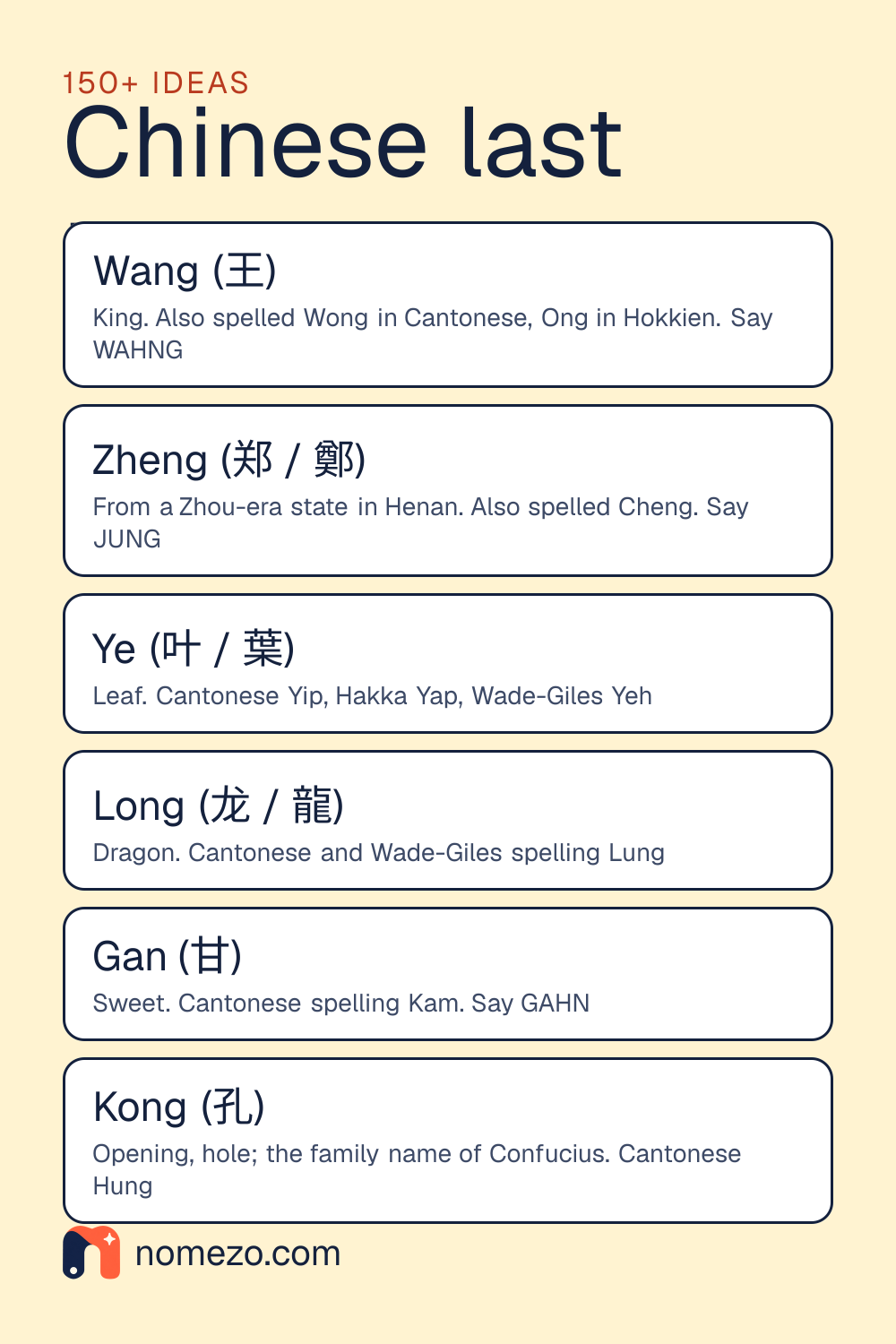
- Zheng (郑 / 鄭) US #781: From a Zhou-era state in Henan. Also spelled Cheng. Say JUNG
- Song (宋) US #1,105: From a Zhou-era state centered on Shangqiu. Wade-Giles Sung
- Han (韩 / 韓) US #953: From a Warring States kingdom. Cantonese Hon; also a Korean surname
- Deng (邓 / 鄧) US #2,521: From a small Zhou-era state. Cantonese Tang, Wade-Giles Teng
- Cao (曹) US #1,324: From a Zhou-era state in Shandong. Cantonese Tso. Say TSOW
- Cai (蔡) US #2,651: From a Zhou-era state. Cantonese Choi, Hokkien Chua. Say TSIGH
- Wei (魏) US #2,425: Lofty; also a Warring States kingdom. Cantonese Ngai. Say WAY
- Jiang (蒋 / 蔣) US #1,014: From a small Zhou-era state. Wade-Giles Chiang, as in Chiang Kai-shek
- Xue (薛): From an ancient state in Shandong. Wade-Giles Hsueh. Say SHWEH
- Qi (齐 / 齊): Even, orderly; a powerful Zhou-era state in Shandong. Say CHEE
- Lu (鲁 / 魯) US #717: From Confucius's home state in Shandong. Cantonese spelling Lo
- Chu (楚) US #1,154: Clear, neat; also a great southern state of old. Cantonese Cho
- Qin (秦): From the state that unified China in 221 BC. Say CHIN
- Zou (邹 / 鄒) US #4,435: From a small state, birthplace of Mencius. Say DZOH
- Shen (沈) US #1,925: From an ancient state; the character also means sink. Cantonese Sham
- Jia (贾 / 賈): From a Zhou-era state; the character also means merchant
- Zeng (曾) US #2,852: Great-, as in great-grandfather; also an ancient state. Cantonese Tsang
- Xu (许 / 許) US #763: To allow or permit; also an ancient state. Cantonese Hui
- Wei (卫 / 衛) US #2,425: To guard or defend; also a Zhou-era state. Cantonese Wai
Chinese last names from nature
Surnames written with the characters for trees, flowers, weather and landscape.
- Ye (叶 / 葉) US #2,281: Leaf. Cantonese Yip, Hakka Yap, Wade-Giles Yeh
- Shi (石) US #2,051: Stone, rock. Cantonese Shek, Wade-Giles Shih. Say SHUR
- Jiang (江) US #1,014: River, especially the Yangtze. Cantonese spelling Kong
- Lei (雷) US #3,478: Thunder. Cantonese spelling Lui. Say LAY
- Xia (夏): Summer; also the traditional first dynasty of China. Say SHYAH
- Tian (田): Field, farmland. Cantonese Tin, Wade-Giles Tien. Say TYEN
- Hua (花) US #4,221: Flower; given to the heroine Mulan in later retellings
- Mei (梅) US #3,578: Plum blossom. Cantonese Mui, Taishanese Moy. Say MAY
- Lan (兰 / 蘭): Orchid, a symbol of refinement. Say LAHN
- Yun (云 / 雲) US #3,640: Cloud. Cantonese spelling Wan. Say YOON
- Liu (柳) US #232: Willow tree. Korean Ryu and Yu share the character
- Bai (柏): Cypress tree. Cantonese spelling Pak
- Du (杜) US #3,097: Birchleaf pear tree. Cantonese To, Wade-Giles Tu. Say DOO
- Xiao (萧 / 蕭) US #3,387: Mugwort, a fragrant herb; often written 肖 in mainland China. Cantonese Siu, Wade-Giles Hsiao
- Hong (洪) US #1,047: Flood, vast waters. Cantonese Hung, Hokkien Ang
- Wang (汪) US #151: Vast, deep water. Also spelled Wong
- Su (苏 / 蘇) US #2,034: To revive; also the perilla herb. Cantonese So
- Qiu (邱) US #4,206: Hill. Cantonese Yau, Hokkien Khoo. Say CHYOH
Chinese surnames from animals, colors and treasures
Surnames written with the characters for creatures, colors and wealth.
- Feng (凤 / 鳳) US #2,163: Phoenix. Cantonese spelling Fung. Say FUNG
- Xiong (熊) US #750: Bear. Cantonese Hung, Wade-Giles Hsiung. In the US, mostly a Hmong clan name. Say SHYOONG
- Niu (牛): Ox or cow. Cantonese spelling Ngau. Say NYOH
- Bai (白): White. Cantonese Pak, Wade-Giles Pai. Say BYE
- Jin (金) US #2,228: Gold, metal. Cantonese Kam; Korean Kim uses this character
- Qian (钱 / 錢): Money, coins; second in the Hundred Family Surnames. Say CHYEN
- Wan (万 / 萬) US #4,631: Ten thousand, a myriad. Cantonese spelling Man
- Mao (毛) US #4,588: Hair, fur. Cantonese spelling Mo. Say MOW
- Yan (燕) US #2,105: Swallow, the bird; also a northern state near Beijing
Chinese surnames meaning good qualities
Surnames whose characters name a virtue, a feeling or a quality.
- Gan (甘): Sweet. Cantonese spelling Kam. Say GAHN
- An (安) US #3,684: Peace, safety. Cantonese On; Korean Ahn uses this character
- Kang (康) US #985: Health, well-being. Cantonese spelling Hong
- Wen (温 / 溫) US #4,040: Warm, gentle. Cantonese spelling Wan
- Yan (严 / 嚴) US #2,105: Strict, stern. Cantonese Yim, Wade-Giles Yen
- Chang (常) US #373: Constant, often. Cantonese Sheung; not the Wade-Giles spelling of 张
- Zhuo (卓): Outstanding, eminent. Cantonese spelling Cheuk. Say JWAW
- Rong (荣 / 榮): Glory, honor. Cantonese spelling Wing. Say ROHNG
- Pang (庞 / 龐) US #4,147: Huge, enormous. Cantonese spelling Pong
- Qiao (乔 / 喬): Tall, lofty. Cantonese Kiu, Wade-Giles Chiao. Say CHYOW
- Cui (崔) US #4,862: Lofty, towering. Cantonese Tsui; Korean Choi uses this character
- Yi (易) US #1,844: Change, or easy, as in the Yijing. Cantonese Yik
- Yin (殷) US #3,572: Abundant; also another name for the Shang dynasty. Cantonese Yan
- Mo (莫): Do not, none. Cantonese spelling Mok. Say MWAW
Chinese surnames of famous families
Surnames tied to philosophers, rulers, generals and legends.
- Kong (孔) US #2,293: Opening, hole; the family name of Confucius. Cantonese Hung
- Meng (孟) US #4,651: Eldest; the family name of Mencius. Say MUNG
- Wu (武) US #318: Martial; surname of Wu Zetian, China's only reigning empress
- Zuo (左): Left. The Tso in General Tso's chicken. Say DZWAW
- Yue (岳): High mountain. Wade-Giles Yueh, Cantonese Ngok. Say YWEH
- Guan (关 / 關) US #3,442: Mountain pass or gate; surname of Guan Yu, the general later worshipped as a god. Cantonese Kwan
- Yao (姚) US #3,235: Handsome; linked to the legendary sage-king Shun. Cantonese Yiu
- Jiang (姜) US #1,014: One of the oldest clan names, tied to the Yan Emperor
- Shao (邵): From an ancient fief; also spelled Shaw, as in Run Run Shaw
- Tang (汤 / 湯) US #794: Soup, hot water. Cantonese Tong; also the Shang dynasty founder
Chinese surnames from titles, jobs and everyday words
Surnames that are also ordinary words for ranks, trades, objects and actions.
- Hou (侯): Marquis, a noble rank. Cantonese spelling Hau. Say HOH
- Fu (傅) US #2,903: Tutor, teacher. Also spelled Foo
- Shi (史) US #2,051: History; originally a court scribe or historian. Cantonese Sze
- Yin (尹) US #3,572: To govern; an official. Cantonese Wan; Korean Yoon uses this character
- Tao (陶): Pottery, ceramics. Cantonese spelling To. Say TOW
- Che (车 / 車): Cart, carriage. Korean Cha uses this character. Say CHUH
- Gong (宫 / 宮) US #4,278: Palace. Cantonese spelling Kung
- Bao (包): To wrap; a bundle. Cantonese Pau, Wade-Giles Pao. Say BOW
- Dong (董) US #1,887: To supervise or direct. Cantonese and Wade-Giles Tung
- Zhong (钟 / 鍾) US #3,839: Goblet or bell. Also spelled Chung or Chong
- Wei (韦 / 韋) US #2,425: Soft leather. Cantonese spelling Wai
- Yuan (袁) US #2,732: Originally a long, flowing robe. Cantonese Yuen. Say YWEN
- Duan (段): Section, segment. Cantonese Tuen, Wade-Giles Tuan. Say DWAHN
- Cheng (程) US #865: Rule, procedure, journey. Cantonese spelling Ching
- Pan (潘) US #1,989: Water used to rinse rice. Cantonese spelling Poon
- Lü (吕 / 呂) US #717: Spine; also musical pitch pipes. Cantonese Lui. Written Lyu, or typed Lv, without the ü
- Feng (冯 / 馮) US #2,163: Galloping horse. Cantonese spelling Fung
- Peng (彭) US #2,757: The sound of a drumbeat. Cantonese spelling Pang. Say PUNG
- Tang (唐) US #794: Shares its character with the 618 to 907 dynasty. Cantonese Tong
- Liang (梁) US #1,066: Roof beam or bridge. Cantonese spelling Leung. Say LYAHNG
- Xie (谢 / 謝) US #2,207: To thank. Cantonese Tse, Wade-Giles Hsieh, Hokkien Chia
- Gu (顾 / 顧) US #3,807: To look after, attend to. Also spelled Koo or Ku
- Tan (谭 / 譚) US #856: To talk or discuss. Cantonese spelling Tam. Say TAHN
Two-character Chinese surnames
Rare compound surnames, most of them from old official titles or places.
- Ouyang (欧阳 / 歐陽): South side of Mount Ouyu. Cantonese spelling Au-Yeung
- Sima (司马 / 司馬): Master of horses, an old title for minister of war
- Zhuge (诸葛 / 諸葛): Compound surname of the strategist Kongming. Wade-Giles Chu-ko
- Shangguan (上官): From Shangguan, a town where a Chu prince settled; literally upper official. Say SHAHNG-gwahn
- Situ (司徒): Minister of the masses, an old title. Cantonese Szeto or Seto
- Dongfang (东方 / 東方): The east, literally east direction. Say DONG-fahng
- Gongsun (公孙 / 公孫): Grandson of a duke. Wade-Giles Kung-sun
- Ximen (西门 / 西門): West gate; a two-character surname. Say SHEE-mun
- Nangong (南宫 / 南宮): Southern palace; a two-character surname. Say NAHN-gong
- Zhangsun (长孙 / 長孫): Eldest grandson; surname of a Tang dynasty empress
- Dongguo (东郭 / 東郭): East outer city wall; known from a Chinese wolf fable
- Sikong (司空): Minister of works, an old official title. Say SUH-kong
Cantonese and Hokkien spellings of Chinese surnames
The same characters are spelled differently in Hong Kong, Singapore, Malaysia and older Chinatowns. These are the spellings you will meet most.
- Wong (黃 or 王) US #271: Cantonese spelling of Huang (黃), yellow, and of Wang (王), king
- Cheung (张 / 張) US #1,789: Cantonese spelling of Zhang, to draw a bow
- Lau (刘 / 劉) US #1,136: Cantonese spelling of Liu, an old word for battle-axe
- Ng (吳 or 黃) US #1,060: Cantonese spelling of Wu (吳); Hokkien spelling of Huang (黃), yellow
- Lam (林) US #555: Forest; Cantonese spelling of Lin
- Leung (梁) US #1,702: Roof beam; Cantonese spelling of Liang
- Kwok (郭): Outer city wall; Cantonese spelling of Guo
- Yip (叶 / 葉): Leaf; Cantonese spelling of Ye
- Tse (谢 / 謝): To thank; Cantonese spelling of Xie
- Ho (何) US #591: What or how; Cantonese spelling of He
- Chow (周) US #2,052: Cantonese spelling of Zhou, circuit or complete
- Tsang (曾): Cantonese spelling of Zeng, great- as in great-grandfather
- Tan (陈 / 陳) US #856: Hokkien and Teochew spelling of Chen, an ancient state
- Lim (林) US #839: Forest; Hokkien and Teochew spelling of Lin
- Ong (王) US #3,350: King; Hokkien spelling of Wang
- Goh (吴 / 吳): Hokkien spelling of Wu, an ancient state
- Teo (张 / 張): Teochew and Hokkien spelling of Zhang, to draw a bow
- Ang (洪): Flood, vast waters; Hokkien spelling of Hong
- Koh (許 or 高): Hokkien spelling of Xu (許), to allow; also used for Gao (高), tall
- Khoo (邱): Hill; Hokkien spelling of Qiu
- Chua (蔡): Hokkien spelling of Cai, an ancient state
- Yeo (杨 / 楊): Poplar; Hokkien spelling of Yang
How to pick the right name
Match the spelling to the region
Pinyin spellings like Wang and Chen are standard in mainland China. Hong Kong families usually use Cantonese spellings like Wong and Chan, and Singapore and Malaysia often use Hokkien or Teochew ones like Ong and Tan.
Check the character
Several surnames share one spelling. Xu can be 徐 (slowly) or 许 (to allow), and Wang can be 王 (king) or 汪 (vast waters), so always note the character.
Put the surname first
In Chinese the family name comes first, so in Zhang Wei the surname is Zhang. Many people abroad reverse the order on English documents.
Pick a fitting surname for a character
For a story or game, a common surname like Lin or Chen sounds natural and modern, while a compound surname like Zhuge or Ouyang feels rare and literary.
Save this list for later
Pin it to a naming board, or tap the heart next to any name to keep it in your favorites on this device.
Chinese last names: one spelling for many surnames, and the names rising fastest in the US
By The Nomezo Editors · Updated October 25, 2026 · How we research names
A Chinese surname is a character, and its English spelling depends on who wrote it down. 黃 is Huang in Mandarin pinyin, Wong in Cantonese and Ng in Hokkien, while Wong can also be 王, Wang. Mainland China has used pinyin for names since 1958; Hong Kong, Taiwan and older Chinatowns kept other spellings.
In the US, pinyin surnames are rising fast: Zhang grew 74% between the 2010 and 2020 Census, while the Cantonese spelling Wong barely changed. The finder above narrows the surnames on this page and shows each one's US Census rank.
- Step 1Start from the characterThe character, not the spelling, is the surname.
- Step 2Pick the right spellingMandarin, Cantonese or Hokkien: the notes give each.
- Step 3Check how common it isChen is No. 93 in the US; Ouyang is rare.
- Step 4Mind the familyMarried women traditionally keep their own surname.
Chinese surnames in the US
| Surname | Rank in 2020 | People in 2020 | Change since 2010 |
|---|---|---|---|
| Chen | #93 | 233,798 | +38% |
| Wang | #151 | 169,987 | +55% |
| Li | #154 | 165,790 | +48% |
| Liu | #232 | 127,257 | +62% |
| Zhang | #252 | 122,053 | +74% |
| Lin | #259 | 116,776 | +47% |
| Wong | #271 | 112,062 | +1% |
Source: US Census Bureau, 2010 and 2020 surnames; changes compare the two counts. Lee is No. 19 in the US but is shared with English and Korean families.
One spelling, many surnames
| Spelling | Surnames | Where the spelling comes from |
|---|---|---|
| Wong | 黃 Huang or 王 Wang | Cantonese |
| Ng | 吳 Wu or 黃 Huang | Cantonese for Wu; Hokkien for Huang |
| Koh | 許 Xu or 高 Gao | Hokkien for Xu |
| Chang | 張 Zhang or 常 Chang | Wade-Giles for Zhang |
Taiwan adopted pinyin in 2009 but still lets people use other spellings on passports, so Wade-Giles forms with hs and ts remain common (Wikipedia).
How Chinese surnames work
- A short list. Wang, Li, Zhang, Liu and Chen together cover 30.8% of China's registered population, according to the Ministry of Public Security's 2020 name report (The Paper, in Chinese).
- The Hundred Family Surnames. This Song-dynasty primer lists 504 surnames, 444 of one character and 60 of two, and puts Zhao first because it was the surname of the Song emperors (Wikipedia).
- Marriage and children. A married woman traditionally keeps her own surname. Children usually take the father's, though mainland China's marriage law lets a child use either parent's surname (Wikipedia).
Sources
Frequently asked questions
What is the most common Chinese last name?
Wang (王), meaning king. China's Ministry of Public Security ranked it first in its 2020 National Name Report, ahead of Li, Zhang, Liu and Chen.
Why do Chinese last names have different spellings?
The same character is pronounced and romanized differently across dialects and systems. 黄 is Huang in pinyin, Wong in Cantonese and Ng in Hokkien, and 张 is Zhang in pinyin but Chang in the older Wade-Giles system.
What are the Hundred Family Surnames?
It is a rhyming list of Chinese surnames from the Song dynasty, long used to teach children characters. It opens with Zhao, Qian, Sun and Li.
What is a two-character Chinese surname?
It is a compound surname written with two characters, such as Ouyang, Sima or Zhuge. Most began as official titles or place names, and they are far rarer than single-character surnames.
Are Chinese last names used in Korea and Vietnam?
Many share the same characters. The Korean surnames Kim and Lee are written 金 and 李 (Jin and Li in Chinese), and the Vietnamese Nguyễn is written 阮 (Ruan).
Is Wong the same as Wang?
Sometimes. Wong is the Cantonese spelling of two different surnames, 黃 (Huang in Mandarin, meaning yellow) and 王 (Wang, meaning king). Only the character tells you which.
Do Chinese women change their surname when they marry?
Traditionally no: a married woman keeps her own surname. Children usually take the father's, though the law in mainland China allows either parent's surname.
More last names and generators
- Japanese last names181 names. Japanese last names with kanji and meanings, from Satō and Suzuki to river and rice field names, rare riddle surnames and last names with dark meanings.
- Last NamesLast names and surnames with meanings and origins: cool, pretty, rare and unique last names, plus a surname generator.
- Korean girl names121 names. Korean girl names in Hangul with hanja meanings: cute Korean girl names like Bom and Dami, 2025 favorites, and native Korean names like Haneul and Byeol.
- Korean boy names118 names. Korean boy names and male names in Hangul with hanja meanings, from Doyun and Minjun to classic names for men like Seongmin, with pronunciation tips.
- Unique last names123 names. Unique last names with real meanings: rare English, Scottish, Irish, Welsh, French, German, Spanish and Japanese surnames, with pronunciation tips.
- Cool last names182 names. Cool last names with real origins: classic, job, nature, animal, global, fancy and strong surnames, plus 30+ invented last names for characters.
- Russian last names148 names. Russian last names with meanings and Cyrillic: common, patronymic, occupational, animal, church and noble surnames, with -ov/-ova and -sky/-skaya explained.
- Names by OriginNames by origin and culture: Japanese, French, Irish, Italian, Spanish, Norse, Greek, Arabic and more, with meanings and pronunciation.
- Last name generatorReal surnames from 24 cultures, each with its meaning, origin and kind.