

Russian girl names: 140+ female Russian names with meanings and nicknames
147 names · Updated · By The Nomezo Editors · Save to Pinterest
Popular Russian girl names include Sofia (wisdom), Anna (grace) and Anastasia (resurrection). Nearly every Russian woman's name has an everyday short form, like Sonya, Anya or Nastya. Sofia was the top name for baby girls across Russia in 2025, while in Moscow Anna edged ahead, given to 1,927 babies against Sofia's 1,847.
Below are 140+ female Russian names and patronymics, each with its meaning, language of origin, common diminutive and a simple pronunciation where English speakers may stumble. Sections cover classic favorites, Slavic names, Greek and Latin names, Russian women's names from the Soviet era, the patronymics that complete a Russian woman's full name, old-fashioned village names and the nicknames that work as names on their own. Popular names whose meaning scholars debate, like Mariya and Tatyana, have their own section.
Can't decide? Shuffle 6 random picks
Rostislava (Ростислава)
Growing glory; Slavic. Diminutives Rostya and Slava
Stefaniya (Стефания)
Wreath, crown; Greek stephanos. Diminutive Stesha
Viktoria (Виктория)
Victory; Latin victoria. Diminutive Vika. Say veek-TOH-ree-yah
Vika (Вика)
Short for Viktoria: victory; Latin
Vasilisa (Василиса)
Queen; Greek basilissa. Diminutive Vasya. A Russian fairy-tale heroine
Arina (Арина)
Folk form of Irina: peace; Greek. Diminutive Arisha
Russian name builder
Pick a first name, the father's name and a family name. The builder makes the patronymic and the right form of the surname, then shows the name in Cyrillic and three Latin spellings, and the way family, friends and officials would say it.
The name
Ivanovna means daughter of Ivan. Petrov first meant Pyotr's.
How people say it
Find a Russian girl name on this page
Narrow 147 names by how common they were for US girls in 2025, by section, length or first letter, or search the meanings.
Classic Russian girls' names
Names that have stayed in use for generations, with the short form Russians use every day. Capital letters in the pronunciation mark the stressed syllable. We use the familiar English spelling for well-known names and -iya for the rest.
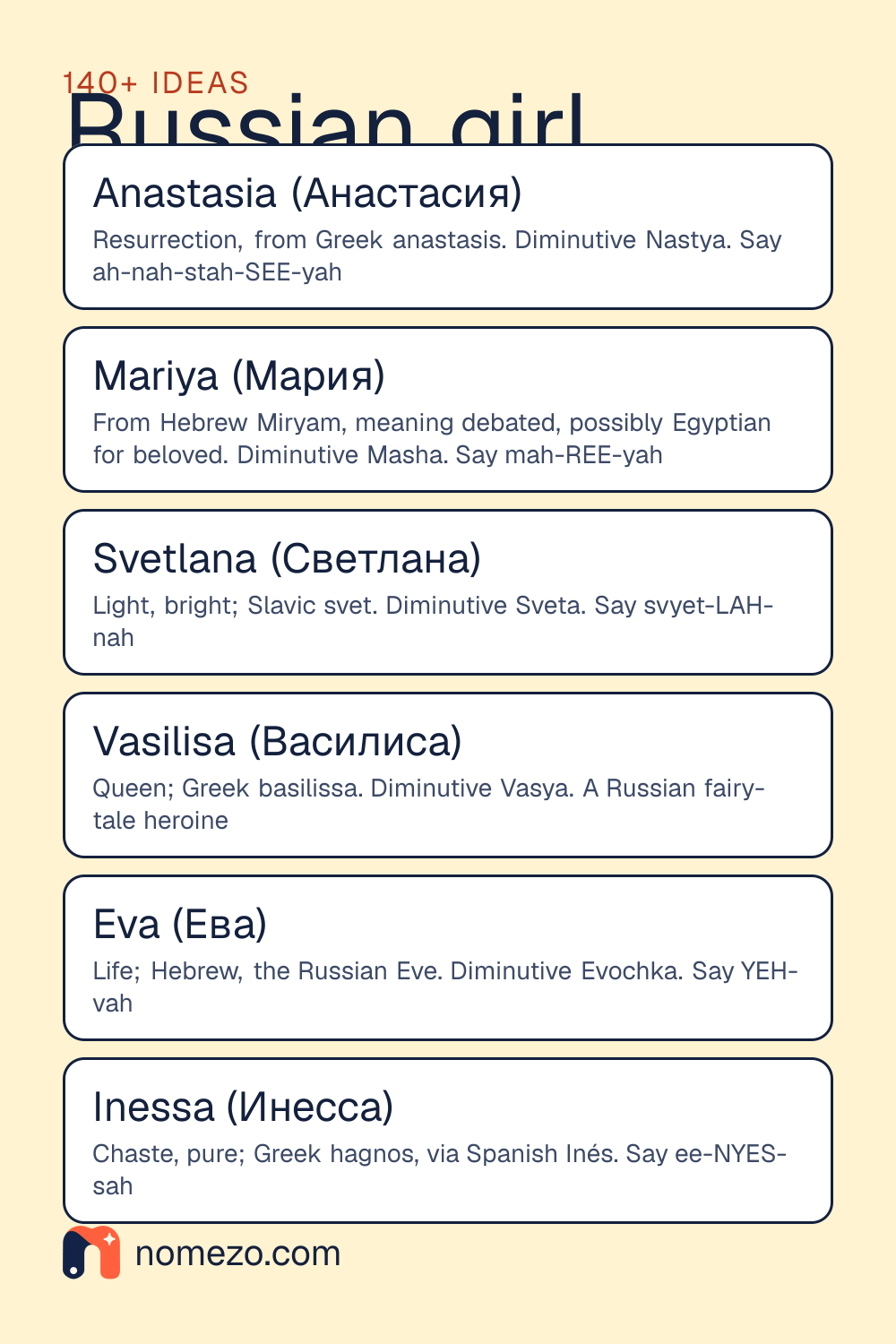
- Anastasia (Анастасия) US #163: Resurrection, from Greek anastasis. Diminutive Nastya. Say ah-nah-stah-SEE-yah
- Aleksandra (Александра) Moscow #8: Defender of the people; Greek. Diminutives Sasha and Shura
- Natalya (Наталья): Born on Christmas Day; Latin. Diminutive Natasha. Say nah-TAHL-yah
- Olga (Ольга): Holy, blessed; Old Norse Helga. Diminutive Olya. Say OHL-gah
- Irina (Ирина): Peace; Greek Eirene. Diminutive Ira. Say ee-REE-nah
- Darya (Дарья): Holding firm the good; Persian, via Darius. Diminutive Dasha
- Yelizaveta (Елизавета): My God is an oath; Hebrew. Diminutive Liza. Say yeh-lee-zah-VYEH-tah
- Ksenia (Ксения): Hospitality; Greek xenia. Diminutive Ksyusha. Say KSYEH-nee-yah
- Viktoria (Виктория) Moscow #7: Victory; Latin victoria. Diminutive Vika. Say veek-TOH-ree-yah
- Yevgenia (Евгения): Well-born, noble; Greek. Diminutive Zhenya. Say yev-GYEH-nee-yah
- Varvara (Варвара) Moscow #6: Foreign woman; Greek, the Russian Barbara. Diminutive Varya
- Polina (Полина) Moscow #9: Russian form of Paulina, from Latin for small, or short for Apollinariya. Diminutive Polya. Say pah-LEE-nah
Popular Russian girl names with debated meanings
Some of the most common Russian names come from older names whose meaning scholars still argue about. The notes give the main theories.
- Mariya (Мария) Moscow #3: From Hebrew Miryam, meaning debated, possibly Egyptian for beloved. Diminutive Masha. Say mah-REE-yah
- Yekaterina (Екатерина): From Greek Aikaterine, meaning debated, later linked to katharos, pure. Diminutive Katya
- Tatyana (Татьяна): From the Roman family name Tatius, of unknown meaning. Diminutive Tanya. Say tah-TYAH-nah
- Yelena (Елена): The Russian Helen: possibly torch or moon; Greek. Diminutive Lena. Say yeh-LYEH-nah
- Alyona (Алёна): First a Russian pet form of Yelena, now a name of its own. Say ah-LYOH-nah
- Yuliya (Юлия): The Russian Julia, from Julius, possibly downy-bearded in Greek. Diminutive Yulya
- Ulyana (Ульяна): The Russian form of Juliana, from Julius. Diminutive Ulya. Say oo-LYAH-nah
- Marina (Марина) US #602: From Latin Marinus, from the family name Marius or marinus, of the sea. Say mah-REE-nah
- Larisa (Лариса): Possibly from the Greek city of Larisa, citadel. Diminutive Lara. Say lah-REE-sah
- Taisiya (Таисия): The Russian form of Thaïs, after the saint; meaning unknown. Diminutive Taya
Slavic girl names
Native Slavic names built from words like svet (light), mil (dear) and slava (glory).
- Svetlana (Светлана): Light, bright; Slavic svet. Diminutive Sveta. Say svyet-LAH-nah
- Lyudmila (Людмила): Dear to the people; Slavic. Diminutives Lyuda and Mila
- Nadezhda (Надежда): Hope; Slavic virtue name. Diminutive Nadya. Say nah-DYEZH-dah
- Lyubov (Любовь): Love; Slavic virtue name. Diminutive Lyuba. Say lyoo-BOF
- Miroslava (Мирослава): Glorious in peace; Slavic. Diminutives Mira and Slava
- Yaroslava (Ярослава): Fierce glory; Slavic. Diminutives Yasya and Yara
- Vladislava (Владислава): Rules with glory; Slavic. Diminutives Vlada and Slava
- Stanislava (Станислава): Becomes glorious; Slavic. Diminutive Stasya
- Rostislava (Ростислава): Growing glory; Slavic. Diminutives Rostya and Slava
- Milena (Милена) US #950: Dear, gracious; Slavic mil. Diminutive Mila. Say mee-LYEH-nah
- Snezhana (Снежана): Snowy; Slavic sneg, snow. Diminutive Snezha. Say snyeh-ZHAH-nah
- Milana (Милана) US #812: Gracious, dear; Slavic mil. Diminutive Mila. Say mee-LAH-nah
- Darina (Дарина): Gift; Slavic dar. Say dah-REE-nah
- Vlada (Влада): To rule; Slavic, short for Vladislava. Say VLAH-dah
Russian girl names from Greek
Orthodox Christianity brought many Greek names to Russia, where they took Russian spellings and nicknames.
- Vasilisa (Василиса) Moscow #5: Queen; Greek basilissa. Diminutive Vasya. A Russian fairy-tale heroine
- Margarita (Маргарита): Pearl; Greek margarites. Diminutive Rita
- Galina (Галина): Calm, serene; Greek galene. Diminutive Galya. Say gah-LEE-nah
- Zoya (Зоя): Life; Greek zoe. Diminutive Zoyenka. Say ZOH-yah
- Lidiya (Лидия): Woman of Lydia, an ancient region; Greek. Diminutive Lida
- Zinaida (Зинаида): Of Zeus; Greek Zenais. Diminutive Zina. Say zee-nah-EE-dah
- Kristina (Кристина): Follower of Christ; Greek. Diminutives Kristya and Tina
- Arina (Арина): Folk form of Irina: peace; Greek. Diminutive Arisha
- Stefaniya (Стефания): Wreath, crown; Greek stephanos. Diminutive Stesha
- Nika (Ника): Short for Veronika, now used on its own; linked to Greek nike, victory. Say NEE-kah
- Melaniya (Мелания): Dark; Greek melas. Diminutive Malasha. Say meh-LAH-nee-yah
- Oksana (Оксана): Ukrainian form of Ksenia: hospitality; Greek. Diminutive Ksana
- Aglaya (Аглая): Splendor, beauty; Greek, one of the three Graces. Say ahg-LAH-yah
Female Russian names from Latin, Hebrew and Germanic
Names from the Bible, the Roman world and Western Europe that Russian adopted and made its own.
- Yana (Яна): God is gracious; Hebrew, via Slavic Jana. Diminutive Yanochka
- Zhanna (Жанна): God is gracious; Hebrew, via French Jeanne. Diminutive Zhannochka
- Tamara (Тамара): Date palm; Hebrew. Diminutive Toma. Say tah-MAH-rah
- Alisa (Алиса) Moscow #10: Noble kind; Germanic, via French Alice. Diminutive Alya
- Liliya (Лилия): Lily; Latin lilium. Diminutive Lilya. Say LEE-lee-yah
- Valeriya (Валерия): To be strong; Latin valere. Diminutive Lera
- Albina (Альбина): White, bright; Latin albus. Diminutives Alya and Bina
- Violetta (Виолетта): Violet, the flower; Latin viola. Diminutive Veta
- Avrora (Аврора): Dawn; Latin Aurora. Say ahv-ROH-rah
- Avgusta (Августа): Venerable, sacred; Latin Augusta. Diminutive Gusta
- Susanna (Сусанна): Lily; Hebrew Shoshannah. Say soo-SAHN-nah
Russian women's names
More names you will meet among Russian women, from Soviet-era inventions like Ninel to elegant imports like Inessa and Roksana.
- Inessa (Инесса): Chaste, pure; Greek hagnos, via Spanish Inés. Say ee-NYES-sah
- Veronika (Вероника): Bringing victory, via Greek Berenike; Latin. Diminutive Nika
- Roksana (Роксана): Bright, shining; Old Persian, via Greek Rhoxane. Say rok-SAH-nah
- Rozaliya (Розалия): Rose; Latin rosa, the Russian Rosalia. Diminutive Roza
- Yanina (Янина): God is gracious; Hebrew, a pet form of Yana. Say yah-NEE-nah
- Agniya (Агния): Chaste; Greek, the Russian Agnes. Borne by children's poet Agniya Barto
- Vasilina (Василина): Royal, queenly; Greek, a feminine form of Vasily. Say vah-see-LEE-nah
- Inga (Инга): Named for Ing, a Germanic god; Old Norse. Say EEN-gah
- Ninel (Нинель): Lenin spelled backward; coined by Soviet parents. Say nee-NEL
- Oktyabrina (Октябрина): October, for the 1917 revolution; a Soviet-era name
- Vladlena (Владлена): Blended from Vladimir Lenin's name; a Soviet-era coinage
- Aelita (Аэлита): Coined by Aleksey Tolstoy for a Martian princess in 1923
A Russian woman's name: common patronymics
A Russian woman's full name has three parts: first name, patronymic and surname, as in Anna Ivanovna Petrova. The patronymic comes from her father's first name, and first name plus patronymic is the polite way to address her.
- Ivanovna (Ивановна): Daughter of Ivan, the Russian John. Say ee-VAH-nov-nah
- Petrovna (Петровна): Daughter of Pyotr, the Russian Peter. Say pyet-ROV-nah
- Aleksandrovna (Александровна): Daughter of Aleksandr. Say ah-lek-SAHN-drov-nah
- Sergeyevna (Сергеевна): Daughter of Sergey; a final y sound takes -evna
- Vladimirovna (Владимировна): Daughter of Vladimir. Say vlah-DEE-mee-rov-nah
- Nikolayevna (Николаевна): Daughter of Nikolay, the Russian Nicholas
- Mikhaylovna (Михайловна): Daughter of Mikhail, the Russian Michael. Say mee-KHAI-lov-nah
- Dmitriyevna (Дмитриевна): Daughter of Dmitry; never Dmitrovna, because Dmitry ends in y
- Andreyevna (Андреевна): Daughter of Andrey, the Russian Andrew
- Alekseyevna (Алексеевна): Daughter of Aleksey, the Russian Alexis
- Pavlovna (Павловна): Daughter of Pavel, the Russian Paul; the e drops out
- Fyodorovna (Фёдоровна): Daughter of Fyodor, the Russian Theodore
- Yuryevna (Юрьевна): Daughter of Yury, the Russian George. Say YOOR-yev-nah
- Lvovna (Львовна): Daughter of Lev, meaning lion; the vowel drops out
- Ilyinichna (Ильинична): Daughter of Ilya; fathers' names in -a take -inichna or -ichna
- Nikitichna (Никитична): Daughter of Nikita, a man's name that ends in -a
- Kuzminichna (Кузьминична): Daughter of Kuzma, an old village name; the standard form, not Kuzmovna
Old-fashioned Russian girl names
Village and saint's-day names that were everywhere before the 20th century and now sound charmingly vintage.
- Matryona (Матрёна): Lady, matron; Latin matrona. Diminutive Motya. Root of matryoshka
- Praskovya (Прасковья): Preparation, the Greek word for Friday. Diminutive Parasha
- Pelageya (Пелагея): Of the sea; Greek pelagos. Diminutive Polya. Say peh-lah-GYEH-yah
- Yevdokiya (Евдокия): Goodwill; Greek eudokia. Diminutives Dunya and Dusya
- Avdotya (Авдотья): Folk form of Yevdokiya: goodwill; Greek. Diminutive Dunya
- Glafira (Глафира): Polished, subtle; Greek glaphyros. Diminutive Glasha. Say glah-FEE-rah
- Lukerya (Лукерья): Sweet; Greek Glykeria. Diminutive Lusha. Say loo-KYEH-ryah
- Agafya (Агафья): Good, kind; Greek agathos. Diminutives Agasha and Ganya
- Yevfrosiniya (Евфросиния): Joy, mirth; Greek Euphrosyne, one of the Graces. Diminutive Frosya
- Serafima (Серафима): Fiery one, from the seraphim; Hebrew. Diminutive Sima
- Marfa (Марфа): Lady, mistress; Aramaic, the Russian Martha. Diminutive Marfusha
- Kapitolina (Капитолина): From Rome's Capitoline Hill; Latin. Diminutive Kapa
- Nastasya (Настасья): Folk form of Anastasia: resurrection; Greek. Diminutive Nastya
- Aksinya (Аксинья): Folk form of Ksenia: hospitality; Greek. Diminutive Aksyusha
- Feodosiya (Феодосия): Giving to God; Greek Theodosia. Diminutives Fenya and Dosya
- Apollinariya (Аполлинария): Belonging to Apollo; Greek. Diminutives Polya and Lina
- Anfisa (Анфиса): Flower; Greek Anthousa, the name of a Byzantine saint
- Akulina (Акулина): Like an eagle; Latin Aquilina, from aquila. Say ah-koo-LEE-nah
- Fyokla (Фёкла): Glory of God; Greek Thekla, a village classic. Say FYOK-lah
- Ustinya (Устинья): Just, fair; Latin Iustina, in its folk form. Say oos-TEEN-yah
Russian nicknames that work as names
Russian short forms that many families outside Russia now use as full given names.
- Natasha (Наташа): Short for Natalya: born on Christmas Day; Latin
- Sonya (Соня): Short for Sofia: wisdom; Greek
- Dasha (Даша): Short for Darya: holding firm the good; Persian
- Nastya (Настя): Short for Anastasia: resurrection; Greek
- Liza (Лиза): Short for Yelizaveta: my God is an oath; Hebrew
- Lera (Лера): Short for Valeriya: to be strong; Latin
- Vika (Вика): Short for Viktoria: victory; Latin
- Rita (Рита): Short for Margarita: pearl; Greek
More Russian pet names for girls
The everyday forms you will hear at home and among friends. Add -ochka or -enka for extra affection.
- Sveta (Света): Short for Svetlana: light, bright; Slavic
- Olya (Оля): Short for Olga: holy, blessed; Old Norse
- Lyuba (Люба): Short for Lyubov: love; Slavic
- Varya (Варя): Short for Varvara: foreign woman; Greek
- Ksyusha (Ксюша): Short for Ksenia: hospitality; Greek
- Galya (Галя): Short for Galina: calm, serene; Greek
- Lida (Лида): Short for Lidiya: woman of Lydia; Greek
- Zina (Зина): Short for Zinaida: of Zeus; Greek
- Valya (Валя): Short for Valentina: strong, healthy; Latin
- Ira (Ира): Short for Irina: peace; Greek
- Zhenya (Женя): Short for Yevgenia or Yevgeny: well-born, noble; Greek
- Dunya (Дуня): Short for Yevdokiya or Avdotya: goodwill; Greek
- Glasha (Глаша): Short for Glafira: polished, subtle; Greek
- Sima (Сима): Short for Serafima: fiery one; Hebrew
- Polya (Поля): Short for Polina or Pelageya; also used for Apollinariya
- Lyuda (Люда): Short for Lyudmila: dear to the people; Slavic
- Stasya (Стася): Short for Anastasia or Stanislava
How to pick the right name
Love the nickname too
Russians rarely use the full name day to day. Anastasia becomes Nastya and Aleksandra becomes Sasha, and endings like -ochka sound tender while -ka (Anka) can sound rude outside a friendly context, so make sure the short forms suit your daughter as well as the full name.
Check the stress
Russian names often stress a different syllable than English speakers expect: sah-FEE-yah, not SO-fee-ah. The pronunciation in each note shows the stressed syllable in capitals.
Say it with the patronymic
A Russian full name includes a middle name formed from the father's name, such as Anna Ivanovna. If your family uses one, say the whole name aloud before you decide.
Pick one English spelling
Cyrillic can be written several ways in English, such as Natalya or Natalia and Ksenia or Kseniya. Choose one spelling and use it on every document.
Save this list for later
Pin it to a naming board, or tap the heart next to any name to keep it in your favorites on this device.
Russian girl names: the 2025 rankings, how a woman's full name is built, and which nicknames are tender
By The Nomezo Editors · Updated October 25, 2026 · How we research names
Sofia was the top name for baby girls across Russia in 2025, given to 3.6% of them, ahead of Eva and Anna (Russia's Social Fund). Moscow was different: Anna came first with 1,927 babies, just ahead of Sofia, among more than 6,700 different names given in the city that year.
A Russian woman's name is more than a first name: it comes with a patronymic from her father and a surname with a feminine ending, and each first name has its own ladder of short forms. The builder above puts the three parts together in Cyrillic and Latin letters, and the finder narrows the names on this page.
The most popular girls' names in Moscow and Russia, 2025
- Across Russia in 2025 the leaders were Sofia (3.6% of baby girls), Eva (3.15%), Anna (3.01%), Mariya and Varvara (2.62% each), according to Russia's Social Fund (Snob, February 6, 2026).
| Rank | Name | Babies in Moscow | US rank, 2025 |
|---|---|---|---|
| 1 | Anna | 1,927 | #107 |
| 2 | Sofia | 1,847 | #9 |
| 3 | Mariya | 1,772 | #87 (as Maria) |
| 4 | Eva | 1,541 | #134 |
| 5 | Vasilisa | 1,470 | — |
| 6 | Varvara | 1,335 | — |
| 7 | Viktoria | 1,322 | #54 (as Victoria) |
| 8 | Aleksandra | 1,200 | #237 (as Alexandra) |
| 9 | Polina | 1,162 | — |
| 10 | Alisa | 1,072 | — |
Sources: Moscow city government, January 2026; US Social Security Administration. A dash means outside the US top 1,000.
How a Russian woman's full name is built
- The patronymic. A daughter takes her father's name plus -ovna, or -evna after a soft ending: Ivan gives Ivanovna, Sergey Sergeyevna. Fathers' names ending in a vowel take -ichna or -inichna, as in Foka, Fokichna, and Kuzma, Kuzminichna (Wikipedia).
- The surname. Surnames in -ov, -ev and -in add -a (Petrova, Lebedeva, Pushkina), adjectival ones take -aya (Tolstoy, Tolstaya), and those ending in -enko or -ich stay the same for men and women (Wikipedia).
- Polite address. Addressing someone of higher standing, or at a business meeting, without the patronymic is considered offensive, so Anna Ivanovna is how a teacher or boss is greeted (Wikipedia).
Tender, everyday or rude: the short forms
- What the law forbids. Since a 2017 amendment (Federal Law 94-FZ), Russian registry offices refuse names with digits, symbols other than a hyphen, obscene words, or ranks and titles (ConsultantPlus).
| Form | Example | How it sounds |
|---|---|---|
| Full name | Anna | Formal |
| Everyday short form | Anya | Normal among family and friends |
| Affectionate | Anechka | Tender |
| -ka form | Anka | Colloquial; can sound rude outside a friendly context |
Sources
- Moscow city government: most popular baby names of 2025 (in Russian)
- Snob: Russia's Social Fund, top baby names of 2025 (February 6, 2026, in Russian)
- Wikipedia: Eastern Slavic naming customs
- ConsultantPlus: restrictions on a child's name (in Russian)
- US Social Security Administration: baby names
- Behind the Name: Russian names
Frequently asked questions
What is the most popular girl name in Russia?
Sofia. It was the top name for baby girls across Russia in 2025, given to 3.6% of them, ahead of Eva and Anna, according to Russia's Social Fund. In Moscow, Anna edged past Sofia in 2025. Sofia's everyday short form is Sonya.
What are common Russian nicknames for girls?
Most Russian names have a standard short form: Sasha for Aleksandra, Natasha for Natalya, Nastya for Anastasia, Masha for Maria, Katya for Yekaterina and Tanya for Tatyana. Endings like -ochka and -enka add extra affection.
What do Maria, Yekaterina and Tatyana mean?
Their origins are debated. Mariya comes from Hebrew Miryam, which may be Egyptian for beloved; Yekaterina from Greek Aikaterine, later linked to katharos, pure; and Tatyana from the Roman family name Tatius, whose meaning is unknown. They have their own section on this page.
What are common Russian women's names?
Tatyana, Yelena, Natalya, Olga, Irina and Svetlana are classic names held by many Russian women today, while Sofia, Anna and Mariya lead for baby girls. Soviet-era names like Ninel and Oktyabrina are rarer but still found among older women.
What does a Russian woman's full name look like?
It has three parts: a first name, a patronymic from her father's first name ending in -ovna or -evna, and a surname with a feminine ending such as -ova, -eva or -ina, as in Anna Ivanovna Petrova. Most Russian female first names also end in -a or -ya.
Are some names banned in Russia?
Yes. Since 2017, Article 58 of Russia's Family Code bars names that contain digits or symbols other than a hyphen, obscene words, or ranks and titles, and registry offices can refuse them.
Which Russian nicknames are affectionate and which are rude?
Forms with -ochka, -enka or -echka, like Anechka, sound tender. The everyday short form, like Anya, is normal among friends. A -ka form, like Anka, is colloquial and can sound rude outside a friendly context.
More by origin and generators
- Russian boy names103 names. Russian boy names with meanings, origins and the everyday nickname for each, from Aleksandr (Sasha) to Mikhail (Misha), plus easy pronunciation tips.
- Russian last names148 names. Russian last names with meanings and Cyrillic: common, patronymic, occupational, animal, church and noble surnames, with -ov/-ova and -sky/-skaya explained.
- Greek girl names187 names. Greek girl names with meanings: 180+ Greek female names, from women's names used in Greece today to female Greek mythology names and ancient Greek women.
- Polish last names129 names. Polish last names with meanings and pronunciation: common, -ski and -cki, -wicz, occupational, animal and regional surnames, with female forms explained.
- Unique girl names136 names. Unique girl names with real meanings: 130+ rare baby girl names and unique nicknames for girls, from Irish, Greek, Hebrew, Norse, Persian and more.
- German girl names170 names. German girl names with meanings: 160+ popular, traditional and vintage female German names, common German women's names and short names for female dogs.
- Names by OriginNames by origin and culture: Japanese, French, Irish, Italian, Spanish, Norse, Greek, Arabic and more, with meanings and pronunciation.
- Baby NamesBaby names with meanings and origins: girl names, boy names, unisex names, popular and unique picks, plus a free baby name generator.
- Random name generatorReal full names from 24 cultures, each with its meaning and origin.