

Russian boy names: 100+ names with meanings and nicknames
103 names · Updated · By The Nomezo Editors · Save to Pinterest
Classic Russian boy names include Mikhail (who is like God?), Aleksandr (defender of men) and Ivan (God is gracious), each with a familiar short form such as Misha, Sasha or Vanya. In 2025, Mikhail was the most popular boys' name in Moscow (2,546 babies), ahead of Aleksandr (2,408) and Lev (1,793), according to Moscow's registry office, and it led across Russia too.
Below are 100+ Russian boys' names and nicknames, each with its meaning, language of origin, common diminutive and a simple pronunciation where English speakers may stumble. Sections cover classic names, biblical names, Greek and Latin names, Slavic and Old Norse names, storybook names and the nicknames Russians use every day. We list names whose meaning is well established and say probably where it is less certain.
Can't decide? Shuffle 6 random picks
Denis (Денис)
Of Dionysus; Greek Dionysios. Diminutive Deniska. Say dyeh-NEES
Pavel (Павел)
Small; Latin Paulus. Diminutive Pasha. Say PAH-vyel
Styopa (Стёпа)
Short for Stepan: crown, wreath; Greek
Roman (Роман)
From Rome; Latin Romanus. Diminutive Roma. Say rah-MAHN
Artyom (Артём)
Dedicated to Artemis; Greek. Diminutive Tyoma. Say ar-TYOM
Eduard (Эдуард)
Guardian of prosperity; Old English Eadweard. Diminutive Edik
Russian name builder
Pick a first name, the father's name and a family name. The builder makes the patronymic and the right form of the surname, then shows the name in Cyrillic and three Latin spellings, and the way family, friends and officials would say it.
The name
Ivanovich means son of Ivan. Petrov first meant Pyotr's.
How people say it
Find a Russian boy name on this page
Narrow 103 names by how common they were for US boys in 2025, by section, length or first letter, or search the meanings.
Classic Russian boy names
Names that have stayed in use for centuries. Capital letters in the pronunciation mark the stressed syllable. We use the familiar English spelling where one exists.
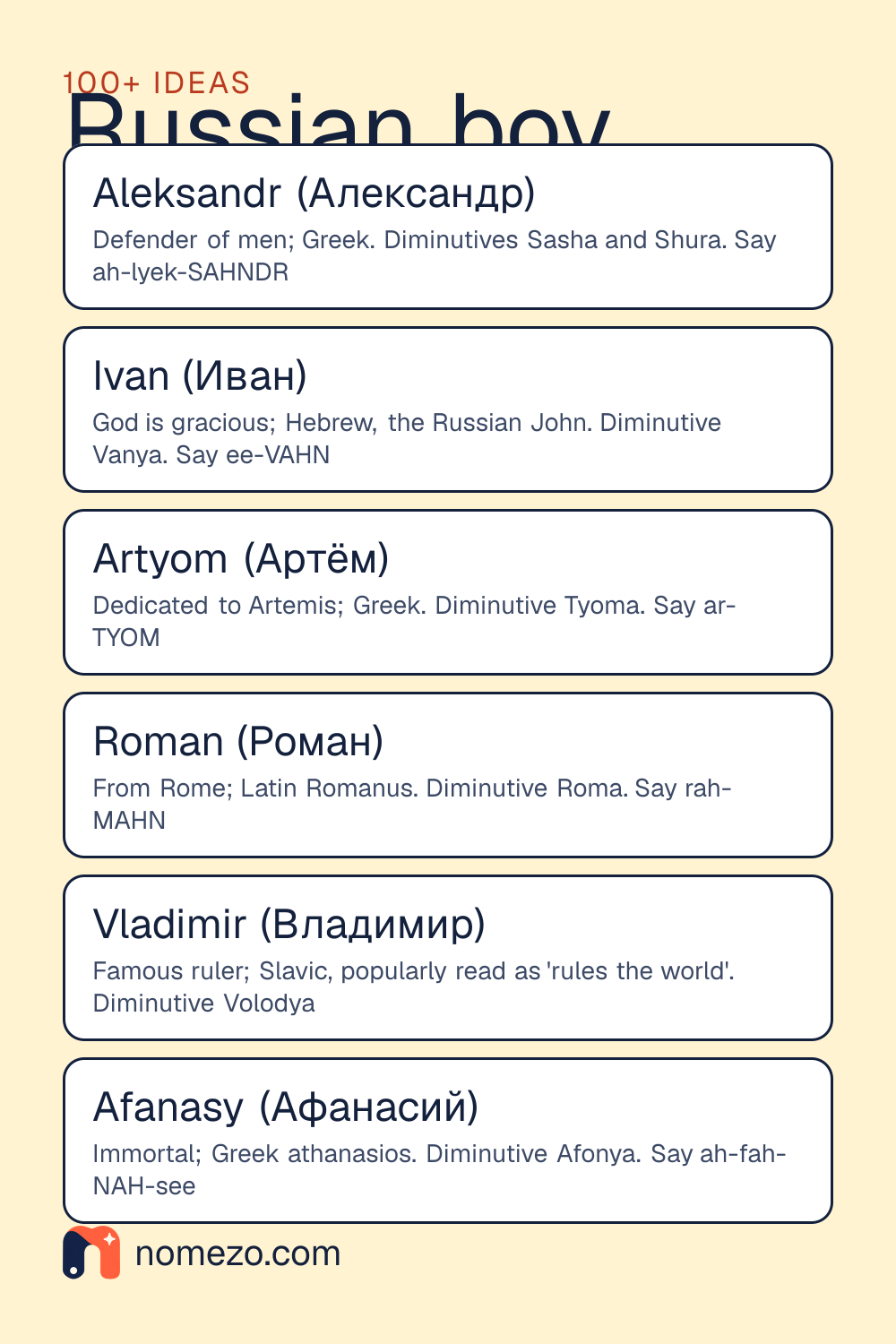
- Aleksandr (Александр) Moscow #2: Defender of men; Greek. Diminutives Sasha and Shura. Say ah-lyek-SAHNDR
- Dmitri (Дмитрий): Devoted to Demeter; Greek. Diminutive Dima. Say DMEE-tree
- Nikolai (Николай) US #605: Victory of the people; Greek. Diminutive Kolya. Say nee-kah-LIE
- Andrei (Андрей): Manly; Greek andreios. Diminutive Andryusha. Say ahn-DRAY
- Alexei (Алексей): Defender, helper; Greek. Diminutives Alyosha and Lyosha. Say ah-lyek-SAY
- Pyotr (Пётр): Stone, rock; Greek petros. Diminutive Petya. Say PYOH-tr
- Fyodor (Фёдор): Gift of God; Greek Theodoros. Diminutive Fedya. Say FYOH-dar
- Yuri (Юрий): Farmer; Greek, a Russian form of George. Diminutive Yura
- Vasily (Василий): Royal, kingly; Greek basileios. Diminutive Vasya. Say vah-SEE-lee
- Grigory (Григорий): Watchful; Greek gregorios. Diminutive Grisha. Say gree-GOH-ree
- Yevgeny (Евгений): Well-born, noble; Greek. Diminutive Zhenya. Say yev-GYEH-nee
- Lev (Лев) Moscow #3: Lion, the Russian word itself. Diminutive Lyova. Say LYEF
- Konstantin (Константин): Constant, steadfast; Latin. Diminutive Kostya. Say kahn-stahn-TEEN
- Pavel (Павел): Small; Latin Paulus. Diminutive Pasha. Say PAH-vyel
Biblical Russian boy names
Hebrew and Aramaic names that reached Russia through the Orthodox Church.
- Ivan (Иван) Moscow #6 US #163: God is gracious; Hebrew, the Russian John. Diminutive Vanya. Say ee-VAHN
- Ilya (Илья): My God is Yahweh; Hebrew Elijah. Diminutive Ilyusha. Say eel-YAH
- Daniil (Даниил): God is my judge; Hebrew Daniel. Diminutive Danya. Say dah-nee-EEL
- Matvei (Матвей) Moscow #7: Gift of God; Hebrew, the Russian Matthew. Diminutive Motya. Say maht-VAY
- Yakov (Яков): Holder of the heel, in Genesis; Hebrew Jacob. Diminutive Yasha
- Semyon (Семён): Hearing, listening; Hebrew Simeon. Diminutive Syoma. Say syeh-MYOHN
- Zakhar (Захар): God remembers; Hebrew Zechariah. Familiar form Zakharka. Say zah-KHAR
- Iosif (Иосиф): He will add; Hebrew, the Russian Joseph. Diminutive Osya
- Osip (Осип): Folk form of Joseph: he will add; Hebrew. Diminutive Osya
- Foma (Фома): Twin; Aramaic, the Russian Thomas. Familiar form Fomka, also slang for a crowbar
Russian boy names from Greek
Greek saints' names that became everyday Russian names, often with a very Russian nickname.
- Artyom (Артём) Moscow #8: Dedicated to Artemis; Greek. Diminutive Tyoma. Say ar-TYOM
- Kirill (Кирилл): Lordly; Greek kyrios, lord. Diminutive Kiryusha. Say kee-REEL
- Timofei (Тимофей) Moscow #10: Honoring God; Greek Timotheos. Diminutives Tima and Timosha
- Yegor (Егор): Farmer; Russian folk form of Georgy. Familiar form Yegorka. Say yeh-GOR
- Georgy (Георгий): Farmer; Greek georgos, the Russian George. Diminutive Zhora
- Leonid (Леонид): Son of the lion; Greek. Diminutive Lyonya. Say lyeh-ah-NEET
- Nikita (Никита): Victor, winner; Greek Niketas. Familiar form Nikitka. Say nee-KEE-tah
- Denis (Денис): Of Dionysus; Greek Dionysios. Diminutive Deniska. Say dyeh-NEES
- Arseny (Арсений): Manly, virile; Greek arsenios. Diminutive Senya. Say ar-SYEH-nee
- Arkady (Аркадий): From Arcadia, a region of Greece. Diminutive Arkasha
- Gennady (Геннадий): Noble, generous; Greek gennadas. Diminutive Gena. Say gyeh-NAH-dee
- Anatoly (Анатолий): Sunrise, east; Greek anatole. Diminutive Tolya. Say ah-nah-TOH-lee
- Filipp (Филипп): Lover of horses; Greek. Diminutive Filipok, as in Tolstoy's story
Russian male names from Latin and English
Roman names that came through the Church, plus one Old English name long used in Russia.
- Valery (Валерий): To be strong; Latin valere. Diminutive Valera. Say vah-LYEH-ree
- Viktor (Виктор): Conqueror, winner; Latin. Diminutive Vitya
- Vitaly (Виталий): Of life, vital; Latin vitalis. Diminutive Vitya. Say vee-TAH-lee
- Maksim (Максим) Moscow #4: Greatest; Latin Maximus. Diminutive Maks. Say mahk-SEEM
- Venedikt (Венедикт): Blessed; Latin Benedictus. Diminutive Venya
- Kliment (Климент): Merciful; Latin clemens. Short form Klim
- Innokenty (Иннокентий): Innocent; Latin innocens. Diminutive Kesha. Say ee-nah-KYEN-tee
- Eduard (Эдуард): Guardian of prosperity; Old English Eadweard. Diminutive Edik
Slavic and Old Norse boy names
Most were names of the princes of early Rus. Oleg, Igor and Gleb came with Norse (Varangian) settlers; Svyatoslav was the first ruler with a Slavic name.
- Vladimir (Владимир): Famous ruler; Slavic, popularly read as 'rules the world'. Diminutive Volodya
- Yaroslav (Ярослав): Fierce glory; Slavic. Diminutive Slava. Say yah-rah-SLAHF
- Vyacheslav (Вячеслав): Greater glory; Slavic. Diminutive Slava. Say vyah-cheh-SLAHF
- Stanislav (Станислав): Becomes glorious; Slavic. Diminutive Stas. Say stah-nee-SLAHF
- Vladislav (Владислав): Rules with glory; Slavic. Diminutives Vlad and Vladik
- Svyatoslav (Святослав): Holy glory; Slavic, borne by medieval Kyiv princes. Diminutive Slava
- Bogdan (Богдан): Given by God; Slavic. Diminutive Bodya (mainly Ukrainian). Say bahg-DAHN
- Vsevolod (Всеволод): Rules over all; Slavic. Diminutive Seva. Say FSYEH-vah-laht
- Rostislav (Ростислав): Growing glory; Slavic. Diminutive Rostik
- Miroslav (Мирослав): Glorious in peace; Slavic. Diminutive Slava
- Mstislav (Мстислав): Vengeance and glory; Slavic, a princely name. Diminutive Mstisha
- Oleg (Олег): Holy, blessed; Old Norse Helgi. Diminutive Olezhka. Say ah-LYEK
- Igor (Игорь): From Norse Yngvarr: the god Yngvi plus warrior. Diminutive Garik. Say EE-gar
- Gleb (Глеб): Heir of God; Old Norse Gudleifr. Diminutive Glebushka
Old-fashioned and storybook Russian boy names
Names from village life, fairy tales and classic literature that are back in fashion with some parents.
- Afanasy (Афанасий): Immortal; Greek athanasios. Diminutive Afonya. Say ah-fah-NAH-see
- Prokhor (Прохор): Leader of the dance; Greek Prochoros. Diminutive Prosha
- Tikhon (Тихон): Lucky, fortunate; Greek tyche, fortune. Diminutive Tisha
- Kuzma (Кузьма): Order, world; Greek Kosmas. Diminutive Kuzya. Say kooz-MAH
- Makar (Макар): Blessed, happy; Greek makarios. Familiar form Makarka. Say mah-KAR
- Yefim (Ефим): Cheerful, good-spirited; Greek Euthymios. Diminutive Fima. Say yeh-FEEM
- Platon (Платон): Broad-shouldered; Greek, the Russian Plato. Diminutive Tosha
- Stepan (Степан): Crown, wreath; Greek stephanos. Diminutive Styopa. Say styeh-PAHN
- Ruslan (Руслан): Probably lion, from Turkic arslan via the folk hero Yeruslan; made famous by Pushkin's poem (1820). Diminutive Rusya
- Timur (Тимур): Iron; Turkic temir. Diminutive Tima. Say tee-MOOR
- Danila (Данила): Folk form of Daniil: God is my judge; Hebrew. Diminutive Danya
Russian nicknames that work as names
Short forms so familiar that many are now used as given names outside Russia. In the US, Sasha, Misha and Vanya are now given mostly to girls.
- Sasha (Саша): Short for Aleksandra or Aleksandr: defender of men; Greek
- Misha (Миша): Short for Mikhail: who is like God?; Hebrew
- Kostya (Костя): Short for Konstantin: constant, steadfast; Latin
- Vanya (Ваня): Short for Ivan: God is gracious; Hebrew
- Dima (Дима): Short for Dmitri: devoted to Demeter; Greek
- Pasha (Паша): Short for Pavel: small; Latin
- Petya (Петя): Short for Pyotr: stone, rock; Greek
- Fedya (Федя): Short for Fyodor: gift of God; Greek
- Yasha (Яша): Short for Yakov, the Russian Jacob; Hebrew
- Slava (Слава): Glory; short for names like Vyacheslav and Yaroslav; Slavic
- Grisha (Гриша): Short for Grigory: watchful; Greek
- Kolya (Коля): Short for Nikolai: victory of the people; Greek
More Russian pet names for boys
The forms friends and family use every day. Endings like -enka and -ushka (Sashenka, Vanyushka) make them warmer, while a -ka ending (Sashka, Vanka) is familiar and can sound rude to an adult.
- Lyosha (Лёша): Short for Alexei: defender, helper; Greek
- Vitya (Витя): Short for Viktor, conqueror, or Vitaly, of life; Latin
- Tolya (Толя): Short for Anatoly: sunrise, east; Greek
- Seva (Сева): Short for Vsevolod: rules over all; Slavic
- Styopa (Стёпа): Short for Stepan: crown, wreath; Greek
- Tyoma (Тёма): Short for Artyom: dedicated to Artemis; Greek
- Yura (Юра): Short for Yuri: farmer; Greek
- Volodya (Володя): Short for Vladimir: famous ruler; Slavic
- Vova (Вова): Playful short form of Vladimir: famous ruler; Slavic
- Gosha (Гоша): Short for Georgy, farmer; also used for Igor
- Lyova (Лёва): Short for Lev: lion; Russian
- Kesha (Кеша): Short for Innokenty: innocent; Latin
- Zhenya (Женя): Short for Yevgenia or Yevgeny: well-born, noble; Greek
- Senya (Сеня): Short for Arseny, manly, or Semyon, hearing
- Shura (Шура): Short for Aleksandr or Aleksandra: defender of men; Greek
- Tima (Тима): Short for Timofei, honoring God, or Timur, iron
- Vlad (Влад): Short for Vladislav or Vladimir: rule; Slavic
How to pick the right name
Love the nickname too
Russians rarely use the full name day to day. Aleksandr becomes Sasha and Mikhail becomes Misha, so make sure the short form suits your son as well as the full name.
Check the stress
Russian stress often falls where English speakers do not expect it: ee-VAHN, not EYE-van. The pronunciation in each note shows the stressed syllable in capitals.
Say it with the patronymic
A Russian full name includes a middle name formed from the father's name, such as Ivan Petrovich. If your family uses one, say the whole name aloud before you decide.
Pick one English spelling
Cyrillic can be written several ways in English, such as Dmitri or Dmitry and Alexei or Aleksei. Choose one spelling and use it on every document.
Save this list for later
Pin it to a naming board, or tap the heart next to any name to keep it in your favorites on this device.
Russian boy names: the 2025 rankings, how patronymics work, and the US gender twist
By The Nomezo Editors · Updated October 25, 2026 · How we research names
Mikhail was the top name for baby boys across Russia in 2025, given to 4.03% of them, ahead of Aleksandr and Artyom (Russia's Social Fund). In Moscow, Mikhail led with 2,546 babies, and Lev, the Russian word for lion, came third.
A Russian boy's name also decides his children's middle names, because a patronymic is built from the father's first name. The builder above puts first name, patronymic and surname together in Cyrillic and Latin letters, with the tender and familiar short forms.
The most popular boys' names in Moscow and Russia, 2025
- Across Russia the 2025 leaders were Mikhail (4.03% of baby boys), Aleksandr (3.56%), Artyom (3.11%), Matvei (2.68%) and Timofei (2.43%), according to Russia's Social Fund (Snob, February 6, 2026).
- Rare picks. Moscow parents also chose old names like Prokhor (14 boys), Trofim (12) and Foma (7) in 2025 (Moscow city government).
| Rank | Name | Babies in Moscow | US rank, 2025 |
|---|---|---|---|
| 1 | Mikhail | 2,546 | #21 (as Michael) |
| 2 | Aleksandr | 2,408 | #30 (as Alexander) |
| 3 | Lev | 1,793 | 227 boys |
| 4 | Maksim | 1,672 | 114 boys (as Maxim) |
| 5 | Mark | 1,515 | #245 |
| 6 | Ivan | 1,492 | #163 |
| 7 | Matvei | 1,351 | #32 (as Matthew) |
| 8 | Artyom | 1,346 | 37 boys (as Artem) |
| 9 | Roman | 1,251 | #42 |
| 10 | Timofei | 1,188 | Fewer than 5 |
Sources: Moscow city government, January 2026; US Social Security Administration.
How a patronymic works
- The rule. A son takes his father's name plus -ovich, or -evich after a soft ending: Ivan gives Ivanovich and Sergey Sergeyevich. Some names ending in a vowel take -ich, so Ilya gives Ilyich and Foka Fokich (Wikipedia).
- One generation ahead. The name you give a son becomes his children's middle name: a boy named Pavel will have children called Pavlovich and Pavlovna, and a Lev's are Lvovich and Lvovna.
- Polite address. Leaving out the patronymic when speaking to someone of higher standing, or at a business meeting, is considered offensive (Wikipedia).
- Norse and Slavic roots. Oleg, Igor and Gleb came with Norse settlers, and Svyatoslav, son of Igor and Olga, was the first ruler of Kyivan Rus with a Slavic name (Behind the Name).
Russian boys' names in the US
| Name | US girls | US boys |
|---|---|---|
| Sasha | 414 | 47 |
| Valery | 366 | 5 |
| Yuri | 139 | 88 |
| Vanya | 75 | Fewer than 5 |
| Misha | 49 | 11 |
| Nikita | 31 | 25 |
Source: US Social Security Administration. In Russia all of these are boys' names, though Sasha also shortens Aleksandra.
Sources
Frequently asked questions
What is the most popular boy name in Russia?
Mikhail. It was the top name for baby boys across Russia in 2025, given to 4% of them, ahead of Aleksandr and Artyom, according to Russia's Social Fund. It was also No. 1 in Moscow, with 2,546 babies.
What are common Russian nicknames for boys?
Sasha for Aleksandr, Misha for Mikhail, Dima for Dmitri, Vanya for Ivan, Kolya for Nikolai and Seryozha for Sergei are among the best known. Endings like -enka and -ushka make them warmer; a -ka ending, like Sashka, is familiar and can sound rude to an adult.
What is a strong Russian boy name?
Ruslan (lion), Timur (iron), Vsevolod (rules over all), Andrei (manly) and Yaroslav (fierce glory) all carry strong meanings.
What do Sergei, Anton and Boris mean?
Sergei and Anton come from Roman family names whose meanings are unknown, and the origin of Boris is debated. They are classic Russian names, but this list sticks to names with a well-established meaning.
What does -slav mean in Russian names?
The ending -slav comes from slava, glory. Yaroslav means fierce glory, Vyacheslav greater glory and Svyatoslav holy glory, and all of them can be shortened to Slava.
How does a Russian patronymic work for a boy?
He takes his father's first name plus -ovich, or -evich after a soft ending, so Ivan's son is Ivanovich and Sergey's son Sergeyevich. Some names add -ich, as in Ilya, Ilyich. His sisters take -ovna or -evna instead.
Is Sasha a boy's or a girl's name?
Both in Russia, where it shortens Aleksandr and Aleksandra. In the US it is now mostly a girl's name: in 2025, 414 US girls and 47 boys were named Sasha.
More by origin and generators
- Russian girl names147 names. Russian girl names and women's names with meanings, nicknames and pronunciation, from Anastasia (Nastya) to Svetlana, plus patronymics like Ivanovna.
- Russian last names148 names. Russian last names with meanings and Cyrillic: common, patronymic, occupational, animal, church and noble surnames, with -ov/-ova and -sky/-skaya explained.
- Greek boy names170 names. Greek boy names with meanings: 160+ Greek male names, male Greek god names, mythology heroes, ancient names, saints and men's nicknames, with pronunciation.
- Strong boy names124 names. Strong boy names and male names that are strong: names meaning strength, bravery or warrior, plus kings, heroes and Vikings, each with its real meaning.
- Polish last names129 names. Polish last names with meanings and pronunciation: common, -ski and -cki, -wicz, occupational, animal and regional surnames, with female forms explained.
- Viking names170 names. Real Viking names with Old Norse meanings: female and male names, famous Vikings, Viking surnames, names that honor Thor, Norse gods and bynames.
- Names by OriginNames by origin and culture: Japanese, French, Irish, Italian, Spanish, Norse, Greek, Arabic and more, with meanings and pronunciation.
- Baby NamesBaby names with meanings and origins: girl names, boy names, unisex names, popular and unique picks, plus a free baby name generator.
- Random name generatorReal full names from 24 cultures, each with its meaning and origin.