
Italian city names: 130+ real cities and towns by region
139 names · Updated · By The Nomezo Editors · Save to Pinterest
Famous Italian city names include Rome, Florence and Venice, and many towns still carry ancient roots: Naples comes from the Greek Neapolis, new city, and Orvieto from the Latin urbs vetus, old city.
This page lists 130+ real Italian cities, towns and villages, grouped by region from the Alps to Sicily and Sardinia. Each entry gives the region and one checked fact or name origin, so you can use the list for travel ideas, trivia, school projects or names for characters and pets.
Can't decide? Shuffle 6 random picks
L'Aquila
Abruzzo: name means the eagle; famous for its fountain of 99 spouts.
Castelfidardo
Marche: the accordion capital of Italy, with an accordion museum.
Taranto
Apulia: founded by Spartans; the tarantula and tarantella are named after it.
Noto
Sicily: rebuilt in golden Baroque stone after the 1693 earthquake.
Asolo
Veneto: hill town nicknamed the city of a hundred horizons.
Cividale del Friuli
Friuli-Venezia Giulia: Roman Forum Iulii, which gave the region its name.
Italian city names in Piedmont, Aosta Valley and Liguria
The Alpine northwest and the Italian Riviera: royal Turin, truffle towns and pastel fishing villages.
- Turin (Torino): Piedmont: first capital of unified Italy, from 1861 to 1865.
- Alba: Piedmont: famous for its prized white truffles and autumn truffle fair.
- Asti: Piedmont: runs a bareback horse race, the Palio, every September.
- Ivrea: Piedmont: home of Olivetti typewriters and a carnival orange-throwing battle.
- Cuneo: Piedmont: means wedge, for its wedge-shaped plateau between two rivers.
- Alessandria: Piedmont: founded in 1168 and named after Pope Alexander III.
- Aosta: Capital of its namesake Alpine region; named after Emperor Augustus.
- Courmayeur: Aosta Valley: ski town at the Italian foot of Mont Blanc.
- Genoa (Genova): Liguria: birthplace of Columbus; the word jeans comes from its French name.
- Sanremo: Liguria: hosts Italy's famous song festival, held since 1951.
- Portofino: Liguria: tiny harbor village of pastel houses loved by yachts and film stars.
- Vernazza: Liguria: one of the five Cinque Terre villages, now a UNESCO site.
- Camogli: Liguria: fries fish in a giant pan at its May festival.
- Imperia: Liguria: created in 1923 by merging two towns, named after the Impero river.
Italian city names in Lombardy
Italy's richest region, from fashion capital Milan to the lake towns of Como and Garda.
- Milan (Milano): Lombardy: from Roman Mediolanum, often explained as middle of the plain.
- Bergamo: Lombardy: hilltop Upper Town ringed by UNESCO-listed Venetian walls.
- Cremona: Lombardy: violin capital where Stradivari and Amati built their instruments.
- Como: Lombardy: lakeside birthplace of Alessandro Volta, inventor of the electric battery.
- Mantua (Mantova): Lombardy: ruled by the Gonzaga family; the poet Virgil was born nearby.
- Pavia: Lombardy: capital of the Lombard kingdom in the early Middle Ages.
- Monza: Lombardy: its royal park hosts the Formula One Italian Grand Prix.
- Bellagio: Lombardy: Lake Como village that lent its name to a Las Vegas hotel.
- Sirmione: Lombardy: Lake Garda peninsula with ruins of a vast Roman villa.
- Lecco: Lombardy: lakeside setting of Manzoni's classic novel The Betrothed.
Italian town names in the northeast
Veneto, Trentino-Alto Adige and Friuli-Venezia Giulia: lagoon islands, Dolomite resorts and old Habsburg ports.
- Venice (Venezia): Veneto: named after the ancient Veneti people; built across more than 100 islands.
- Verona: Veneto: Shakespeare's setting for Romeo and Juliet, with a Roman arena.
- Padua (Padova): Veneto: its university, founded in 1222, once employed Galileo.
- Vicenza: Veneto: showcase of Palladio's villas and buildings, a UNESCO site.
- Murano: Veneto: Venice's glassmakers were moved to this island in 1291.
- Burano: Veneto: lagoon island of brightly painted houses and handmade lace.
- Bassano del Grappa: Veneto: known for a covered wooden bridge designed by Palladio.
- Cortina d'Ampezzo: Veneto: Dolomites resort that hosted the 1956 Winter Olympics and co-hosted 2026.
- Asolo: Veneto: hill town nicknamed the city of a hundred horizons.
- Trento: Trentino-Alto Adige: hosted the Council of Trent, which met from 1545 to 1563.
- Bolzano (Bozen): Trentino-Alto Adige: its museum displays Ötzi, the 5,300-year-old Iceman.
- Rovereto: Trentino-Alto Adige: rings a giant peace bell cast from cannons every evening.
- Trieste: Friuli-Venezia Giulia: Austria-Hungary's main seaport until 1918; James Joyce lived here.
- Aquileia: Friuli-Venezia Giulia: major Roman city with a basilica of vast floor mosaics.
- Cividale del Friuli: Friuli-Venezia Giulia: Roman Forum Iulii, which gave the region its name.
- Palmanova: Friuli-Venezia Giulia: Venetian fortress town laid out as a nine-pointed star.
City names in Emilia-Romagna
The food and motor valley of Italy, between the Po River and the Adriatic.
- Bologna: Emilia-Romagna: home of the oldest university in the Western world, from 1088.
- Modena: Emilia-Romagna: birthplace of Enzo Ferrari and tenor Luciano Pavarotti.
- Maranello: Emilia-Romagna: headquarters and factory of Ferrari since the 1940s.
- Parma: Emilia-Romagna: Parmesan cheese takes its English name from this city.
- Reggio Emilia: Emilia-Romagna: the green, white and red Italian flag was born here in 1797.
- Ravenna: Emilia-Romagna: last capital of the Western Roman Empire; Dante is buried here.
- Rimini: Emilia-Romagna: beach city and birthplace of film director Federico Fellini.
- Ferrara: Emilia-Romagna: Renaissance seat of the Este family, ringed by intact walls.
- Faenza: Emilia-Romagna: gave its name to faience, glazed earthenware pottery.
- Piacenza: Emilia-Romagna: Roman Placentia, a name traditionally read as pleasant place.
- Busseto: Emilia-Romagna: composer Giuseppe Verdi was born in a nearby hamlet.
- Imola: Emilia-Romagna: its Enzo and Dino Ferrari circuit has hosted Formula One races.
Town names in Tuscany and Umbria
Hill towns, Renaissance cities and saints' birthplaces in the green heart of Italy.
- Florence (Firenze): Tuscany: from Roman Florentia, usually read as flourishing; cradle of the Renaissance.
- Pisa: Tuscany: its leaning bell tower was begun in 1173.
- Siena: Tuscany: runs the Palio horse race around its main square twice each summer.
- Lucca: Tuscany: walled city and birthplace of opera composer Giacomo Puccini.
- Livorno: Tuscany: port city long called Leghorn in English.
- Arezzo: Tuscany: birthplace of the poet Petrarch and of artist Giorgio Vasari.
- San Gimignano: Tuscany: medieval town of stone towers, named after Saint Geminianus.
- Volterra: Tuscany: Etruscan hill town famed for carving alabaster.
- Cortona: Tuscany: Etruscan hill town made famous by the memoir Under the Tuscan Sun.
- Vinci: Tuscany: Leonardo was born nearby in 1452 and took its name.
- Carrara: Tuscany: its white marble quarries supplied Michelangelo.
- Prato: Tuscany: means meadow; a textile center since the Middle Ages.
- Pienza: Tuscany: rebuilt by Pope Pius II as an ideal Renaissance town.
- Perugia: Umbria: Etruscan hill city, home of Perugina chocolates and Baci.
- Assisi: Umbria: birthplace of Saint Francis, a patron saint of Italy.
- Orvieto: Umbria: from Latin urbs vetus, old city, set atop a volcanic cliff.
- Spoleto: Umbria: hosts the Festival of Two Worlds, founded in 1958.
- Gubbio: Umbria: keeps the Iguvine Tables, bronze tablets in the ancient Umbrian language.
- Norcia: Umbria: birthplace of Saint Benedict; Italian pork butchers are called norcini.
- Terni: Umbria: Saint Valentine was its bishop and remains its patron saint.
Cities in Lazio, Marche, Abruzzo and Molise
From Rome and the papal towns of Lazio to the Adriatic hills of Marche and the mountain villages of Abruzzo.
- Rome (Roma): Lazio: Italy's capital, founded according to legend by Romulus in 753 BC.
- Viterbo: Lazio: the City of the Popes, seat of the papacy in the 1200s.
- Tivoli: Lazio: Roman Tibur, home of Hadrian's Villa and the fountains of Villa d'Este.
- Anzio: Lazio: ancient Antium, birthplace of emperors Nero and Caligula.
- Civitavecchia: Lazio: name means old city; the main cruise port for Rome.
- Gaeta: Lazio: said to be named after Caieta, the nurse of Aeneas.
- Rieti: Lazio: claimed since Roman times as the navel, or center, of Italy.
- Subiaco: Lazio: from Latin for below the lakes, after Nero's artificial lakes.
- Latina: Lazio: founded in 1932 as Littoria and renamed in 1946.
- Civita di Bagnoregio: Lazio: crumbling hilltop village reached only by a long footbridge.
- Ancona: Marche: from Greek ankon, elbow, for its curved headland.
- Urbino: Marche: Renaissance hill town and birthplace of the painter Raphael.
- Pesaro: Marche: birthplace of Gioachino Rossini, composer of The Barber of Seville.
- Recanati: Marche: hometown of the great Romantic poet Giacomo Leopardi.
- Fabriano: Marche: papermaking center since the 1200s, famous for watermarks.
- Castelfidardo: Marche: the accordion capital of Italy, with an accordion museum.
- Ascoli Piceno: Marche: gave its name to olive all'ascolana, stuffed fried olives.
- L'Aquila: Abruzzo: name means the eagle; famous for its fountain of 99 spouts.
- Pescara: Abruzzo: seaside birthplace of the poet Gabriele D'Annunzio.
- Sulmona: Abruzzo: birthplace of the Roman poet Ovid; known for sugared almonds.
- Scanno: Abruzzo: mountain village beside a heart-shaped lake.
- Agnone: Molise: home of a bell foundry run by one family for centuries.
Italian town names in Campania
Naples, Vesuvius and the cliffside towns of the Amalfi Coast.
- Naples (Napoli): Campania: from Greek Neapolis, new city; the birthplace of pizza.
- Pompeii (Pompei): Campania: Roman city buried by Vesuvius in AD 79.
- Ercolano: Campania: modern town above Herculaneum, also buried in AD 79.
- Sorrento: Campania: cliff-top town famous for lemons and Neapolitan songs.
- Amalfi: Campania: once a powerful maritime republic; gives its name to the coast.
- Positano: Campania: pastel village stacked down the cliffs of the Amalfi Coast.
- Ravello: Campania: its cliff gardens inspired Wagner while writing Parsifal.
- Salerno: Campania: home of the Schola Medica, medieval Europe's first medical school.
- Benevento: Campania: Romans renamed it from Maleventum, bad event, to Beneventum, good event.
- Caserta: Campania: home of the Reggia, a vast Bourbon royal palace.
- Pozzuoli: Campania: Roman Puteoli, where actress Sophia Loren grew up.
Town names in Apulia, Basilicata and Calabria
The heel and toe of the Italian boot: whitewashed towns, cave cities and Greek colonies.
- Bari: Apulia: has kept the relics of Saint Nicholas since 1087.
- Lecce: Apulia: called the Florence of the South for its ornate Baroque.
- Alberobello: Apulia: UNESCO town of trulli, whitewashed stone huts with cone roofs.
- Ostuni: Apulia: hilltop old town known as the White City.
- Taranto: Apulia: founded by Spartans; the tarantula and tarantella are named after it.
- Polignano a Mare: Apulia: clifftop birthplace of Domenico Modugno, singer of Volare.
- Gallipoli: Apulia: from Greek Kallipolis, beautiful city.
- Otranto: Apulia: Italy's easternmost town, setting of the first Gothic novel.
- Locorotondo: Apulia: name means round place, after its circular old town.
- Matera: Basilicata: famous for the Sassi cave dwellings; European Capital of Culture 2019.
- Potenza: Basilicata: at 819 meters, the highest regional capital in Italy.
- Maratea: Basilicata: coastal town watched over by a huge statue of Christ.
- Reggio Calabria: Calabria: its museum holds the Riace Bronzes, two ancient Greek warriors.
- Tropea: Calabria: cliff-top town famous for sweet red onions.
- Scilla: Calabria: named after Scylla, the sea monster of Greek myth.
- Pizzo: Calabria: seaside town credited with inventing tartufo ice cream.
- Crotone: Calabria: ancient Croton, where Pythagoras founded his school.
Cities of Sicily and Sardinia
Greek temples, Baroque towns and Bronze Age towers on Italy's two great islands.
- Palermo: Sicily: from Greek Panormos, all harbor; now the island's capital.
- Catania: Sicily: rebuilt in black lava stone beneath Mount Etna.
- Syracuse (Siracusa): Sicily: powerful ancient Greek city and birthplace of Archimedes.
- Taormina: Sicily: cliff town with an ancient Greek theater facing Etna.
- Agrigento: Sicily: overlooks the Valley of the Temples, ancient Greek ruins.
- Cefalù: Sicily: from Greek kephale, head, for the rocky headland above it.
- Noto: Sicily: rebuilt in golden Baroque stone after the 1693 earthquake.
- Modica: Sicily: makes grainy chocolate with an old cold-working method.
- Marsala: Sicily: where Garibaldi's Expedition of the Thousand landed in 1860.
- Enna: Sicily: at 931 meters, the highest provincial capital in Italy.
- Piazza Armerina: Sicily: nearby Roman villa holds some of the finest mosaics anywhere.
- Cagliari: Sardinia: the island's capital, first settled by Phoenician traders.
- Alghero: Sardinia: many locals still speak a dialect of Catalan.
- Olbia: Sardinia: name usually read from Greek olbios, happy or prosperous.
- Nuoro: Sardinia: hometown of Grazia Deledda, Nobel Prize winner in literature.
- Orgosolo: Sardinia: mountain village covered in hundreds of painted murals.
- Barumini: Sardinia: home of Su Nuraxi, a UNESCO-listed Bronze Age stone fortress.
How to pick the right name
Start with the region
Italy's 20 regions differ in landscape, food and dialect. For a coastal feel look at Liguria, Campania or Apulia; for mountains, try Aosta Valley or Trentino-Alto Adige.
Pick one form and stick to it
Florence and Firenze are the same city. Use either the English or the Italian form throughout a story, map or project so readers are not confused.
Check the stress
Most Italian place names stress the second-to-last syllable, as in Pe-RU-gia. An accent mark changes that: Cefalù is stressed on the last syllable.
Borrow a short one as a name
Short town names like Alba, Asti, Como or Siena work well for characters and pets. Read the note first so the meaning fits.
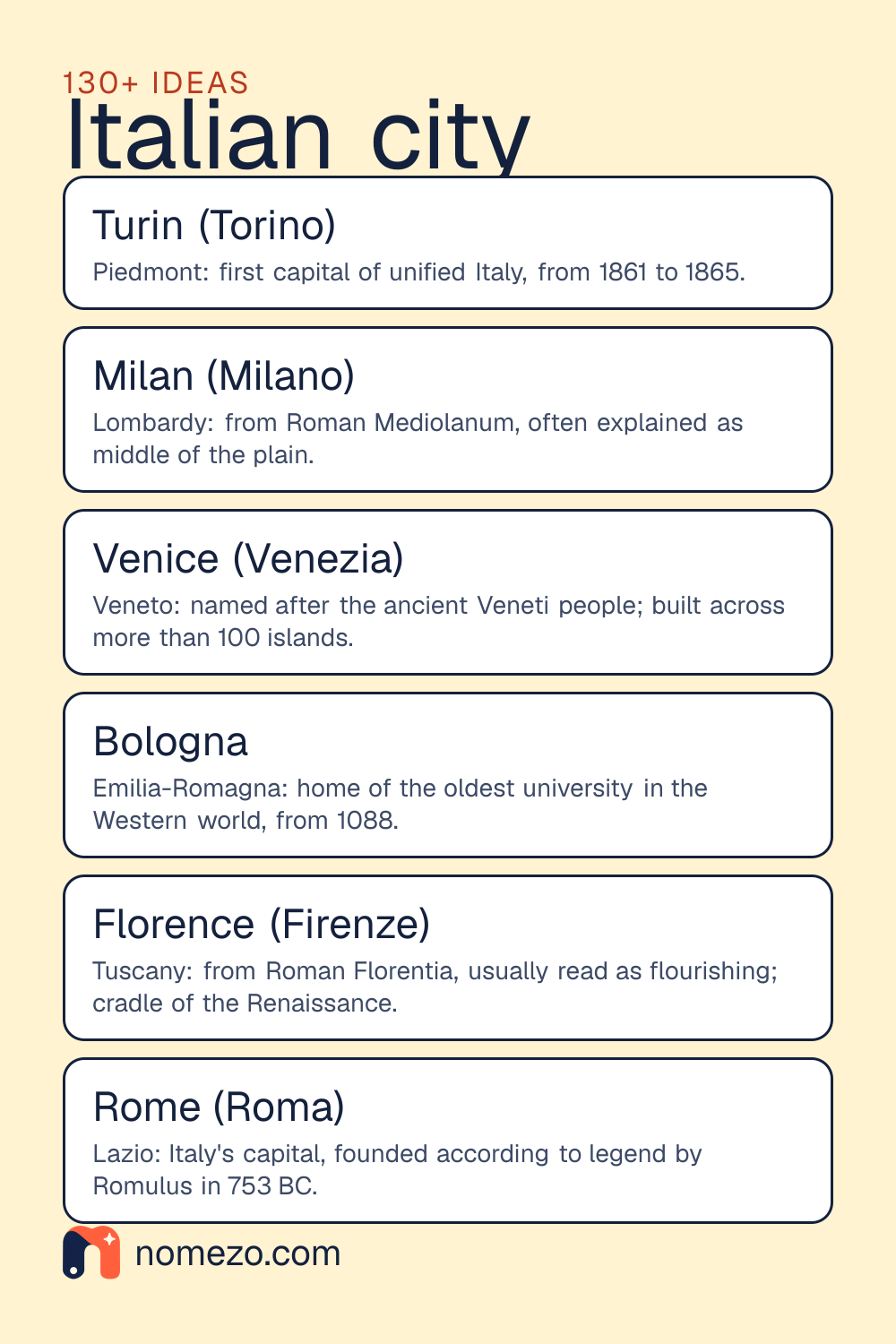
Save this list for later
Pin it to a naming board, or tap the heart next to any name to keep it in your favorites on this device.
Frequently asked questions
What are the most famous cities in Italy?
Rome, Milan, Naples, Turin, Florence, Venice and Bologna are the best known. Rome is the capital and largest city, and Milan is the country's business center.
How many regions does Italy have?
Italy has 20 regions. Five have special autonomy: Sicily, Sardinia, Aosta Valley, Trentino-Alto Adige and Friuli-Venezia Giulia.
Why do some Italian cities have different names in English?
English borrowed older forms of the biggest cities long ago, so Firenze became Florence, Napoli became Naples and Venezia became Venice. Smaller towns usually keep their Italian names.
Which Italian city names have meanings?
Many do. Naples means new city, Orvieto means old city, L'Aquila means the eagle and Prato means meadow, while Alessandria honors Pope Alexander III.
Can I use an Italian city name for a baby or pet?
Yes. Florence, Siena and Verona are already used as given names, and short town names like Alba, Asti or Como suit pets well.
More place names and generators
- French town names138 names. French town names from every region of mainland France, from Giverny to Carcassonne. 130+ real towns and villages, each with a checked origin or fact.
- Weird Wisconsin town names118 names. Weird Wisconsin town names that are real, from Imalone and Embarrass to Footville and Luck. 110+ crazy Wisconsin city names with county and name origin.
- Weird Florida city names118 names. Weird Florida city names that are real: Two Egg, Yeehaw Junction, Frostproof, Niceville and 100+ more, each with its county and the story behind the name.
- Funny town names in Alberta113 names. Funny town names in Alberta that are real: Vulcan, Dead Man's Flats, Cereal, Seven Persons, Hairy Hill and 100+ more, each with its location and name story.
- Funny street names224 names. Funny street names you can find on Google Maps, from Chicken Dinner Road to Whip-Ma-Whop-Ma-Gate, plus 150+ invented ideas for games and stories.
- Funny island names232 names. Funny island names for Animal Crossing, maps and stories. 230+ cute, punny and cheeky but clean ideas, including short names that fit the 10-character limit.
- Place NamesPlace names real and imagined: funny town and street names, kingdom and city names for fiction, and names for your home or garden.
- Names by OriginNames by origin and culture: Japanese, French, Irish, Italian, Spanish, Norse, Greek, Arabic and more, with meanings and pronunciation.
- Country name generatorFictional country names in European, desert, island, northern and fantasy styles.