

African last names: 150+ African surnames and their meanings
157 names · Updated · By The Nomezo Editors · Save to Pinterest
African last names come from hundreds of languages, like Okonkwo (Igbo, a boy born on Nkwo market day), Ndlovu (Zulu, elephant) and Adeniyi (Yoruba, the crown has honor). Many African surnames began as an ancestor's given name, a clan totem, a birth order or the day of a birth, and colonial and church records, mostly in the 1900s, often turned those into fixed family names.
This page lists 150+ real African surnames by language and region: Yoruba, Igbo, Akan, Hausa and Fulani, West African names from Senegal to Sierra Leone, Zulu, Xhosa and Ndebele, Sotho, Tswana and Shona, Kenyan (Kikuyu, Luo, Luhya and Kalenjin), Swahili, and Ethiopian and Eritrean names. Each note gives the meaning and the language, with a simple pronunciation where it helps. African second names is another way of saying surnames, and in Ethiopia and Eritrea the second name is the father's first name.
Can't decide? Shuffle 6 random picks
Nyoni
Bird in Ndebele and Zulu
Olanrewaju
Wealth goes forward; Yoruba. Say oh-lahn-reh-WAH-joo
Wanjala
Born during a famine; Luhya, from injala, hunger
Diop
A popular Wolof surname in Senegal, written Jobe in Gambia
Afolabi
Born into wealth; Yoruba. Say ah-foh-LAH-bee
Mensah
Third-born child; Akan, and one of the most common African surnames in the US
Find an African surname on this page
Narrow 157 surnames by how common they are in the 2020 US Census, by section, length or first letter, or search the meanings.
Yoruba last names (Nigeria and Benin)
Yoruba surnames usually began as an ancestor's given name, so many carry a whole sentence of meaning. Adé means crown, Olá wealth and Akin a brave man.
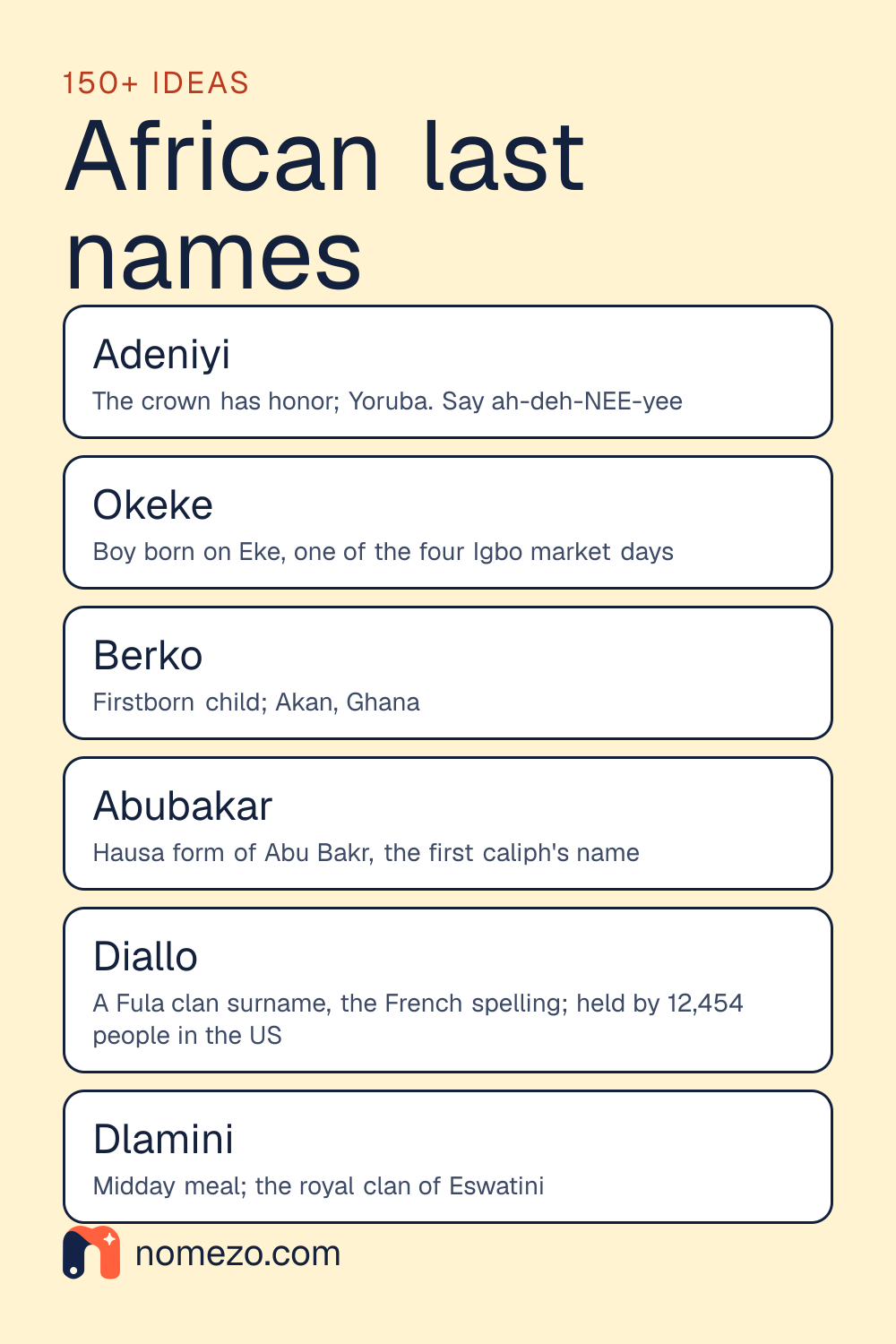
- Adeniyi 1,018 in the US: The crown has honor; Yoruba. Say ah-deh-NEE-yee
- Adeola 310 in the US: Crown of wealth; Yoruba, also a common given name
- Adekunle 677 in the US: The crown has filled the home; Yoruba
- Ademola 270 in the US: The crown is with wealth; Yoruba
- Adegoke 551 in the US: The crown has ascended the mountain; Yoruba
- Adebowale 332 in the US: The crown has returned home; Yoruba
- Adewale 566 in the US: The crown has come home; Yoruba. Say ah-deh-WAH-leh
- Adebola Under 100 in the US: The crown meets wealth; Yoruba
- Adedayo Under 100 in the US: The crown becomes joy; Yoruba
- Olayinka 373 in the US: Wealth surrounds me; Yoruba. Say oh-lah-YEEN-kah
- Olawale 234 in the US: Wealth has come home; Yoruba
- Olajide 478 in the US: Wealth has awakened; Yoruba
- Olanrewaju 457 in the US: Wealth goes forward; Yoruba. Say oh-lahn-reh-WAH-joo
- Afolabi 1,195 in the US: Born into wealth; Yoruba. Say ah-foh-LAH-bee
- Afolayan 288 in the US: Walks with the confidence of the wealthy; Yoruba
- Abiodun 405 in the US: Born on a festival day; Yoruba
- Abioye 235 in the US: Born into royalty; Yoruba
- Bankole 700 in the US: Build a house with me; Yoruba
- Bamidele Under 100 in the US: Follow me home; Yoruba
- Ogunleye 631 in the US: Ogun has honor; Ogun is the Yoruba orisha of iron
- Akinwale 222 in the US: The brave one has come home; Yoruba
- Dada 1,499 in the US: Born with curly hair; a Yoruba name
- Ogunbiyi 196 in the US: Ogun gave birth to this child; Yoruba. Say oh-goon-BEE-yee
- Olatunji 754 in the US: Wealth has woken again; Yoruba. Say oh-lah-TOON-jee
- Adeleke 816 in the US: The crown has triumphed; Yoruba. Say ah-deh-LEH-keh
- Ogundele 297 in the US: Ogun has come home; Yoruba, honoring the orisha of iron
- Adeyinka 285 in the US: The crown surrounds me; Yoruba. Say ah-deh-YEEN-kah
- Adeyemi 1,794 in the US: The crown suits me; Yoruba
Igbo last names (southeastern Nigeria)
Igbo surnames often praise God (Chukwu, Chi), mark a family role or record the market day of a birth. The Igbo week has four days: Eke, Orie, Afọ and Nkwọ.
- Okeke 2,140 in the US: Boy born on Eke, one of the four Igbo market days
- Okonkwo 1,562 in the US: Boy born on Nkwo market day; the hero of Things Fall Apart
- Okorie 725 in the US: Boy born on Orie market day; Igbo
- Okoye 1,544 in the US: Boy born on Orie market day, in a dialect form; Igbo
- Nwankwo 1,284 in the US: Child born on Nkwo market day; Igbo
- Nwachukwu 1,567 in the US: Child of God; Igbo. Say nwah-CHOOK-woo
- Eze 1,193 in the US: King or ruler; Igbo. Say EH-zeh
- Opara 1,078 in the US: Firstborn or eldest son; Igbo
- Okoro 1,840 in the US: Boy or young man; Igbo
- Obi 1,895 in the US: Heart or mind; Igbo
- Chukwu 1,020 in the US: God, the Supreme Being; Igbo. Say CHOOK-woo
- Uzoma 370 in the US: Good road or good way; Igbo
- Okechukwu 373 in the US: Portion of God, God's share; Igbo
- Chibueze Under 100 in the US: God is king; Igbo
- Ekwueme Under 100 in the US: One who says and does, a truthful person; Igbo
- Azubuike 259 in the US: The past is your strength; Igbo
- Amadi 1,220 in the US: Freeborn man; Igbo. Say ah-MAH-dee
- Njoku 1,451 in the US: Named for the Igbo deity of yams and yam farming
- Ihejirika Under 100 in the US: What I have is greater; Igbo
- Nwafor 358 in the US: Child born on Afọ market day; Igbo
- Nwoye 156 in the US: Child born on Orie market day, in a dialect form; Igbo
- Nweke 437 in the US: Child born on Eke market day; Igbo. Say NWEH-keh
- Igwe 921 in the US: Sky or heaven, also the title of a traditional king; Igbo
- Okafor 2,678 in the US: Boy born on Afọ market day; Igbo
Akan last names (Ghana and Ivory Coast)
Akan surnames from Ghana often record birth order or a people. Many Ghanaians also carry a day name, like Kofi for a Friday birth, before the family name.
- Berko 655 in the US: Firstborn child; Akan, Ghana
- Manu 1,580 in the US: Second-born child; Akan, and also a Polynesian name. Say MAH-noo
- Annan 1,262 in the US: Fourth-born child; Akan. Kofi Annan led the United Nations, 1997 to 2006
- Nsiah 357 in the US: Sixth-born child; Akan. Say n-SEE-ah
- Nsowah Under 100 in the US: Seventh-born child; Akan, Ghana
- Botwe Under 100 in the US: Eighth-born child; Akan, Ghana
- Nkrumah 546 in the US: Ninth-born child; the surname of Ghana's first president
- Badu 482 in the US: Tenth-born child; Akan. Say bah-DOO
- Duku 137 in the US: Eleventh-born child; Akan, Ghana
- Asante 2,394 in the US: For a member of the Akan people of central Ghana, also spelled Ashanti
- Anum Under 100 in the US: Fifth-born child; Akan, Ghana. Say ah-NOOM
- Tawia Under 100 in the US: First child born after twins; Akan, Ghana
- Mensah 6,325 in the US: Third-born child; Akan, and one of the most common African surnames in the US
Hausa and Fulani last names (northern Nigeria and the Sahel)
In northern Nigeria and across the Sahel, family names are often Hausa forms of Arabic names, usually a father's or grandfather's given name.
- Abubakar 1,074 in the US: Hausa form of Abu Bakr, the first caliph's name
- Aliyu 186 in the US: Hausa form of Ali, lofty or sublime
- Abdullahi 4,776 in the US: Servant of God, the Hausa form of Abd Allah
- Yakubu 372 in the US: Hausa form of Yaqub, the Arabic form of Jacob
- Lawal 2,588 in the US: From Arabic awwal, first; marks the first of brothers who share a given name
- Sani 747 in the US: From Arabic thani, second; marks the second brother with a shared name
- Salisu Under 100 in the US: From Arabic thalith, third; marks the third brother with a shared name; Hausa
- Rabiu Under 100 in the US: From Arabic rabi, fourth; marks the fourth brother with a shared name; Hausa
- Usman 2,475 in the US: Hausa form of Uthman, Arabic for a young bustard; also common in South Asia
- Shehu 923 in the US: From Arabic shaykh, elder; a title of scholar Usman dan Fodio
- Dauda 229 in the US: Hausa form of David, beloved
- Danjuma Under 100 in the US: Son born on Friday, from Hausa ɗa, son
West African last names from Senegal, Guinea, Mali and Sierra Leone
Fula, Manding, Wolof and Soninke family names from the western Sahel and coast. Many are clan names whose original meaning is uncertain, and several are among the most common African surnames in the US.
- Diallo 12,454 in the US: A Fula clan surname, the French spelling; held by 12,454 people in the US
- Jalloh 3,825 in the US: The English spelling of the Fula surname Diallo, common in Sierra Leone
- Traoré 3,086 in the US: A Manding surname common in Mali, Senegal, Burkina Faso, Ivory Coast and Guinea
- Diop 3,247 in the US: A popular Wolof surname in Senegal, written Jobe in Gambia
- Keita 2,655 in the US: A Mandinka surname; Sundiata Keita founded the Mali Empire
- Kamara 9,045 in the US: A surname most common in Sierra Leone, also found in Liberia and Guinea
- Touré 3,495 in the US: A West African clan name, Turay or Touray in English; Mali and Guinea
- Ndiaye 3,783 in the US: From Njie, a Serer and Wolof patronym; Senegal
- Cissé 2,877 in the US: Of Soninke origin, said to mean white horse; a name of marabout lineages
- Coulibaly 1,875 in the US: A common Bambara surname of Mali and Ivory Coast; the Bambara Empire's founding dynasty
Zulu, Xhosa, Swazi and Ndebele last names
In South Africa, Eswatini and Zimbabwe the surname is the isibongo, a clan name, often an animal or an ancestor. Clan names are used in respectful greetings.
- Dlamini 157 in the US: Midday meal; the royal clan of Eswatini
- Dube 8,737 in the US: Zebra in Zulu and Ndebele; in the US it is usually the French-Canadian Dubé. Say DOO-beh
- Khumalo Under 100 in the US: Named for a Zulu tree; the clan of King Mzilikazi
- Ngwenya Under 100 in the US: Crocodile in Zulu and Ndebele. Say n-GWEN-yah
- Nkomo Under 100 in the US: Cow in Zulu, Ndebele and Xhosa
- Shabalala Under 100 in the US: To disappear or vanish; Zulu, the family of Ladysmith Black Mambazo's founder
- Sithole 178 in the US: Heifer, a young cow, in Zulu and Ndebele
- Nkosi 167 in the US: King or chief in Zulu. Say n-KOH-see
- Zulu 340 in the US: Heaven or sky; the royal clan of King Shaka
- Ndlovu 265 in the US: Elephant in Zulu and Ndebele. Say n-DLOH-voo
- Nyathi Under 100 in the US: Buffalo; Ndebele and Zulu
- Mpofu 146 in the US: Eland, a large antelope, in Zulu and Ndebele
- Nyoni Under 100 in the US: Bird in Ndebele and Zulu
Sotho, Tswana and Shona totem surnames
Sotho, Tswana and Shona families also take names from a clan totem, an animal the clan honors and traditionally does not eat.
- Mokoena Under 100 in the US: Crocodile clan, from Sotho kwena, crocodile
- Tau 523 in the US: Lion; Sotho and Tswana, and also a Polynesian name. Say TAH-oo
- Tlou Under 100 in the US: Elephant; Sotho and Tswana
- Kgosi Under 100 in the US: Chief or king; Tswana. Say KHO-see
- Nkwe Under 100 in the US: Leopard; Sotho and Tswana
- Moyo 630 in the US: Heart, a major Shona and Ndebele totem
- Shumba Under 100 in the US: Lion, a Shona totem
- Nzou Under 100 in the US: Elephant, a Shona totem. Say n-ZOH-oo
- Soko 172 in the US: Monkey, a widespread Shona totem
- Shiri Under 100 in the US: Bird, a Shona totem
- Shava Under 100 in the US: Eland, the great antelope; a Shona totem
- Ngwena Under 100 in the US: Crocodile, a Shona totem. Say NGWEH-nah
Kenyan last names: Kikuyu, Luo, Luhya and Kalenjin
Many Kenyan surnames are a father's or grandfather's given name. Luo, Luhya and Kalenjin names often record the time, season or circumstances of a birth.
- Kenyatta 223 in the US: From kinyata, a beaded Maasai belt; Kenya's first president adopted it
- Mwangi 2,601 in the US: Rapid expansion; a very common Kikuyu surname
- Kariuki 1,282 in the US: Reincarnated one; a Kikuyu name
- Onyango 522 in the US: Born in the late morning; Luo
- Okoth 241 in the US: Born during rain; Luo
- Opiyo Under 100 in the US: Firstborn of twins; Luo
- Odongo Under 100 in the US: Second-born of twins; Luo
- Okello 310 in the US: A Luo name, also common in Uganda; often said to mark a child born after twins
- Obama 129 in the US: From a Luo name meaning bent or leaning; the family name of Barack Obama's father
- Kipchoge Under 100 in the US: Born near the grain store; Kalenjin
- Kipkoech Under 100 in the US: Born in the first part of the day, about 5 to 6 a.m.; Kalenjin
- Kiprono Under 100 in the US: Born around dusk, about 5 to 6 p.m.; Kalenjin
- Wafula Under 100 in the US: Born during the rainy season; Luhya, western Kenya
- Wekesa Under 100 in the US: Born during the harvest; Luhya. Say weh-KEH-sah
- Wanjala Under 100 in the US: Born during a famine; Luhya, from injala, hunger
- Simiyu Under 100 in the US: Born during the dry season; Luhya. Say see-MEE-yoo
- Wanyonyi Under 100 in the US: Born during the weeding season; Luhya
- Nyongesa Under 100 in the US: Born on Saturday; Luhya. Say nyon-GEH-sah
Swahili last names (Kenya and Tanzania)
Along the Swahili coast and across Tanzania, a surname is often a father's given name, and many come from Arabic through Islam.
- Hamisi Under 100 in the US: Born on Thursday, from the Swahili word for Thursday
- Jumanne Under 100 in the US: Tuesday in Swahili, for a child born that day
- Ramadhani Under 100 in the US: Swahili form of Ramadan, the month of fasting
- Shabani 1,118 in the US: Swahili form of Shaban, the month before Ramadan
- Rajabu Under 100 in the US: Swahili form of Rajab, a sacred month of the Islamic calendar
- Bakari 338 in the US: The Swahili name for the constellation Boötes
- Zuberi 455 in the US: Swahili form of Zubair, from Arabic for pieces of iron
- Mwamba 503 in the US: Rock or boulder in Swahili
- Abdallah 5,527 in the US: Servant of God; Swahili and Arabic
- Daudi Under 100 in the US: Swahili form of David, beloved
Ethiopian and Eritrean second names
Ethiopians and Eritreans traditionally have no inherited surname. A person's second name is the father's given name, so these are African second names in the literal sense.
- Bekele 2,410 in the US: Grow or flourish; Amharic. Runner Kenenisa carries it
- Girma 1,338 in the US: Majesty; an Amharic name from Ethiopia
- Tadesse 2,427 in the US: Revived or renewed; Amharic
- Kebede 2,762 in the US: Heavy or serious; Amharic
- Mekonnen 2,204 in the US: Nobleman, official or leader; Amharic
- Alemu 1,958 in the US: From alem, world; Amharic
- Ayele 1,380 in the US: Became strong or powerful; Amharic
- Kassa 2,376 in the US: Compensation or reparation; Amharic
- Hailu 2,187 in the US: His power, from Ge'ez hayl, strength; Amharic and Tigrinya
- Tamrat 301 in the US: Miracle; an Amharic name
- Tariku Under 100 in the US: His history or his story; Amharic
- Sisay 665 in the US: Good omen; an Amharic name
- Dejen Under 100 in the US: Foundation or support; Amharic
- Abera 975 in the US: Shine or give light; Amharic
- Workneh 343 in the US: You are gold; Amharic, from werq, gold
- Gebreselassie 420 in the US: Servant of the Trinity, from Ge'ez gebre, servant; Amharic and Tigrinya
- Woldemariam 892 in the US: Son of Mary, from Ge'ez wolde, son of; Amharic and Tigrinya
How to pick the right name
Name the language, not just Africa
Africa has about 1,250 to 2,100 languages. Okeke is Igbo, Nkosi is Zulu and Tadesse is Amharic, so say which people and region a surname comes from.
Know how the system works
Igbo and Yoruba surnames are often an ancestor's name, Zulu surnames are clan names, Shona names are clan totems, and Ethiopian second names change every generation. A family history makes more sense once you know which system applies.
Respect clan names
In Southern Africa a clan name links a family to its ancestors and is used in greetings. Treat it as heritage, not decoration.
Keep the spelling the family uses
Many names have several spellings, like Nsiah and Nsia or Gebreselassie and Gebrselassie. Use the spelling on the person's own records.
Save this list for later
Pin it to a naming board, or tap the heart next to any name to keep it in your favorites on this device.
African last names in the US Census, how each naming system works, and the Akan birth-order names
By The Nomezo Editors · Updated October 25, 2026 · How we research names
The most common African surnames in the US are West African: Diallo was carried by 12,454 people in the 2020 Census and Kamara by 9,045, ahead of Ghana's Mensah. Most surnames on this page belong to a few thousand US residents or fewer.
Africa has no single naming system. An Akan surname can record birth order, an Igbo one a market day, and an Ethiopian second name is simply the father's first name. The finder above narrows the names by region, length and how common each is in the US Census.
The most common African surnames in the US
| Surname | Origin | People in the US |
|---|---|---|
| Diallo | Fula, West Africa | 12,454 |
| Kamara | Sierra Leone | 9,045 |
| Mensah | Akan, Ghana | 6,325 |
| Jalloh | Fula, Sierra Leone | 3,825 |
| Ndiaye | Wolof and Serer, Senegal | 3,783 |
| Touré | West Africa | 3,495 |
| Diop | Wolof, Senegal | 3,247 |
| Traoré | Manding, Mali | 3,086 |
| Kebede | Amharic, Ethiopia | 2,762 |
| Okafor | Igbo, Nigeria | 2,678 |
Source: US Census Bureau, 2020 surnames, which drops accents. Some names are shared with other groups in the US, like the French-Canadian Dubé, so a count is not only African families.
Akan birth-order names
| Born | Name |
|---|---|
| Second | Manu |
| Third | Mensah |
| Fourth | Anan (Annan) |
| Fifth | Anum |
| Eighth | Botwe |
| Ninth | Nkrumah |
| Tenth | Badu |
| After twins | Tawia |
Source: Wikipedia: Akan names. Kofi Annan's name says he was born on a Friday (Kofi) and was a fourth child (Annan); Kwame Nkrumah's surname is traditionally given to a ninth child.
How African naming systems work
- Igbo. Fixed surnames are recent: in the early and middle 20th century, as Christianity spread, many families took the grandfather's name as a surname (Wikipedia). Many names record one of the four market days, Eke, Orie, Afọ and Nkwọ.
- Hausa. Lawal, Sani, Salisu and Rabiu, from the Arabic for first to fourth, are added to tell apart brothers who share a given name (Behind the Name).
- Ethiopian and Eritrean. There is no inherited surname: a person's given name is followed by the father's, and abroad the father's name usually becomes the official surname (Wikipedia).
- Kalenjin. Boys' names often start with Kip- and girls' with Chep- or Che-, and many record the time of birth: Kipkoech in the first part of the day, Kiprono around dusk (Wikipedia).
Sources
Frequently asked questions
What are common African last names?
Common African surnames include Okafor and Okeke (Igbo), Adeyemi (Yoruba), Mensah (Akan), Abubakar (Hausa), Dlamini and Nkosi (Zulu and Swazi), Moyo (Shona), Mwangi (Kikuyu), Wafula (Luhya) and Bekele (Amharic). What is common depends entirely on the country and language.
What are African second names?
Second name is another way of saying surname or last name. In Ethiopia and Eritrea it has a special meaning: a person's second name is the father's given name, so it changes every generation.
Why do many Nigerian surnames start with Ade or Oko?
Adé means crown in Yoruba, so Ade- names often belonged to royal or chiefly families. In Igbo, Oko- and Oke- mean a boy, and many add a market day: Okeke (Eke), Okafor (Afọ) and Okonkwo (Nkwọ).
What do Zulu last names mean?
A Zulu surname, or isibongo, is a clan name. Many are animals or things, like Ndlovu (elephant), Ngwenya (crocodile) and Nkomo (cow), while others honor a founding ancestor.
Do Ethiopians have last names?
Traditionally no. Ethiopians and Eritreans use their own given name followed by the father's given name, and sometimes the grandfather's. Abroad, the father's name is usually treated as the surname.
Do African Americans have African last names?
Most do not, a legacy of slavery. The 1850 and 1860 US census slave schedules listed enslaved people under their enslavers' names, by sex and age, and only occasionally by name; the 1870 census was the first to name everyone in a household. Some families have since chosen African surnames.
What does Mensah mean?
Mensah is the Akan name for a third-born child, from Ghana. It is one of the most common African surnames in the US, carried by 6,325 people in the 2020 Census.
More last names and generators
- African names181 names. African names with meanings: names for boys and girls, African women's names, Nigerian names in Yoruba and Igbo, plus Akan, Swahili, Zulu and Amharic names.
- Last NamesLast names and surnames with meanings and origins: cool, pretty, rare and unique last names, plus a surname generator.
- Arabic names209 names. Arabic names with meanings: 200+ Arabic names: boy and girl names, Arabic lady names, Arabic last names and family names, plus prophets' names and Quranic names.
- Cool last names182 names. Cool last names with real origins: classic, job, nature, animal, global, fancy and strong surnames, plus 30+ invented last names for characters.
- Unique last names123 names. Unique last names with real meanings: rare English, Scottish, Irish, Welsh, French, German, Spanish and Japanese surnames, with pronunciation tips.
- Names by OriginNames by origin and culture: Japanese, French, Irish, Italian, Spanish, Norse, Greek, Arabic and more, with meanings and pronunciation.
- Last name generatorReal surnames from 24 cultures, each with its meaning, origin and kind.
- Russian last names148 names. Russian last names with meanings and Cyrillic: common, patronymic, occupational, animal, church and noble surnames, with -ov/-ova and -sky/-skaya explained.
- Mexican last names127 names. Mexican last names with meanings: the most common surnames in Mexico, -ez names, Basque, Nahuatl and Maya surnames, and how Mexico's two surnames work.