
French town names: 130+ real towns and villages by region
138 names · Updated · By The Nomezo Editors · Save to Pinterest
French town names often hide a story: Orange is named after a Celtic god, not the fruit, Chenonceaux is spelled with an x while its château is not, and Aigues-Mortes means dead waters.
Below are 130+ real towns and villages from all 13 regions of mainland France, from Normandy's harbors to Corsica's citadels. Each one comes with its region and a short fact or name origin that we checked, so the list works for trip planning, trivia, French class or naming a character.
Can't decide? Shuffle 6 random picks
Amiens
Hauts-de-France: largest Gothic cathedral in France; Jules Verne lived here.
Albi
Occitanie: red-brick cathedral town and birthplace of Toulouse-Lautrec.
Camembert
Normandy: tiny village that gave its name to the soft cheese.
Cherbourg
Normandy: harbor town of a famous 1964 musical film about umbrellas.
Barbizon
Île-de-France: village that lent its name to a landscape painting school.
Collioure
Occitanie: Matisse and Derain launched the Fauvist style here in 1905.
French town names around Paris and the north
Île-de-France and Hauts-de-France: royal palaces, painters' villages and Gothic cathedrals.
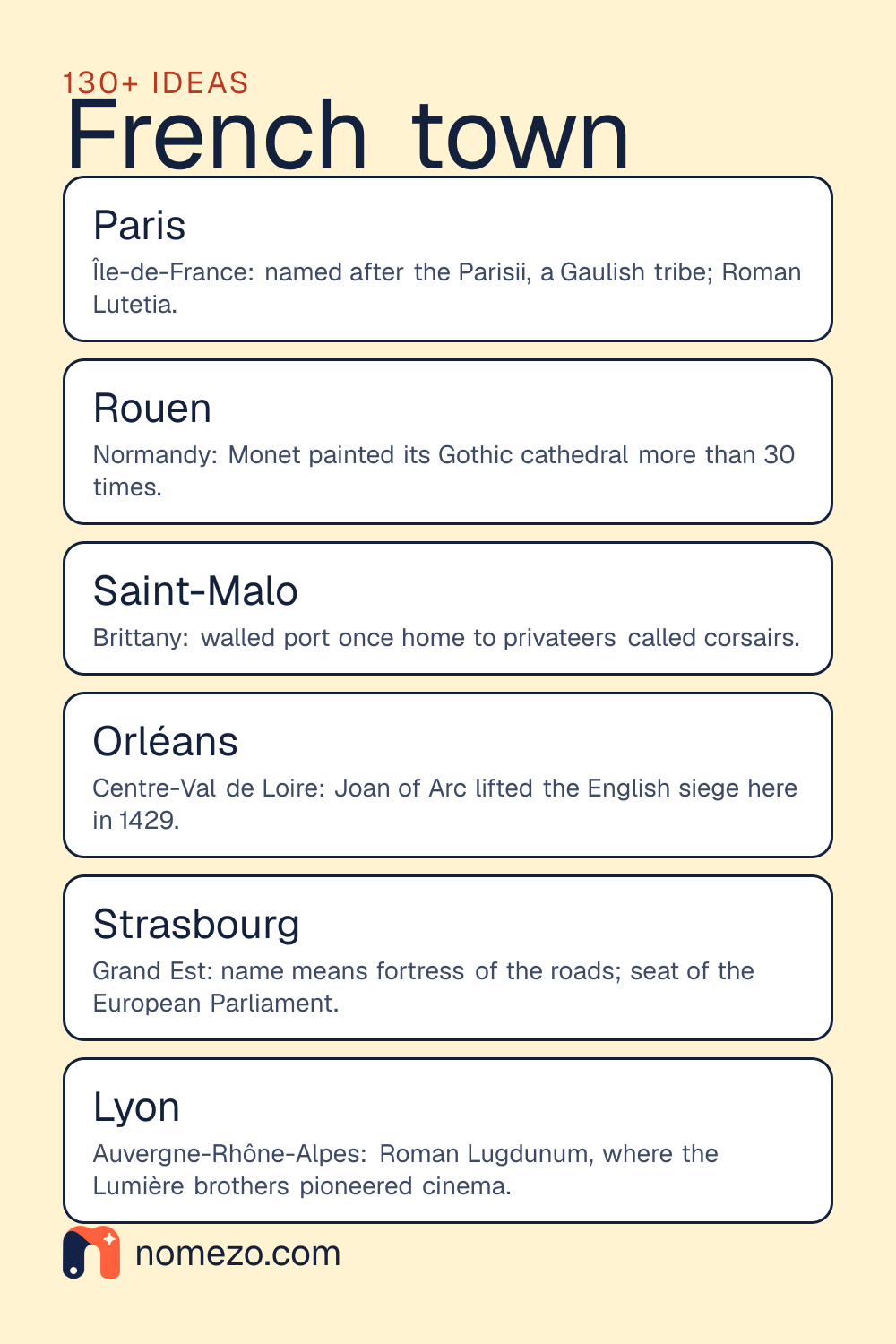
- Paris: Île-de-France: named after the Parisii, a Gaulish tribe; Roman Lutetia.
- Versailles: Île-de-France: Louis XIV turned a hunting lodge here into his palace.
- Fontainebleau: Île-de-France: royal château where Napoleon signed his first abdication in 1814.
- Barbizon: Île-de-France: village that lent its name to a landscape painting school.
- Provins: Île-de-France: medieval trade-fair town, now a UNESCO World Heritage site.
- Saint-Denis: Île-de-France: its basilica is the burial place of French kings.
- Auvers-sur-Oise: Île-de-France: Vincent van Gogh spent his final weeks here in 1890.
- Chantilly: Hauts-de-France: lends its name to a whipped cream and to bobbin lace.
- Amiens: Hauts-de-France: largest Gothic cathedral in France; Jules Verne lived here.
- Lille: Hauts-de-France: birthplace of Charles de Gaulle in 1890.
- Calais: Hauts-de-France: port nearest England, home of Rodin's famous Burghers statue.
- Arras: Hauts-de-France: its medieval weavers made tapestries so famous English named them after it.
- Compiègne: Hauts-de-France: Joan of Arc was captured here; the 1918 Armistice was signed nearby.
- Dunkirk (Dunkerque): Hauts-de-France: Flemish for church in the dunes; scene of the 1940 evacuation.
- Cambrai: Hauts-de-France: gave its name to cambric, a fine linen cloth.
- Roubaix: Hauts-de-France: its velodrome is the finish of a famous cobbled bike race.
Town names in Normandy
Chalk cliffs, apple orchards and the harbors that inspired the Impressionists.
- Rouen: Normandy: Monet painted its Gothic cathedral more than 30 times.
- Bayeux: Normandy: home of the famous embroidered tapestry of the Norman Conquest.
- Honfleur: Normandy: painters' harbor and birthplace of composer Erik Satie.
- Étretat: Normandy: famous for white chalk cliffs and natural sea arches.
- Giverny: Normandy: Claude Monet painted his water lilies in his garden here.
- Camembert: Normandy: tiny village that gave its name to the soft cheese.
- Deauville: Normandy: chic seaside resort that hosts an American film festival.
- Le Havre: Normandy: founded in 1517; Monet painted Impression, Sunrise in its harbor.
- Caen: Normandy: William the Conqueror built its castle and two great abbeys.
- Mont-Saint-Michel: Normandy: abbey island surrounded by some of Europe's biggest tides.
- Cherbourg: Normandy: harbor town of a famous 1964 musical film about umbrellas.
- Falaise: Normandy: birthplace of William the Conqueror, around 1028.
- Villedieu-les-Poêles: Normandy: copper pan town; the name means God's town of the pans.
- Lisieux: Normandy: pilgrimage town of Saint Thérèse, with a huge basilica.
Town names in Brittany and Pays de la Loire
Celtic Brittany's granite ports and standing stones, plus the lower Loire around Nantes.
- Saint-Malo: Brittany: walled port once home to privateers called corsairs.
- Carnac: Brittany: more than 3,000 prehistoric standing stones line its fields.
- Quimper: Brittany: from Breton kemper, confluence; famous for hand-painted pottery.
- Concarneau: Brittany: fishing port with a walled old town on an island.
- Pont-Aven: Brittany: Paul Gauguin led a school of painters here.
- Dinan: Brittany: hilltop town with well-preserved medieval ramparts and timbered houses.
- Roscoff: Brittany: its Onion Johnnies sold pink onions door to door in Britain.
- Rennes: Brittany: the region's capital, with colorful half-timbered houses.
- Locronan: Brittany: granite village of former sailcloth weavers, used in many films.
- Nantes: Pays de la Loire: birthplace of Jules Verne, home of a giant mechanical elephant.
- Angers: Pays de la Loire: its castle holds the medieval Apocalypse Tapestry.
- Le Mans: Pays de la Loire: home of the famous 24-hour car race since 1923.
- Saumur: Pays de la Loire: seat of the Cadre Noir, an elite riding school.
- Guérande: Pays de la Loire: walled town surrounded by sea salt marshes.
- Fontevraud-l'Abbaye: Pays de la Loire: Richard the Lionheart is buried in its abbey.
- Les Sables-d'Olonne: Pays de la Loire: start of the Vendée Globe solo round-the-world race.
French village names in the Loire Valley
Centre-Val de Loire: châteaux country and the towns of Joan of Arc.
- Orléans: Centre-Val de Loire: Joan of Arc lifted the English siege here in 1429.
- Tours: Centre-Val de Loire: city of Saint Martin, a famous fourth-century bishop.
- Chartres: Centre-Val de Loire: Gothic cathedral famous for its deep blue stained glass.
- Amboise: Centre-Val de Loire: Leonardo da Vinci spent his last years here.
- Blois: Centre-Val de Loire: royal château showing four centuries of architecture.
- Chambord: Centre-Val de Loire: home of the largest château in the Loire Valley.
- Chenonceaux: Centre-Val de Loire: village spelled with an x; its château without one.
- Chinon: Centre-Val de Loire: Joan of Arc first met the future Charles VII here.
- Bourges: Centre-Val de Loire: home of merchant Jacques Coeur and a UNESCO cathedral.
- Loches: Centre-Val de Loire: walled royal town with a towering medieval keep.
Town names in eastern France
Grand Est and Bourgogne-Franche-Comté: Alsace villages, coronation cities and Burgundy abbeys.
- Strasbourg: Grand Est: name means fortress of the roads; seat of the European Parliament.
- Reims: Grand Est: most French kings were crowned in its cathedral.
- Colmar: Grand Est: birthplace of Bartholdi, sculptor of the Statue of Liberty.
- Nancy: Grand Est: known for Art Nouveau and the golden gates of Place Stanislas.
- Domrémy-la-Pucelle: Grand Est: birthplace of Joan of Arc, around 1412.
- Verdun: Grand Est: scene of one of World War I's longest battles, in 1916.
- Troyes: Grand Est: its medieval fairs gave the name to troy weight for gold.
- Kaysersberg: Grand Est: Alsace village where Albert Schweitzer was born in 1875.
- Colombey-les-Deux-Églises: Grand Est: Charles de Gaulle's country home and resting place.
- Dijon: Bourgogne-Franche-Comté: Burgundy's old capital and the home of a famous mustard.
- Beaune: Bourgogne-Franche-Comté: home of the Hospices, a charity hospital founded in 1443.
- Besançon: Bourgogne-Franche-Comté: birthplace of Victor Hugo and a center of watchmaking.
- Vézelay: Bourgogne-Franche-Comté: hilltop basilica on the pilgrim road to Santiago.
- Cluny: Bourgogne-Franche-Comté: its abbey, founded in 910, led a vast monastic network.
- Dole: Bourgogne-Franche-Comté: birthplace of Louis Pasteur in 1822.
- Flavigny-sur-Ozerain: Bourgogne-Franche-Comté: makes aniseed candies; the film Chocolat was shot here.
- Alise-Sainte-Reine: Bourgogne-Franche-Comté: site of Alesia, where Caesar defeated Vercingetorix in 52 BC.
Town names in the French Alps and Auvergne
Auvergne-Rhône-Alpes: Olympic ski towns, spa resorts, lakes and volcanoes.
- Lyon: Auvergne-Rhône-Alpes: Roman Lugdunum, where the Lumière brothers pioneered cinema.
- Chamonix: Auvergne-Rhône-Alpes: hosted the first Winter Olympics in 1924.
- Annecy: Auvergne-Rhône-Alpes: canal town called the Venice of the Alps.
- Grenoble: Auvergne-Rhône-Alpes: hosted the 1968 Winter Olympics.
- Albertville: Auvergne-Rhône-Alpes: hosted the 1992 Winter Olympics.
- Vichy: Auvergne-Rhône-Alpes: spa town known for its mineral water.
- Clermont-Ferrand: Auvergne-Rhône-Alpes: home of Michelin tires, founded here in 1889.
- Le Puy-en-Velay: Auvergne-Rhône-Alpes: famous for green lentils and a start of the Way of St. James.
- Thiers: Auvergne-Rhône-Alpes: France's knife-making capital for centuries.
- Évian-les-Bains: Auvergne-Rhône-Alpes: lakeside spa town known for bottled mineral water.
- Aix-les-Bains: Auvergne-Rhône-Alpes: spa town on Lac du Bourget, France's largest natural lake.
- Saint-Étienne: Auvergne-Rhône-Alpes: industrial city named a UNESCO City of Design.
- Pérouges: Auvergne-Rhône-Alpes: perfectly preserved medieval village often used as a film set.
- Yvoire: Auvergne-Rhône-Alpes: flower-filled medieval village on Lake Geneva.
Town names in southwest France
Nouvelle-Aquitaine: the Atlantic coast, Basque Country, Périgord and the Bordeaux area.
- Bordeaux: Nouvelle-Aquitaine: its crescent-shaped riverfront is the UNESCO-listed Port of the Moon.
- Biarritz: Nouvelle-Aquitaine: surf town made fashionable by Empress Eugénie.
- Limoges: Nouvelle-Aquitaine: world-famous for fine hard-paste porcelain.
- La Rochelle: Nouvelle-Aquitaine: old port guarded by two medieval towers.
- Sarlat-la-Canéda: Nouvelle-Aquitaine: golden-stone medieval town in the Périgord.
- Arcachon: Nouvelle-Aquitaine: oyster bay beside the Dune of Pilat, Europe's tallest dune.
- Saint-Émilion: Nouvelle-Aquitaine: named after a hermit monk; has a church carved from rock.
- Aubusson: Nouvelle-Aquitaine: tapestry-weaving town whose craft is UNESCO-listed.
- Bayonne: Nouvelle-Aquitaine: the bayonet is believed to take its name from here.
- Angoulême: Nouvelle-Aquitaine: hosts a famous international comics festival each January.
- Pau: Nouvelle-Aquitaine: King Henry IV was born in its castle in 1553.
- Espelette: Nouvelle-Aquitaine: Basque village famous for strings of drying red chili peppers.
- Montignac-Lascaux: Nouvelle-Aquitaine: teenagers found famous Ice Age cave paintings nearby in 1940.
- Saint-Jean-de-Luz: Nouvelle-Aquitaine: Louis XIV married the Spanish princess Maria Theresa here in 1660.
Village names in Occitanie
The deep south between the Pyrenees and the Mediterranean: pink cities, walled towns and cliff villages.
- Toulouse: Occitanie: the Pink City, built of rosy brick; home of Airbus.
- Carcassonne: Occitanie: hilltop walled city with 52 towers and two rings of walls.
- Lourdes: Occitanie: Catholic pilgrimage town since reported visions in 1858.
- Nîmes: Occitanie: Roman arena city; the fabric denim is named after it.
- Montpellier: Occitanie: home of the oldest medical school still operating in the world.
- Albi: Occitanie: red-brick cathedral town and birthplace of Toulouse-Lautrec.
- Rocamadour: Occitanie: pilgrimage village built into a sheer limestone cliff.
- Roquefort-sur-Soulzon: Occitanie: its caves age the famous blue sheep's milk cheese.
- Sète: Occitanie: canal port and hometown of singer Georges Brassens.
- Collioure: Occitanie: Matisse and Derain launched the Fauvist style here in 1905.
- Millau: Occitanie: spanned by the world's tallest bridge, a cable-stayed viaduct.
- Cordes-sur-Ciel: Occitanie: hilltop bastide that added sky to its name in 1993.
- Saint-Cirq-Lapopie: Occitanie: cliff-top village voted France's favorite village in 2012.
- Perpignan: Occitanie: Salvador Dalí called its train station the center of the universe.
- Narbonne: Occitanie: Narbo Martius, the first Roman colony in Gaul, in 118 BC.
- Aigues-Mortes: Occitanie: walled town whose name means dead waters.
Town names in Provence, the Riviera and Corsica
Provence-Alpes-Côte d'Azur and the island of Corsica: Greek ports, perched villages and film-star resorts.
- Marseille: Provence-Alpes-Côte d'Azur: founded by Greeks as Massalia around 600 BC; France's oldest city.
- Nice: Provence-Alpes-Côte d'Azur: from Greek Nikaia, linked to Nike, goddess of victory.
- Cannes: Provence-Alpes-Côte d'Azur: hosts the world-famous film festival, first held in 1946.
- Avignon: Provence-Alpes-Côte d'Azur: the popes lived here in the 1300s; famous for its bridge song.
- Arles: Provence-Alpes-Côte d'Azur: Van Gogh painted hundreds of works here in 1888 and 1889.
- Aix-en-Provence: Provence-Alpes-Côte d'Azur: Roman Aquae Sextiae, named for its springs; Cézanne's hometown.
- Saint-Tropez: Provence-Alpes-Côte d'Azur: fishing port turned glamorous after a 1956 Brigitte Bardot film.
- Grasse: Provence-Alpes-Côte d'Azur: the perfume capital of the world, surrounded by flower fields.
- Antibes: Provence-Alpes-Côte d'Azur: Greek Antipolis, city opposite; home of a Picasso museum.
- Menton: Provence-Alpes-Côte d'Azur: lemon-growing town with a famous citrus festival each February.
- Moustiers-Sainte-Marie: Provence-Alpes-Côte d'Azur: a gold star hangs on a chain between its two cliffs.
- Orange: Provence-Alpes-Côte d'Azur: named after Arausio, a Celtic god, not the fruit.
- Saint-Paul-de-Vence: Provence-Alpes-Côte d'Azur: walled hill village where painter Marc Chagall is buried.
- Les Baux-de-Provence: Provence-Alpes-Côte d'Azur: the mineral bauxite was named after it in 1821.
- Briançon: Provence-Alpes-Côte d'Azur: at 1,326 meters, the highest town in France.
- Gordes: Provence-Alpes-Côte d'Azur: stone village stacked on a hillside in the Luberon.
- Ajaccio: Corsica: birthplace of Napoleon Bonaparte in 1769.
- Bastia: Corsica: named after the bastiglia, a Genoese fortress built in 1380.
- Bonifacio: Corsica: old town perched on white limestone cliffs above the sea.
- Calvi: Corsica: citadel town that claims to be Christopher Columbus's birthplace.
- Corte: Corsica: capital of Pasquale Paoli's independent island state in the 1700s.
How to pick the right name
Start with the region
Each French region has its own feel. Brittany names often come from Breton, Alsace names sound German, and Provence names lean on Latin and Greek roots.
Keep the accents and hyphens
Sète, Nîmes and Évian-les-Bains need their accents and hyphens to be spelled correctly. Leaving them out can turn the name into a different word.
Read the meaning before you borrow it
A town name can make a lovely name for a character, pet or house, but check the note first. Aigues-Mortes, for example, means dead waters.
Save this list for later
Pin it to a naming board, or tap the heart next to any name to keep it in your favorites on this device.
Frequently asked questions
What are some famous French town names?
Well-known examples include Versailles, Chamonix, Saint-Tropez, Giverny and Carcassonne. Each is famous for a palace, a ski resort, film stars, Monet's garden or medieval walls.
How many regions does France have?
Mainland France has 13 regions since a 2016 reform, counting Corsica. There are also five overseas regions.
Why do so many French towns start with Saint?
Many grew up around a church, abbey or saint's shrine and took the saint's name. Saint-Malo, Saint-Émilion and Saint-Tropez are all named after early Christian figures.
What do the hyphens and small words in French town names mean?
French place names join their parts with hyphens, and small words describe the location: sur means on and en means in. Aix-en-Provence is simply Aix in Provence.
Which English words come from French town names?
Denim comes from Nîmes, bayonet from Bayonne, cambric from Cambrai, troy weight from Troyes and bauxite from Les Baux-de-Provence. Chantilly cream and Camembert cheese are named after towns too.
More place names and generators
- Italian city names139 names. Italian city names by region, from Rome and Florence to hill towns like Orvieto and Matera. 130+ real places, each with a checked origin or fact.
- Weird Wisconsin town names118 names. Weird Wisconsin town names that are real, from Imalone and Embarrass to Footville and Luck. 110+ crazy Wisconsin city names with county and name origin.
- Weird Florida city names118 names. Weird Florida city names that are real: Two Egg, Yeehaw Junction, Frostproof, Niceville and 100+ more, each with its county and the story behind the name.
- Funny town names in Alberta113 names. Funny town names in Alberta that are real: Vulcan, Dead Man's Flats, Cereal, Seven Persons, Hairy Hill and 100+ more, each with its location and name story.
- Funny street names224 names. Funny street names you can find on Google Maps, from Chicken Dinner Road to Whip-Ma-Whop-Ma-Gate, plus 150+ invented ideas for games and stories.
- Louisiana nicknames86 names. Louisiana nicknames explained: why it is the Pelican State, plus 80+ real state, New Orleans, city, region and capital of the world nicknames with origins.
- Place NamesPlace names real and imagined: funny town and street names, kingdom and city names for fiction, and names for your home or garden.
- Names by OriginNames by origin and culture: Japanese, French, Irish, Italian, Spanish, Norse, Greek, Arabic and more, with meanings and pronunciation.
- Country name generatorFictional country names in European, desert, island, northern and fantasy styles.