

Hawaiian last names: 60+ surnames and their meanings
64 names · Updated · By The Nomezo Editors · Save to Pinterest
Hawaiian last names usually begin with ka or ke, the Hawaiian word for the, as in Kahale (the house), Kanahele (the forest) and Kahananui (the great work). Most date from 1860, when an Act to Regulate Names signed by Kamehameha IV required children to take their father's name as a family name, so a grandfather's Hawaiian given name often became the surname his descendants carry today.
This page lists 60+ real Hawaiian surnames with their literal meanings: common family names, names from land, sea and sky, names for family and work, names of chiefs and warriors, names of love and spirit, and Hawaiian forms of Bible names, plus two Chinese-Hawaiian surnames. Spellings keep the ʻokina (a glottal stop) and kahakō (a long vowel), though many families write their names without them. Literal meanings are only the surface: many Hawaiian names also carry a kaona, a deeper meaning known to the family.
Can't decide? Shuffle 6 random picks
Kauahikaua
The smoke of battle, from uahi, smoke, and kaua, war
Hanohano
Glorious, honored and distinguished
Kaʻuhane
The soul or spirit, from ʻuhane
Kealohapauʻole
The endless love, from pau ʻole, never finished
Keliʻi
The chief, from liʻi, short for aliʻi. Say keh-LEE-ee
Makua
Parent or elder, a respected older relative
Common Hawaiian last names
Family names you will meet across the islands. Most begin with ka or ke, the Hawaiian word for the, followed by a noun.
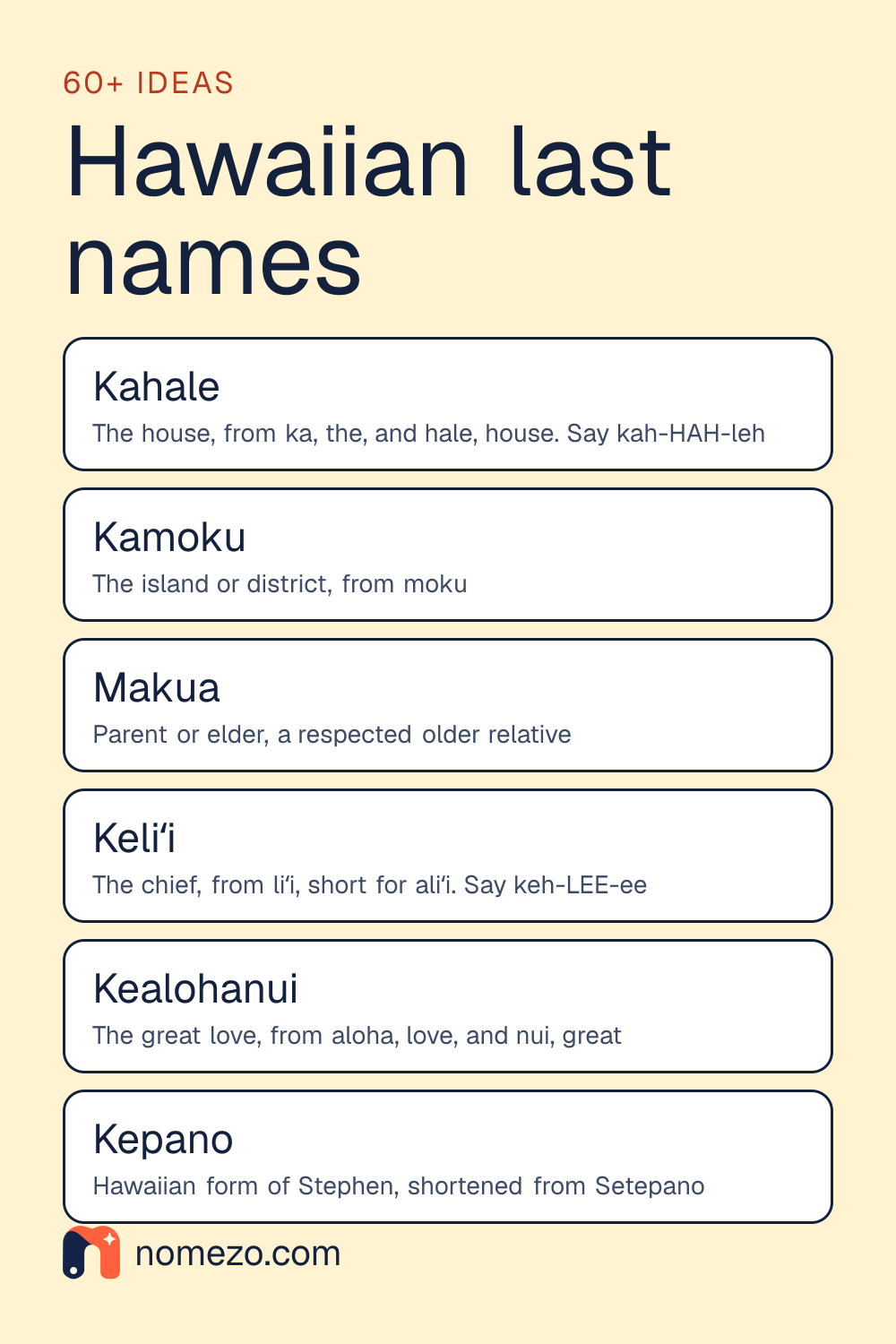
- Kahale: The house, from ka, the, and hale, house. Say kah-HAH-leh
- Kahananui: The great work, from hana, work, and nui, great
- Kanahele: The forest, from nahele, forest or wild growth
- Kamakana: The gift, from makana, gift or prize
- Kaleikini: The many leis, from lei and kini, a multitude
- Kahalewai: The water house, from hale, house, and wai, fresh water
- Kekumu: The source or foundation; kumu also means teacher
- Kaiwi: The bone; ancestral bones are sacred in Hawaiian tradition
- Kahikina: The east, the direction of the rising sun
- Kaniho: The tooth, from niho, tooth
Hawaiian surnames from land, sea and sky
Islands, cliffs, streams, sands and sunrise: many surnames describe the places and plants Hawaiian families knew best.
- Kamoku: The island or district, from moku
- Kapali: The cliff, from pali, cliff or steep slope
- Kahawai: Stream or gulch, from kaha, place, and wai, water
- Kalāhiki: The rising sun, from lā, sun, and hiki, to arrive
- ʻĀkau: North, or the right-hand side. Say AH-kow
- Nāone: The sands, from nā, the (plural), and one, sand
- Kaloʻi: The taro pond, the flooded field where taro grows
- Kalaukoa: The koa leaf, from lau, leaf, and the koa tree
- Kapuaʻala: The fragrant flower, from pua, flower, and ʻala, fragrance
- Kamanu: The bird, from manu, bird
- Kauahi: The smoke, from uahi, smoke
- Kahue: The gourd, a calabash used to carry water
Hawaiian surnames for family, roles and work
Some surnames name a place in the family, like parent or firstborn. Others name a skill or office, from priest to fisherman.
- Makua: Parent or elder, a respected older relative
- Makuakāne: Father, from makua, parent, and kāne, male
- Kahiapo: The firstborn child of a family
- Māhoe: Twin; also a Hawaiian given name
- Kamaliʻi: Children, from kama, child, and liʻi, small
- Kekahuna: The priest or expert in any profession
- Kekahu: The guardian, keeper or honored attendant
- Kalawaiʻa: The fisherman, from lawe, to take, and iʻa, fish
- Kaʻaukai: The seafarer, a sailor at home on the ocean
- Kiaʻāina: Governor, the Hawaiian word for the head of a state
- Kanakanui: The great person, from kanaka, person, and nui, big
Hawaiian surnames of chiefs and warriors
Aliʻi (chiefs) and koa (warriors) appear in many family names, along with words for honor, peace and the sacred.
- Keliʻi: The chief, from liʻi, short for aliʻi. Say keh-LEE-ee
- Keliʻikoa: The brave chief, from aliʻi, chief, and koa, brave
- Keliʻiholokai: The chief who sails the sea
- Keliʻihoʻomalu: The chief who protects and keeps the peace
- Nākoa: The warriors or the brave ones
- Koanui: Great warrior, from koa, warrior, and nui, great
- Kauahikaua: The smoke of battle, from uahi, smoke, and kaua, war
- Hoʻomalu: To shelter, protect or bring peace, from malu
- Kapu: Sacred or forbidden; the old Hawaiian system of sacred law
- Hanohano: Glorious, honored and distinguished
Hawaiian surnames of love, life and spirit
Aloha (love), ola (life) and ʻuhane (spirit) run through these names, which often honor a quality a family wanted to pass on.
- Kealohanui: The great love, from aloha, love, and nui, great
- Kealohapauʻole: The endless love, from pau ʻole, never finished
- Kamakawiwoʻole: The fearless eye or bold face; singer Israel's surname
- Hoʻomanawanui: Patience, or to be patient and persevere
- Kaʻimiola: The seeker of life, from ʻimi, to seek, and ola
- Kamalu: The shelter or peaceful shade, from malu
- Kealaiki: The little path, from ala, path, and iki, small
- Kapule: The prayer or blessing, from pule
- Kahanu: The breath, from hanu, to breathe
- Kaʻuhane: The soul or spirit, from ʻuhane
Hawaiian surnames from Bible names and Chinese names
After 1860 many fathers' Christian names, in Hawaiian form, became family surnames. Chinese immigrants added names built on Ah, a friendly Cantonese prefix.
- Kepano: Hawaiian form of Stephen, shortened from Setepano
- Kimokeo: Hawaiian form of Timothy, from biblical Timoteo
- Kelekolio: Hawaiian form of Gregory, a patronymic surname
- Kapeliela: Hawaiian form of Gabriel, from biblical Gaberiela
- Palakiko: Hawaiian form of Francisco, also used for Francis
- Kapika: Hawaiian form of Tabitha, a woman's name from the Bible
- Iosua: Hawaiian form of Joshua, a patronymic surname
- Hekekia: Hawaiian form of Hezekiah, a king of Judah
- Mahelona: Hawaiian form of Mahlon, from the Book of Ruth
- Afong: Chinese-Hawaiian; a merchant's given name, Ah Fong, recorded as a surname
- Ahana: Chinese-Hawaiian; from Ah Hung, a merchant's nickname as Hawaiians said it
How to pick the right name
Keep the ʻokina and kahakō
The marks change pronunciation and meaning. Write Keliʻi and Nākoa with them, but respect families who spell their own surname without the marks.
Ask about the kaona
A Hawaiian name often has a hidden or poetic meaning beyond its literal words. If the name is in your family, ask your kūpuna (elders) what it means to them.
Use ka and ke correctly
Hawaiian uses ke before words starting with k, e, a or o, and ka before most others, so it is Kekumu but Kahale. Nā is the plural the, as in Nākoa.
Treat them as family names
These surnames belong to living Hawaiian families. If you borrow one for a character, give it the same respect you would give any real family's name.
Save this list for later
Pin it to a naming board, or tap the heart next to any name to keep it in your favorites on this device.
Frequently asked questions
How did Hawaiians get last names?
Before the 1800s Hawaiians used single personal names. An 1860 Act to Regulate Names, signed by Kamehameha IV, required children to take their father's name as a surname and a Christian first name, so many Hawaiian given names moved into the surname and middle-name places. In 1967 the law was changed to allow any given name.
What are common Hawaiian last names?
Familiar Native Hawaiian surnames include Kealoha, Kahale, Kahananui, Kahalewai, Kanahele and Keliʻi. Many of Hawaiʻi's most common surnames overall, such as Lee and Kim, come from families who arrived from Asia.
Why do so many Hawaiian last names start with Ka or Ke?
Ka and ke both mean the. Ke is used before words starting with k, e, a or o, and ka before most others, so Kahale is the house and Kekumu is the source. Nā is the plural form, as in Nākoa, the warriors.
What do the ʻokina and kahakō mean in Hawaiian names?
The ʻokina (ʻ) is a glottal stop, like the break in uh-oh, and the kahakō (a macron over a vowel) makes the vowel longer. They change meaning, so Kaʻuhane and Kauhane are written differently even when families use both spellings.
Are there Hawaiian surnames from English or Chinese names?
Yes. Many families carry a father's Christian name in Hawaiian form, such as Kepano (Stephen) or Kimokeo (Timothy). Some Chinese immigrants' given names were recorded as surnames, as with Chun Afong, which is how names like Afong and Ahana became Hawaiian family names.
More last names and generators
- Hawaiian names133 names. Hawaiian names with meanings and pronunciation: female and male names, women's and guy names, flower, sea and lani names, and Hawaiian forms of English names.
- Last NamesLast names and surnames with meanings and origins: cool, pretty, rare and unique last names, plus a surname generator.
- Native American last names69 names. Native American last names with their nations and sources: 60+ real surnames like Begay, Yazzie, Red Cloud and Harjo, and how Native surnames began.
- Unique last names123 names. Unique last names with real meanings: rare English, Scottish, Irish, Welsh, French, German, Spanish and Japanese surnames, with pronunciation tips.
- Pretty last names135 names. Pretty last names with real meanings: soft English, nature, elegant French, cute, Italian, Spanish, Irish and Scandinavian surnames, with origins noted.
- Ocean names134 names. Ocean names that mean sea, wave or water, like Marina, Moana and Kai, plus mythical ocean names, ocean-themed word names and pearl names, with origins.
- Names by OriginNames by origin and culture: Japanese, French, Irish, Italian, Spanish, Norse, Greek, Arabic and more, with meanings and pronunciation.
- Russian last names148 names. Russian last names with meanings and Cyrillic: common, patronymic, occupational, animal, church and noble surnames, with -ov/-ova and -sky/-skaya explained.
- Last name generatorReal surnames from 24 cultures, each with its meaning, origin and kind.