

Native American names: 100+ real male and female names with their nations and meanings
101 names · Updated · By The Nomezo Editors · Save to Pinterest
Native American names belong to specific nations and languages, like Tȟatȟáŋka Íyotake (Lakota, buffalo bull who sits down, the name of Sitting Bull), Po've'ka (Tewa, pond lily) and Wa-Tho-Huk (Sac and Fox, bright path). Below are real Native American male and female names and other North American Native names from the Plains to the Arctic. Almost every name belonged to a real person; a few are birth-order names or hereditary titles, and their notes say so.
There is no single Native American language. Hundreds of nations each have their own language and naming customs, and many names carry cultural or ceremonial meaning: some are given in ceremony, some belong to a family or clan, and many change over a lifetime. Every name below, from the Lakota and Dakota sections to Native American female names and First Nations and Inuit names from Canada, is documented, with the nation and language in each note and the English meaning as published in historical and tribal sources. Translations are approximate, and spellings vary. We left out the many "Native American baby names" online that name no nation or language, because many of them are invented or misattributed. Please read these names as history and use them with respect.
Can't decide? Shuffle 6 random picks
Hastiin Chʼil Haajiní
Navajo: man of the black plants place. Navajo leader Manuelito
Inshta Theamba
Omaha: bright eyes. Susette La Flesche, Omaha writer and speaker
Polingaysi
Hopi: butterfly sitting among the flowers in the breeze. A Hopi educator and author
Lalawethika
Shawnee: noisemaker, or rattle. Birth name of the Shawnee Prophet
Asi-yahola
Muscogee: black drink shouter, a ceremonial title. Osceola, Seminole leader born among the Creek
Pʼoe Tsą́wą̈́
Tewa: blue water. Esther Martinez, storyteller and Tewa teacher at Ohkay Owingeh
Find a name on this page
Narrow 101 names by section, length or first letter, or search the notes.
Lakota and Dakota names
The Lakota and Dakota belong to the Očhéthi Šakówiŋ, the Seven Council Fires, often called the Sioux. Names are in Lakota or Dakota with their English meaning.
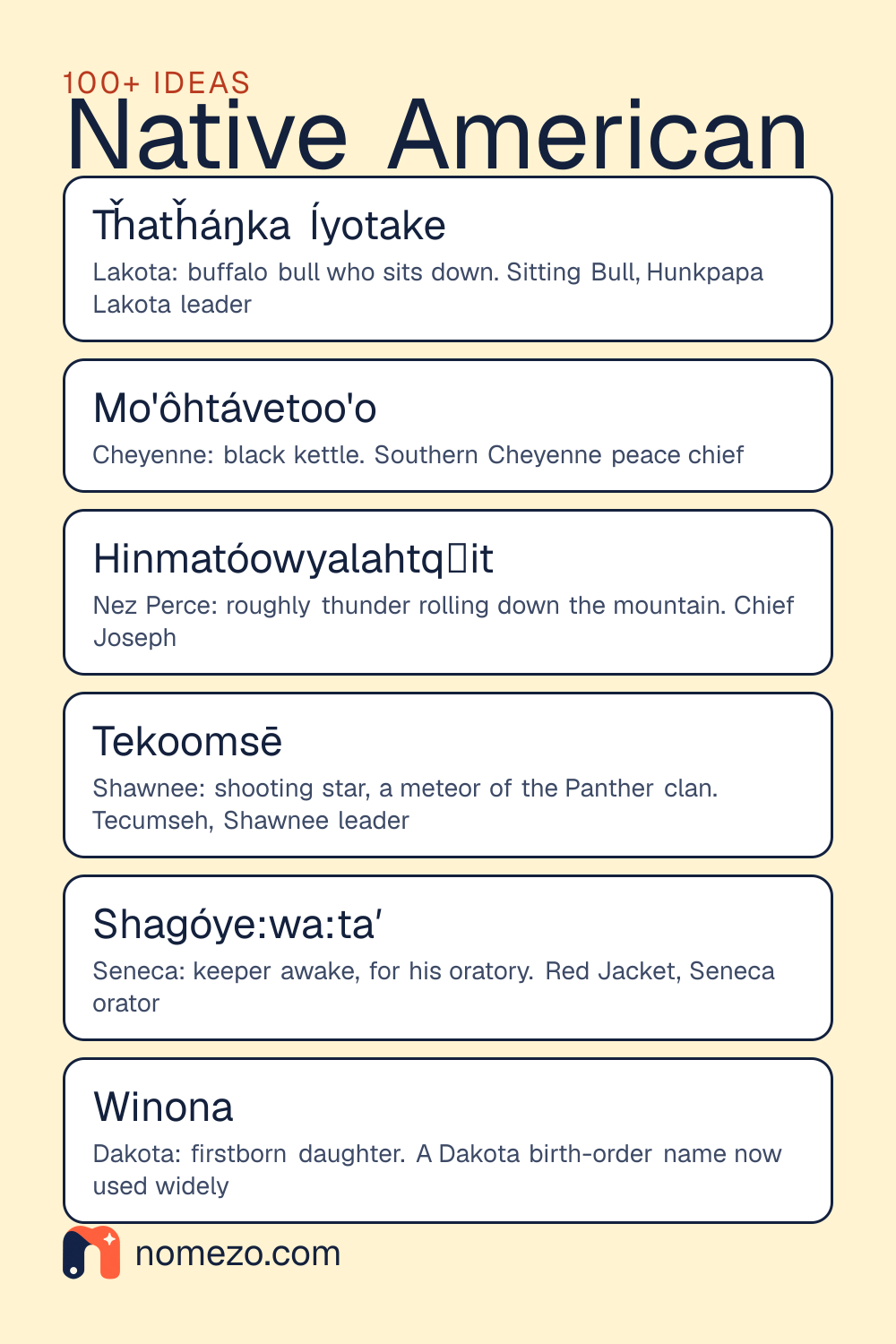
- Tȟatȟáŋka Íyotake: Lakota: buffalo bull who sits down. Sitting Bull, Hunkpapa Lakota leader
- Ȟoká Psíče: Lakota: jumping badger. A boyhood name of Sitting Bull, Hunkpapa Lakota
- Tȟašúŋke Witkó: Lakota: his horse is crazy, or spirited. Crazy Horse, Oglala Lakota
- Čháŋ Óhaŋ: Lakota: among the trees. Crazy Horse's birth name, Oglala Lakota
- Maȟpíya Lúta: Lakota: red cloud. Oglala Lakota leader, 1822 to 1909
- Siŋté Glešká: Lakota: spotted tail. Sicangu (Brulé) Lakota leader known for diplomacy
- Heȟáka Sápa: Lakota: black elk. Oglala Lakota holy man; South Dakota's highest peak honors him
- Ité Omáǧažu: Lakota: rain in the face. Hunkpapa Lakota war chief at Little Bighorn
- Phizí: Lakota: gall, the organ. Gall, Hunkpapa Lakota war leader
- Tȟašúŋke Kȟokípȟapi: Lakota: they fear even his horses. Oglala Lakota leader, often mistranslated
- Uŋpȟáŋ Glešká: Lakota: spotted elk cow. Miniconjou Lakota chief killed at Wounded Knee
- Matȟó Nážiŋ: Lakota: standing bear. Luther Standing Bear, Lakota author and educator
- Matȟó Héȟloǧeča: Lakota: hollow horn bear. Sicangu Lakota leader on a 1923 US stamp
- Matȟó Wanáȟtaka: Lakota: kicking bear. Oglala-born Miniconjou band chief and Ghost Dance leader
- Thaóyate Dúta: Dakota: his red nation. Little Crow, Mdewakanton Dakota leader in 1862
- Ohíyesa: Dakota: the winner. Charles Eastman, Santee Dakota physician and author
- Hakadah: Dakota: the pitiful last. Charles Eastman's birth name, Santee Dakota
- Čhaské: Dakota birth-order name for a firstborn son, used across Dakota families
- Ṡakpe: Dakota: six. Title of a line of Mdewakanton Dakota village leaders
- Ištáȟba: Dakota: sleepy eyes. Sisseton Dakota chief who signed several treaties
Names from other Plains nations
Cheyenne, Arapaho, Crow, Blackfoot, Kiowa, Comanche and Ponca names, in the bearer's own language with the English meaning.
- Mo'ôhtávetoo'o: Cheyenne: black kettle. Southern Cheyenne peace chief
- Vóóhéhéve: Cheyenne: morning star. Northern Cheyenne chief, called Dull Knife from his Lakota name Tȟamílapȟéšni
- Ó'kôhómôxháahketa: Cheyenne: little coyote, usually given as Little Wolf. Northern Cheyenne chief
- Éše'he Ôhnéšesêstse: Cheyenne: two moons. Northern Cheyenne chief at Little Bighorn
- Niwot: Arapaho: left hand. Southern Arapaho chief; a Colorado town bears his name
- Alaxchíia Ahú: Crow: many achievements. Plenty Coups, a celebrated Apsáalooke (Crow) chief
- Chíilaphuchissaaleesh: Crow: buffalo bull facing the wind. Birth name of Crow chief Plenty Coups
- Isapo-Muxika: Blackfoot: Crow Indian's big foot. Crowfoot, Siksika chief and treaty negotiator
- Set'tainte: Kiowa: white bear. Satanta, a Kiowa war chief and orator
- Setangya: Kiowa: sitting bear. Satank, a senior Kiowa warrior and leader
- Guipago: Kiowa: lone wolf. Principal Kiowa chief of the 1860s and 1870s
- Tene-angpote: Kiowa: kicking bird, or eagle striking with talons. Kiowa peace leader
- Kwana: Comanche: smell, or scent. Quanah Parker, Kwahadi Comanche leader
- Paruasemena: Comanche: ten bears. Yamparika Comanche chief and noted speaker
- Maⁿchú-Naⁿzhíⁿ: Ponca: standing bear. Ponca chief who won the 1879 ruling that Indians are persons
Names from the West and Southwest
Names from the Plateau, the Great Basin and the Southwest: Nez Perce, Okanagan, Paiute, Apache, Navajo and Tewa Pueblo.
- Hinmatóowyalahtq̓it: Nez Perce: roughly thunder rolling down the mountain. Chief Joseph
- Hemene Moxmox: Nez Perce: yellow wolf. A Nez Perce warrior in the war of 1877
- Heinmot Hihhih: Nez Perce: white thunder. The war name of Yellow Wolf, Nez Perce
- Wovoka: Northern Paiute: cutter, or woodcutter. Paiute prophet of the Ghost Dance
- Hum-ishu-ma: Okanagan Salish: mourning dove. Salish name of Okanagan author Christine Quintasket
- Goyaałé: Chiricahua Apache: one who yawns. Geronimo, Bedonkohe Apache leader
- Hastiin Chʼil Haajiní: Navajo: man of the black plants place. Navajo leader Manuelito
- Hastiin Adiitsʼaʼii: Navajo: Mister Interpreter. Chee Dodge, first Navajo tribal chairman
- Po'pay: Tewa: ripe squash. Ohkay Owingeh leader of the 1680 Pueblo Revolt
- Po've'ka: Tewa: pond lily. Maria Martinez, San Ildefonso Pueblo potter
- Tse Tsan: Tewa: golden dawn. Pablita Velarde, Santa Clara Pueblo painter
Names from the East and Southeast
Shawnee, Sauk, Mohawk, Wampanoag, Cherokee, Muscogee and Chickasaw names.
- Tekoomsē: Shawnee: shooting star, a meteor of the Panther clan. Tecumseh, Shawnee leader
- Tenskwatawa: Shawnee: the open door. The Shawnee Prophet, Tecumseh's brother
- Lalawethika: Shawnee: noisemaker, or rattle. Birth name of the Shawnee Prophet
- Makataimeshekiakiak: Sauk: black sparrow hawk. Black Hawk, Sauk war leader of 1832
- Wa-Tho-Huk: Sac and Fox (Sauk): bright path. Olympic champion Jim Thorpe
- Thayendanegea: Mohawk: he places two bets together, often retold as two sticks bound for strength. Joseph Brant, Mohawk leader
- Ousamequin: Wampanoag: yellow feather. Personal name of the sachem called Massasoit
- Tsiyu Gansini: Cherokee: he is dragging the canoe. Dragging Canoe, Chickamauga Cherokee leader
- Nanyehi: Cherokee: one who goes about. Nancy Ward, a Cherokee Beloved Woman
- Asi-yahola: Muscogee: black drink shouter, a ceremonial title. Osceola, Seminole leader born among the Creek
- Te Ata: Chickasaw: usually given as bearer of the morning, though its origin is debated. Stage name of storyteller Mary Frances Thompson
Native American male names from more nations
Documented names of Seneca, Miami, Mohegan, Cherokee, Ojibwe, Ute, Shoshone, Apache, Kiowa, Dakota and Lakota men, from 17th-century sachems to modern artists and athletes.
- Shagóye:wa:taʼ: Seneca: keeper awake, for his oratory. Red Jacket, Seneca orator
- Gayë́twageh: Seneca: the planter. Cornplanter, Seneca war leader and diplomat
- Mihšihkinaahkwa: Miami: a kind of terrapin, probably the painted turtle; the Miami name has no word for little. Little Turtle, Miami war chief
- Uncas: Mohegan: from Wonkus, fox. A Mohegan sachem of the 1600s
- Ganundalegi: Cherokee: the man who walks on the mountaintop. Cherokee leader Major Ridge
- Guwisguwi: Cherokee: mysterious little white bird. John Ross, longtime Cherokee principal chief
- Degadoga: Cherokee: stands on two feet. Stand Watie, Cherokee chief and Confederate general
- Bagone-giizhig: Ojibwe: hole in the day. Mississippi band Ojibwe chief in Minnesota
- Ouray: Ute: usually given as arrow. Tabeguache (Uncompahgre) Ute chief
- Pinaquanah: Shoshone: smells of sugar. Birth name of Chief Washakie
- Cheis: Chiricahua Apache: oak. Cochise, Chokonen Chiricahua Apache leader
- Naiche: Chiricahua Apache: meddlesome one, or mischief maker. Last hereditary Chiricahua chief
- Tsoai-talee: Kiowa: rock-tree boy, for Devils Tower. Pulitzer-winning author N. Scott Momaday
- Mazuha Hokshina: Yanktonai Dakota: trader boy. Painter Oscar Howe
- Waŋblí Ohítika: Lakota: brave eagle. Oglala Lakota activist Russell Means
- Tamakhóčhe Theȟíla: Lakota: loves his country, or respects the earth. Olympic champion Billy Mills
Native American female names
Native American women's names from history: writers, artists, saints, leaders and warriors.
- Winona US #627: Dakota: firstborn daughter. A Dakota birth-order name now used widely
- Zitkála-Šá: Lakota: red bird. Yankton Dakota writer and activist Gertrude Bonnin
- Aŋpétu Wašté Wiŋ: Dakota: beautiful day woman. Ella Deloria, Yankton Dakota linguist
- Thaté Iyóhiwiŋ: Dakota: every wind, or reaches for the wind. Mother of Zitkála-Šá, Yankton Dakota
- Tȟašína Máni: Lakota: moving robe. Hunkpapa Lakota woman who fought at Little Bighorn
- Bíawacheeitchish: Crow: woman chief. A Crow war leader, born Gros Ventre, who sat on the council of chiefs
- Pi'tamaka: Blackfoot: running eagle. Piikani (Piegan) Blackfeet woman war leader
- Inshta Theamba: Omaha: bright eyes. Susette La Flesche, Omaha writer and speaker
- Wa-Xthe-Thoṉba: Osage: two standards. Osage name of ballerina Maria Tallchief
- Thocmetony: Northern Paiute: shell flower. Sarah Winnemucca, Paiute author and advocate
- Tekakwitha: Mohawk: she who bumps into things. Saint Kateri, born in 1656
- Konwatsi'tsiaiénni: Mohawk: someone lends her a flower. Molly Brant, Mohawk leader
- Maaxiiriwia: Hidatsa: buffalo bird woman. A Hidatsa farmer who shared her gardening knowledge
- Hinook-Mahiwi-Kalinaka: Ho-Chunk: fleecy cloud floating in place. Painter and teacher Angel De Cora
- Pʼoe Tsą́wą̈́: Tewa: blue water. Esther Martinez, storyteller and Tewa teacher at Ohkay Owingeh
- Polingaysi: Hopi: butterfly sitting among the flowers in the breeze. A Hopi educator and author
- Ehyophsta: Cheyenne: yellow-haired woman. A Cheyenne woman warrior at Beecher Island in 1868
First Nations and Inuit names from Canada
Native North American names do not stop at the border. These are documented Cree, Ojibwe, Mohawk and Inuit names from what is now Canada.
- Mistahi-maskwa: Plains Cree: big bear. A Cree chief who resisted the treaty system
- Pîhtokahânapiwiyin: Plains Cree: for his skill at leading buffalo into pounds. Chief Poundmaker
- Atāhkakohp: Plains Cree: starblanket. Ahtahkakoop, a House Cree chief of Saskatchewan
- Mistawasis: Plains Cree: big child. A chief who signed Treaty 6 in 1876
- Kisikawasan: Cree: flash in the sky. Birth name of Chief Piapot
- Kahkewāquonāby: Mississauga Ojibwe: sacred waving feathers. Missionary and author Peter Jones
- Kahgegagahbowh: Mississauga Ojibwe: he who stands forever. Writer and lecturer George Copway
- Shingwaukonse: Ojibwe: little pine. A chief of Garden River near Sault Ste. Marie
- Oronhyatekha: Mohawk: burning sky, or burning cloud. A Six Nations physician and scholar
- Nahnebahwequay: Ojibwe: standing upright woman. Catherine Sutton, who argued for Ojibwe land rights
- Pitseolak: Inuktitut: sea pigeon. Inuit printmaker Ashoona of Kinngait (Cape Dorset)
How to pick the right name
Learn the person behind the name
Almost every name here belonged to a real person. Read their story first: a name like Tȟatȟáŋka Íyotake carries the history of Sitting Bull and the Hunkpapa Lakota.
Ask before you use a name
Some names are given in ceremony or belong to a family or clan, and they are not meant for outside use. If you are not a citizen of that nation, ask members of the nation for guidance, or honor the person through the English meaning instead.
Keep the nation and spelling together
Say where a name comes from, and keep its marks: Lakota, Cheyenne and Navajo spellings use letters such as ȟ, ô and ʼ that change the sound.
Be wary of unsourced lists
If a website calls a name simply "Native American" without naming a nation, a language or a source, treat it with caution. Many of those names were invented.
Save this list for later
Pin it to a naming board, or tap the heart next to any name to keep it in your favorites on this device.
Native American names: real people, real nations, and the names other lists get wrong
By The Nomezo Editors · Updated October 25, 2026 · How we research names
Most "Native American name" lists online give a pretty word and a one-line meaning with no nation, no language and no source. The names on this page belong to real people and nations, and the notes say who. Below, we check the names other lists repeat, and explain why English translations of Native names so often go wrong.
These names carry history: some were given in ceremony, some belong to families, and descendants have objected when famous ancestors' names were used carelessly. Read them first as history, and if you are not part of the nation, ask before you borrow one.
- Step 1Read the person's storyEach note names the nation, the language and the person.
- Step 2Check other lists' namesSeveral popular "Native" baby names have no documented origin.
- Step 3Expect translations to varyEnglish versions can be badly wrong.
- Step 4Ask the nationEach nation has its own language program and its own customs.
Names you will see on other lists, checked
| Name | US babies, 2025 | What we found |
|---|---|---|
| Winona | 466 girls (No. 627) | Dakota birth-order name for a firstborn daughter; its highest US count since records began in 1880 |
| Dakota | 1,035 girls, 1,074 boys | From the name of the Dakota people, meaning allies or friends, or the states named for them |
| Tallulah | 276 girls | From waterfalls in Georgia; the popular "leaping waters" meaning is doubtful, and it may mean town in Creek |
| Aiyana | 184 girls | Behind the Name has no definition or documented origin |
| Enola | 44 girls | Meaning unknown; it first appeared as the title character of an 1886 novel |
| Takoda | 44 boys | Behind the Name has no definition or documented origin |
| Chayton | 23 boys | Behind the Name has no definition or documented origin |
Sources: US Social Security Administration; Behind the Name (Winona, Dakota, Tallulah, Aiyana, Enola, Takoda, Chayton). "No documented origin" means we could not find one; it does not prove a name is invented.
Why translations disagree
- They can be badly wrong. The Lakota name Tȟašúŋke Kȟokípȟapi means They Fear Even His Horses, a warrior so feared that even his horse was dreaded. Records turned it into "Young Man Afraid of His Horses", which the Indian agent James McLaughlin said it was "by no means" (Wikipedia).
- Or add something. Little Turtle's Miami name names a kind of terrapin, probably the painted turtle, and has no word for little in it (Wikipedia).
- Names changed over a lifetime. In many nations a person received new names for a deed, a vision or a new role: Charles Eastman was first called Hakadah, then Ohíyesa. That is why many leaders on this page appear under more than one name.
Names and history
- Names were taken away. The federal Indian boarding school system ran from 1819 to 1969, with 408 schools in 37 states or then territories, and renaming children from Indian to English names was one of its assimilation methods (US Department of the Interior).
- Names can still hurt. The US military's use of "Geronimo" as a code name in the 2011 raid that killed Osama bin Laden outraged some Native Americans; his great-grandson called it "an outrageous insult" (Wikipedia).
- Many nations, many traditions. 9.7 million people in the US identified as American Indian and Alaska Native, alone or with another race, in the 2020 Census (Census Bureau). There is no single Native American naming custom.
Learn from the nations themselves
The best guide to a name is the nation's own language program. These are run by or with Native communities:
- Lakota Language Consortium (Lakota)
- Ojibwe People's Dictionary (Ojibwe)
- itwêwina, the Plains Cree dictionary (Cree)
- Cherokee Nation Language Department (Cherokee)
- FirstVoices (First Nations languages in Canada)
Sources
- Wikipedia: Young Man Afraid of His Horses
- Wikipedia: Little Turtle
- Wikipedia: Geronimo
- US Department of the Interior: federal Indian boarding school report (2022)
- US Census Bureau: 2020 race and ethnicity results
- Behind the Name: Winona
- Behind the Name: Tallulah
- Behind the Name: Enola
- US Social Security Administration: baby names
Frequently asked questions
What are some real Native American names for guys?
Documented men's names include Tȟatȟáŋka Íyotake (Sitting Bull, Lakota), Goyaałé (Geronimo, Chiricahua Apache), Thayendanegea (Joseph Brant, Mohawk) and Ouray (arrow, Ute). Each belongs to a specific nation and language.
Are the Native American baby names on other websites real?
Many are not. Lists often label words as Native American without naming a nation or language, and some are simply invented. A real name can be traced to a specific nation, language and source.
Can I use a Native American name if I am not Native?
It depends on the name and the nation. Some names are given in ceremony or belong to families and clans, so they are not meant for outside use. Learn the name's story and ask citizens of that nation for guidance.
What are some Native American female names?
Winona (Dakota, firstborn daughter), Tekakwitha (Mohawk, she who bumps into things), Po've'ka (Tewa, pond lily) and Ehyophsta (Cheyenne, yellow-haired woman) are documented women's names. Winona is a Dakota birth-order name, matched by Čhaské for a firstborn son.
Why did many Native American leaders have more than one name?
In many nations a person received new names over a lifetime, for a deed, a vision or a new role. Crazy Horse was born Čháŋ Óhaŋ (among the trees), and Charles Eastman was first called Hakadah, then Ohíyesa.
What does Winona mean?
Winona is a Dakota birth-order name for a firstborn daughter; Čhaské is the matching name for a firstborn son. 466 US girls were named Winona in 2025, the most in any year since records began in 1880.
Is Dakota a Native American name?
It comes from the name of the Dakota people, which means allies or friends, and from the two states named after them. In 2025 it went to about as many US girls (1,035) as boys (1,074).
Why do translations of Native American names disagree?
Many were written down by outsiders who did not speak the language well. They Fear Even His Horses became Young Man Afraid of His Horses, and Little Turtle's Miami name has no word for little in it. Spellings also vary between older records and modern writing systems.
More by origin and generators
- Native American last names69 names. Native American last names with their nations and sources: 60+ real surnames like Begay, Yazzie, Red Cloud and Harjo, and how Native surnames began.
- Names by OriginNames by origin and culture: Japanese, French, Irish, Italian, Spanish, Norse, Greek, Arabic and more, with meanings and pronunciation.
- Baby NamesBaby names with meanings and origins: girl names, boy names, unisex names, popular and unique picks, plus a free baby name generator.
- Hawaiian names133 names. Hawaiian names with meanings and pronunciation: female and male names, women's and guy names, flower, sea and lani names, and Hawaiian forms of English names.
- African names181 names. African names with meanings: names for boys and girls, African women's names, Nigerian names in Yoruba and Igbo, plus Akan, Swahili, Zulu and Amharic names.
- Nature names112 names. Nature names for girls and boys with real meanings: tree, forest, earth, stone, rain, wind and sky names like Willow, River, Sylvia, Daichi and Gaia.
- Names by MeaningNames by meaning: names that mean moon, light, fire, love, strength, hope and more, for girls, boys and every gender.
- Random name generatorReal full names from 24 cultures, each with its meaning and origin.
- Fake name generatorFictional names with a birthday, username, example.com email and 555 phone.