

Filipino boy names: 100+ Tagalog, Spanish-era and modern names
107 names · Updated · By The Nomezo Editors · Save to Pinterest
Filipino boy names include Tagalog words like Bayani (hero), Dakila (noble) and Makisig (gallant), along with Spanish-era names like Diosdado and blends like Jomar. In Philippine Statistics Authority birth data, Nathaniel was the most popular name for baby boys in 2024, ahead of Jayden and Ezekiel.
Below are 100+ Filipino male names with their meanings and a simple pronunciation where it helps. Sections cover Tagalog boy names, heroes from Philippine epics and history, the Spanish Catholic names of older generations, the palayaw (nicknames) Filipino men go by every day, and modern blends and coinages.
Can't decide? Shuffle 6 random picks
Berting
Pet form of Alberto or Roberto, bright
Dranreb
Bernard spelled backward, a playful Filipino naming habit
Tuwaang
Hero of an epic chanted by the Manobo of Mindanao
Goyong
Pet form of Gregorio, watchful
Lapulapu
Mactan chief whose forces defeated Magellan in 1521
Emong
Pet form of Guillermo, by way of Memo
Tagalog boy names
Native Tagalog words and precolonial titles used as boys' names. The meanings are fixed because the words are still in use.
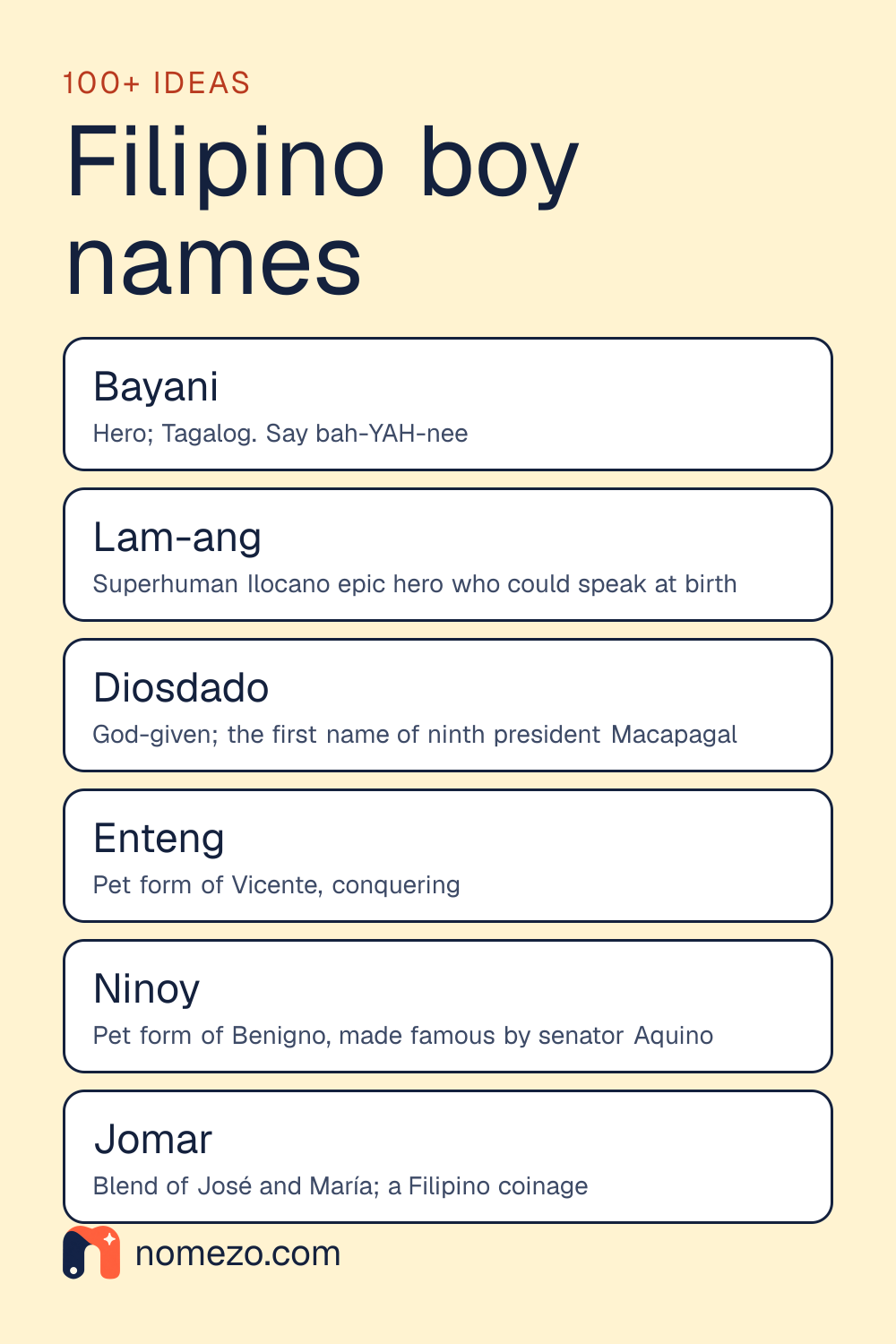
- Bayani: Hero; Tagalog. Say bah-YAH-nee
- Dakila: Great, noble, majestic; Tagalog. Say dah-KEE-lah
- Makisig: Gallant, dashing; Tagalog. Say mah-kee-SIG
- Magtanggol: To defend; a Tagalog name for a protector
- Maliksi: Agile, quick; a rare Tagalog given name
- Kidlat: Lightning; Tagalog. Say kid-LAHT
- Datu: Chief, ruler; a precolonial title still used in Mindanao
- Lakan: Paramount ruler; a precolonial Tagalog title for a great lord
- Agila: Eagle; a Filipino word borrowed from Spanish águila
- Bagani: Warrior; a title for fighters among Mindanao peoples
- Diwa: Spirit, soul, essence; Tagalog. Say dee-WAH
- Malakas: Strong; also the first man in a Tagalog creation tale
- Akmad: Maguindanao and Tausug form of Ahmad, most praiseworthy
Filipino boy names from epics, myths and history
Heroes of Philippine oral epics, precolonial gods and the rulers who met the first Spanish ships. Bold picks with a story behind them.
- Lam-ang: Superhuman Ilocano epic hero who could speak at birth
- Aliguyon: Warrior hero of an Ifugao hudhud epic chant
- Bantugan: Brave prince of the Maranao epic Darangen
- Tuwaang: Hero of an epic chanted by the Manobo of Mindanao
- Labaw Donggon: Hero of the Hinilawod, the oral epic of Panay
- Humadapnon: Brother-hero of the Panay epic Hinilawod
- Dumalapdap: One of the triplet demigod heroes of the Panay epic Hinilawod
- Indarapatra: Maguindanao epic king whose brother battled monsters
- Apolaki: Sun and war god; Mayari's brother in Kapampangan myth
- Bathala: Supreme god of the precolonial Tagalogs
- Kaptan: Sky god of Visayan mythology
- Lakandula: Title of the last paramount ruler of Tondo, in the 1570s
- Sikatuna: Bohol chief who sealed a blood compact with Legazpi in 1565
- Lapulapu: Mactan chief whose forces defeated Magellan in 1521
- Humabon: Cebu ruler baptized Carlos in 1521, among the first Filipino Christians
- Rizal: From Spanish ricial, a green field; the national hero's family name
Spanish-era Filipino male names
Catholic and Spanish names carried by generations of Filipino men. Many are ripe for a comeback as strong vintage picks.
- Diosdado: God-given; the first name of ninth president Macapagal
- Bienvenido: Welcome; a warm Spanish name common in older Filipino generations
- Dominador: Lord, master; Spanish, popular in the Philippines
- Restituto: Restored, reinstated; from Latin restitutus
- Perfecto: Perfect; a Spanish virtue name
- Primitivo: First, original; from Latin primitivus
- Crisostomo: Golden mouth, after Saint John Chrysostom; also Rizal's fictional hero
- Apolinario: Latin, of Apollo; the first name of hero Mabini
- Macario: Blessed, happy; from Greek makarios
- Graciano: From Latin gratus, pleasing; reformist López Jaena bore it
- Policarpio: Spanish form of Polycarp, much fruit; Greek
- Sofronio: Spanish form of Sophronius, self-controlled; Greek
- Wenceslao: Spanish form of Wenceslas, more glory; Slavic
- Eleuterio: Free; from Greek eleutheros
- Fortunato: Fortunate, lucky; Spanish and Italian
- Anacleto: Called forth, invoked; from Greek anakletos
- Hermogenes: Born of Hermes; Greek. Say er-MOH-heh-nes
- Benigno: Kind, good; Latin. Ninoy Aquino's formal first name
- Claro: Clear, bright; Spanish. Say KLAH-roh
- Delfin: Dolphin; Spanish. Say del-FEEN
- Prospero: Fortunate, thriving; from Latin prosperus
- Remigio: Oarsman, from Latin remex
- Romualdo: Fame and rule; Germanic, by way of Spanish
- Timoteo: Honoring God; the Spanish form of Timothy
- Venancio: Hunting, from Latin Venantius
- Zosimo: Viable, likely to survive; from a Greek word
Filipino boy nicknames ending in -ing, -eng and -ong
Most Filipino men are known by a palayaw (nickname). The classic recipe clips the formal name and adds -ing, -eng or -ong.
- Enteng: Pet form of Vicente, conquering
- Paeng: Pet form of Rafael, God has healed
- Karding: Pet form of Ricardo, brave ruler
- Narding: Pet form of Bernardo, brave bear
- Pedring: Pet form of Pedro, stone
- Berting: Pet form of Alberto or Roberto, bright
- Iking: Pet form of Enrique, home ruler
- Maning: Pet form of Manuel, God is with us
- Domeng: Pet form of Domingo, of the Lord
- Emong: Pet form of Guillermo, by way of Memo
- Erning: Pet form of Ernesto, serious
- Asiong: Pet form of Ignacio, Nicasio or Horacio
- Nonong: Pet form of Manuel, by way of Manolo
- Ponching: Pet form of Alfonso, by way of Poncho
- Temyong: Pet form of Artemio
- Timong: Pet form of Timoteo
- Zosing: Pet form of Zosimo
- Goyong: Pet form of Gregorio, watchful
- Sebyong: Pet form of Eusebio, pious
- Tonying: Pet form of Antonio, by way of Tonyo
Short forms, -oy names and doubled Filipino nicknames
Clipped names, the boyish -oy ending and doubled syllables. Several belong to Philippine presidents.
- Ninoy: Pet form of Benigno, made famous by senator Aquino
- Noynoy: Doubled pet form of Benigno; President Aquino III's nickname
- Bongbong: Doubled pet name; the nickname of President Marcos Jr.
- Junjun: Doubled short form of Junior
- Boy: From the English word or a pet form of Bonito
- Isko: Short form of Francisco, the Frenchman
- Kiko: Pet form of Francisco or Francis
- Kulas: Short form of Nicolas, victory of the people
- Tonyo: Short form of Antonio
- Caloy: Pet form of Carlos or Carlo
- Kokoy: Pet form of Francisco, by way of Koko
- Butchoy: Butch plus the boyish -oy ending
- Natoy: Pet form of Renato, born again
- Netoy: Pet form of Nestor or Ernesto
- Pitoy: Pet form of Agapito, beloved
- Yoyoy: Pet form of Mateo, gift of God
- Kanor: Short form of Nicanor
- Pekto: Short form of Perfecto, recorded since the 1940s
- Puli: Pet form of Apolinario, by way of Spanish Poli
- Ambo: Pet form of Pablo, small
- Mando: Clipped from a Spanish name meaning soldier
Filipino boy name blends and coinages
Modern Filipino inventions built from saints, parents' names, initials and even spelling backward. The meaning comes from the pieces.
- Jomar: Blend of José and María; a Filipino coinage
- Jomari: José and María run together into one name
- Josemari: The pair José María written as a single name
- Joemar: Variant of Jomar, shaped by English Joe
- Jejomar: Blend of Jesus, Joseph and Mary
- Luzvimindo: Luzon, Visayas and Mindanao blended; male form of Luzviminda
- Rizalino: Honors national hero José Rizal
- Jay Ar: Phonetic spelling of JR, for a junior
- Junard: Jun plus -ard, modeled on Bernard or Leonard
- Dranreb: Bernard spelled backward, a playful Filipino naming habit
- Erap: Pare, buddy, spelled backward; Joseph Estrada's nickname
How to pick the right name
Choose a meaning that travels
Tagalog words like Bayani and Dakila carry a clear meaning to every Filipino relative and are easy for English speakers to say. Check the pronunciation with a native speaker first.
Test the palayaw
Nearly every Filipino boy gets a nickname at home. Say the formal name, then try the home version, such as Vicente to Enteng, before you decide.
Learn the story behind epic names
Names like Lam-ang, Bantugan and Lakandula come from epics and history. Read the tale first so you can tell it when people ask.
Decide on the junior custom
A son named after his father is often called Junior, then Jun or Junjun at home. If you want him to have his own name, give him one.
Save this list for later
Pin it to a naming board, or tap the heart next to any name to keep it in your favorites on this device.
Frequently asked questions
What is the most popular Filipino boy name?
Nathaniel. It ranked first among boys' names in Philippine Statistics Authority birth data for 2024, followed by Jayden, Ezekiel, Gabriel and Liam.
What are some Tagalog boy names?
Bayani (hero), Dakila (great, noble), Makisig (gallant), Kidlat (lightning), Lakan (paramount ruler) and Magtanggol (to defend) are real Tagalog words used as boys' names.
Why do Filipino men have nicknames like Enteng and Bongbong?
Filipinos use a palayaw (nickname) in daily life. Common patterns clip the formal name and add -ing, -eng or -oy, as in Vicente to Enteng, or double a syllable, as in Bongbong and Junjun.
What does Jomar mean?
Jomar is a Filipino blend of José and María, honoring Saint Joseph and the Virgin Mary. Jomari and Josemari are other versions of the same pair.
What are old Filipino male names?
Older generations often carry Spanish Catholic names such as Diosdado (God-given), Bienvenido (welcome), Restituto (restored) and Crisostomo (golden mouth), a legacy of more than 300 years of Spanish rule.
More by origin and generators
- Filipino girl names104 names. Female Filipino names with meanings: Tagalog girl names like Ligaya and Tala, Spanish-era classics, Maria blends like Marites and the nicknames Filipinas use.
- Filipino last names173 names. Filipino names and surnames with meanings: Spanish last names from the 1849 Clavería catalog, Tagalog names like Maligaya, Chinese Filipino and famous surnames.
- Spanish boy names153 names. Spanish boy names and male Spanish names with meanings and pronunciation: Spain's top names for 2024, men's compound names, Basque, Catalan and Latino picks.
- Strong boy names124 names. Strong boy names and male names that are strong: names meaning strength, bravery or warrior, plus kings, heroes and Vikings, each with its real meaning.
- Unique boy names147 names. Unique boy names with meanings: 140+ rare baby boy names from Irish, Norse, Greek, Hebrew, Finnish, Welsh and more, with origins and pronunciation help.
- Hawaiian names133 names. Hawaiian names with meanings and pronunciation: female and male names, women's and guy names, flower, sea and lani names, and Hawaiian forms of English names.
- Names by OriginNames by origin and culture: Japanese, French, Irish, Italian, Spanish, Norse, Greek, Arabic and more, with meanings and pronunciation.
- Baby NamesBaby names with meanings and origins: girl names, boy names, unisex names, popular and unique picks, plus a free baby name generator.
- Random name generatorReal full names from 24 cultures, each with its meaning and origin.